|
|
||||
|---|---|---|---|---|
| Volume 56 Number 32, October 31, 2026 | ARCHIVE | HOME | JBCENTRE | SUBSCRIBE |

Chancellor John Healey presented the Labour government's autumn Budget on October 28 under the promise of "Breathing Space now, Fresh Hope for the Future". Its direction is revealed by the claims it guarantees. Public funds are to expand private investment and military production; departmental capital budgets are to be reduced to help meet the Defence Investment Plan; and further restraints on social provision are being prepared in the name of fiscal discipline.
The issue running through the Budget is how the economy is directed and who sets that direction. RCPB(ML) upholds that it is the producers of social wealth who must organise to become the authority that determines its use, defends the rights of all and develops society's productive capacities to meet human needs.
The Chancellor's Budget announced the provision of a £100 Household Energy Payment for eligible households in England in council tax bands A-D from January 2027, through a £2.6bn package which includes funding for devolved governments. The electricity VAT cut is extended to July 2027. The Bank Corporation Tax Surcharge rises from 3% to 6% for fifteen months to help fund the support, with the official document ruling out an extension. Industrial electricity support is to begin in April, including backdated payments. [1][2]
From April 2027, the National Living Wage rises by 3.9% to £13.21 an hour, with a lower rate of £11.27 retained for 18 to 20-year-olds. The Union Learning Fund is to be restored in England. An additional £1.5bn is allocated for around 10,000 social and affordable homes, prioritising Social Rent, alongside a separate £4.7bn equity-loan scheme for first-time buyers.

The National Wealth Fund receives an additional £15.4bn of capital, including £2bn for the Energy Wealth Fund, bringing its total capitalisation to £43.2bn. The government also commits the NWF and British Business Bank to deploy up to £5bn over four years in defence, dual-use and other sectors serving its national-security priorities. A new taskforce is to mobilise private and international defence finance. The Budget retains full expensing for eligible corporate investment and introduces a founders' capital-gains relief with a 10% rate on qualifying lifetime gains up to £10m.
However, it is the military's direct claim on departmental resources which is taking priority. The £15bn Defence Investment Plan announced in June required a further £4.7bn of funding. The Budget supplies £3bn of this by further reducing departmental capital budgets by 1% in each of the years 2027-28 to 2029-30, with £1.7bn from the Treasury's capital Reserve. It confirms a target of military spending at 3% of GDP in 2030, on the path to the NATO commitment of 3.5% by 2035. Additional support for Ukraine includes loans, export-finance guarantees and urgent military funding.
Chancellor Healey reaffirmed the government's intention to reduce what is called the welfare bill, with further proposals to follow the Milburn and Timms reports. From 2030, the State Pension Triple Lock is to be adjusted; the government estimates pension expenditure will consequently be £15bn a year lower by the late 2030s. It links this change to its promise of a National Care Service in England. The Budget also advances the assignment of tax revenues to mayors and local authorities, presented as a means of driving regional growth.
The Budget is therefore organising social resources around the government's conception of growth and its pro-war direction. It sets aside further public capital to attract private investment while opening public financial institutions more explicitly to military production. It places departmental investment under renewed pressure to secure the military plan.
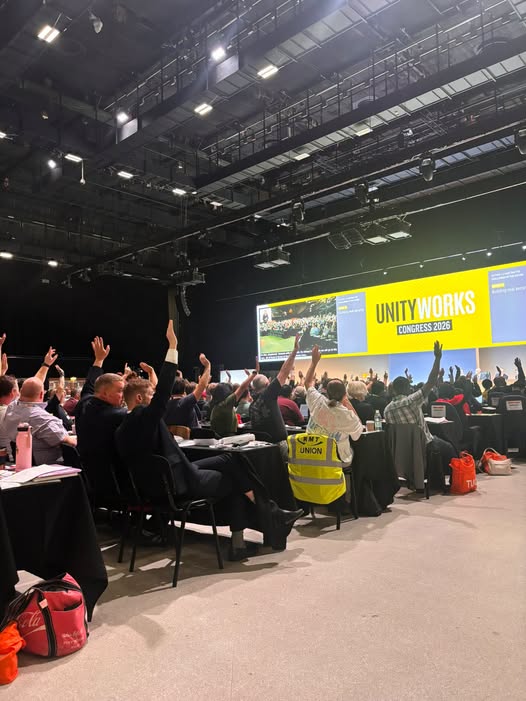
Delegates voting to support Motion 75 at the TUC Congress
2026
Public investment has to be judged by its aim, ownership and control. Housing, energy and industrial development require substantial investment. Society's need for these things is real. Under the Budget's arrangements, which are based on so-called "fiscal rules" that do not recognise that social wealth is produced by working people, the state supplies finance, tax advantages, procurement opportunities and regulatory changes intended to make investment attractive to private owners. The new founders' relief gives qualifying owners a preferential tax rate on gains of up to £10m, while public financial institutions are assigned the task of drawing private capital into the government's chosen sectors. Workers and communities must then fit their lives around decisions taken through those arrangements. The demand for a new direction requires that they acquire the authority to determine what is produced, how it is developed and how its revenue serves society.
Military production intensifies this fundamental problem. The reduction of departmental capital budgets establishes an actual transfer of priorities towards the Defence Investment Plan. Capital spending sustains buildings, equipment and infrastructure essential to services and communities. This is being squeezed while money is mobilised to expand military capability and the industries supplying it.
In this respect, it is significant that the recent TUC Congress passed Motion 75, supporting the Wages Not Weapons campaign and affirming a conception of security founded on social provision, rights, peace and international cooperation. [3] Although the slogan of Wages Not Weapons does not encompass the full scale of the contradiction, nevertheless this decision gives expression to opposition within the workers' movement to the militarisation of the economy. Pursuing that stand brings workers into conflict with the economic direction upheld by the cartel-party system and raises the necessity for their own independent programme.
The treatment of social provision also reveals a conception of wealth that the working class must challenge. Health care, education and other social programmes produce value by developing and sustaining people's productive capacities. Those capacities enter every branch of the economy through the work people do. The value embodied in the capacity to work is reproduced through living labour. The enterprises employing workers benefit from the education, health care and other social provision which develops that capacity. Yet responsibility for financing its production is shifted onto public budgets and the workers themselves. The institutions producing that value are left appealing for sufficient allocations.
Investment in social programmes must proceed from the claims people have on society and the value these programmes produce. Society requires economic relations that secure the reproduction of its human productive force. Enterprises must meet direct obligations for the social value they use, and workers in these services need the authority to meet the needs they well know through their experience.
In this Budget, the government's programme for restructuring the state is tied to business growth, military capability and further austerity. Public institutions are being directed towards securing private investment and expanding military production, while social provision must accommodate the fiscal priorities set by the executive. Devolving revenue streams gives mayors and local authorities additional resources within this same economic direction. The people remain outside the authority that determines its aims. This restructuring carries forward the anti-social offensive, repurposing public authority around the demands of narrow private interests. The fight to defend services and livelihoods therefore also concerns the power to decide. Workers and communities need mechanisms through which they can set priorities, determine the use of social wealth and exercise control over the decisions made in their name.
Working people are acting within this situation. The demands brought to TUC Congress, the fight for public services, and opposition to militarisation express efforts to assert their own claims and economic aims. The immediate question is how to strengthen this motion as an independent political force. The movement's own discussion, organisation and action must develop its ability to make another direction prevail.
This alternative direction includes the people's right to peace. The use of jobs and skills to enlist workers behind military expansion must be rejected. The social wealth and productive capacities exist. It is the working class who must organise to set the direction of the economy and vest decision-making power in the people.
Reject the fraud of "breathing space" and "hope for the future"! Occupy the space for change, and take control of the future!
Notes
1. Budget 2026, HM Treasury, October 28, 2026.
https://www.gov.uk/government/publications/budget-2026-document/budget-2026-html
2. Financial Statement and Budget Report, House of Commons, Hansard, October
28, 2026.
https://hansard.parliament.uk/commons/2026-10-28/debates/3C01A9B5-6F3F-4C82-95F2-21BDCBEBF7AC/FinancialStatementAndBudgetReport
3. "TUC Congress 2026: A Step Forward in the Independent Voice of the
Working Class Movement", Workers' Weekly, September 26, 2026.
https://www.rcpbml.org.uk/wwie-26/ww26-27/ww26-27.htm#1