
|
|
||||
|---|---|---|---|---|
| Volume 55 Number 29, November 22, 2025 | ARCHIVE | HOME | JBCENTRE | SUBSCRIBE |

A mass gymnastics and artistic performance "Long
Live the Workers' Party of Korea" celebrating the 80th
founding anniversary of the Workers' Party of Korea, May Day Stadium,
Pyongyang, October 9, 2025 - KCNA
The Co-ordinating Committee of Friends of Korea (Britain) organised a hybrid meeting with the above title on November 15, 2025. It was one in a series of occasional public meetings organised by Friends of Korea on the DPRK and the world situation.

Ri Yong Uk, First Secretary of the DPRK Embassy in London
speaking at the meeting
The DPRK and the Korean people have never wavered from defending their right to be and their own path of development, as well as striving for peace in the face of imperialist intervention by the US and its allies. The meeting discussed how, given the important geopolitical position of the country, the DPRK had adopted a militant and resolute approach towards defending its socialist path and maintaining political power in the people's hands. At the same time, the DPRK is making substantial progress in developing and consolidating its external relations. Contributions to the meeting from representatives of Friends of Korea elaborated the DPRK's historic contribution to implementing the common cause of humanity for independence, justice and peace at this defining moment in history. Ri Yong Uk, First Secretary of the DPRK Embassy in London, joined the meeting, giving a significant presentation. The meeting was chaired by Andy Brooks, Chair of Friends of Korea, and General Secretary of the New Communist Party.
Speakers included Dr Dermot Hudson, Chairman of Korean Friendship Association UK, who spoke of the striving of the DPRK for peace in the face of imperialist intervention by the US and its allies; the response of the DPRK to imperialist aggression and how this contributes to and guarantees peace; and the change in reunification policy which goes together with the whole question of the DPRK's enemies and those who are hostile to the DPRK. In speaking of his experience of recently visiting the DPRK, a country which he has visited many times, Dr Hudson referred to the advances the country has made and how its upholding of its independence and sovereignty as against the efforts for regime change is a positive contribution to peace and stability.

Left to right Dr Dermot Hudson, Keith Bennett and Michael
Chant
International figure Keith Bennett, Deputy Chair of the Kim Il Sung and Kim Jong Il Foundation, spoke of how the DPRK is a symbol of resistance and resilience, taking a principled and anti-imperialist stand, and working for the unity of all anti-imperialist forces. He referred to the significance of the alliance of the leadership of the People's Republic of China, of the Russian Federation, and of the DPRK on the world stage, particularly as represented at the events on September 3 this year, marking the 80th anniversary of the victory of the Chinese People's War of Resistance against Japanese Aggression and the World Anti-Fascist War. Keith Bennett also spoke of the opportunity the mood of the people's movements gives to the anti-imperialist struggles in Britain, particularly that of standing as one with the Palestinian people, and how this is also favourable to the work of Friends of Korea.
Michael Chant, Secretary of Friends of Korea, and General Secretary of RCPB(ML), after outlining the programme and work of Friends of Korea in the context of further building friendship between the people of Britain and those of the DPRK, acquainting people with the necessary information and analysis regarding the DPRK, gave a presentation which we reproduce below.
The DPRK defends its socialist path and maintains political power in the people's hands

Kim Jong Un, General Secretary of the Workers' Party of
Korea and President of State Affairs of the DPRK
At present, there is a particular moment in history, chiefly how the people's movement to make history themselves comes up sharply against those in authority in the world determined desperately to hold back the growing people's movements. Therefore it is important to take advantage of this what can be called a transitional period, in order to assist the movement in being armed with the information as to how the DPRK fits in to the tide of the people's movements world-wide for peace, justice and sovereignty, and the striving for socialism.
In other words, the consideration of the DPRK cannot be looked at in isolation from the context of history and the people's strivings, a check-list of, say, what socialism is or is not, pro or con, but appreciated also in an international context, with the particularity of the DPRK. It is in this context, and in particular the consideration of where political power lies, that the outlook of the DPRK can be appreciated nationally and internationally.
Two very important anniversaries have taken place in 2025: the 80th anniversary of the final defeat of Japanese imperialism at the end of the Second World War, and the 80th anniversary of the founding of the Workers' Party of Korea. Perhaps others will talk more about the significance of the former.
To the great merit of the DPRK and the Workers' Party of Korea as the inspirer and organiser of the people to achieve their aspirations, the 80th anniversary celebrations of the WPK focused on the people throughout. The speech by Kim Jong Un, who is the General Secretary of the WPK and President of State Affairs of the DPRK, at the meeting to celebrate the anniversary, is worth studying in its entirety. But just to illustrate the significance of some crucial points from the speech. Firstly as to how Kim Jong Un puts the WPK and the government of the DPRK in the global context, both from the point of view of its global adversaries, and of the progressive and people's camp, he says:
"Our Party and government are still coping with our adversaries' ferocious political and military moves of pressure by pursuing harder-line policies, holding fast to firm principles and employing brave, unflinching countermeasures. This is powerfully propelling the growth of the progressive camp against war and hegemony, and the international prestige of our Republic as a faithful member of the socialist forces and a bulwark for independence and justice is further increasing with each passing day." He adds that there is a key to what brings victory to such as Party as the WPK. It is, he says, "in a nutshell .. that the Party has shared everything with a great people ... [a] history of relying on the strength of the people".
There is something else which Kim Jong Un mentions in passing, but perhaps is implicit in its whole argument. It is the issue of political power and who holds it. Without political power being in the hands of the people, it would not be possible for the Party to guide them in socialist construction and defence of the social system. As he says: "In fact, maintaining the political power and defending the social system was a miracle itself, but our Party has taken on all those important tasks; it has cleared an untrodden path for their implementation, writing a history of epochal transformations."
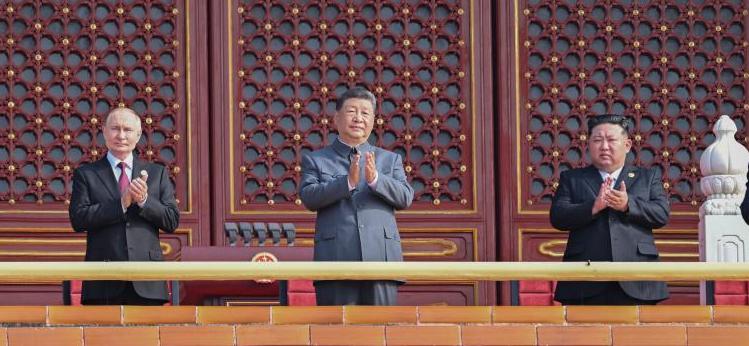
The leadership of the People's Republic of China, of the
Russian Federation, and of the DPRK at the events on September 3 this year,
marking the 80th anniversary of the victory of the Chinese People's War of
Resistance against Japanese Aggression and the World Anti-Fascist
War.
The work, of course, is ongoing. The Workers' Party of Korea recently announced the decision to convene the 13th Plenary Meeting of the 8th Central Committee of the WPK in mid-December to review the execution of the policies of the Party and state in 2025 and discuss and decide on a series of important issues including the preparations for the 9th Congress of the WPK.
On October 10, 1945, the WPK was founded with the fighters who had been tempered and trained during the anti-Japanese revolutionary struggle as its core and communists who had been active in various regions. The founding of the WPK enabled the Korean people to victoriously carve out their destiny and usher in a new era of epochal changes by relying on their own vanguard force.
As Kim Jong Un says, looking back on the 80 years of the WPK as a party of a new type, the leadership of which has been decisive in the achievements of the Korean people in socialist construction and self-reliance to the present: "The founding of our Party did not simply mean the birth of a political party in a country; it was a political event that signalled the emergence on the stage of history a new-type revolutionary party that would verify the righteousness of socialism and demonstrate its unique superiority and might."
Throughout, the DPRK has defended the dignity and interests of the state and its people. It has rebuffed the criticism of human rights coming from the United States as well as from Britain. For these governments basing themselves on so-called "representative democracy" and property rights, the collective and individual human rights of the people of the DPRK can never be appreciated, and they are clutching at straws in also fabricating disinformation about so-called "human rights abuses". It is important in this respect that the DPRK has structures that bind its society together, so that society is provided with an aim, the ever-rising levels of the people's well-being and their culture.
This is not to say that everything easily falls into place. But Kim Jong Un has been able to report in his speech how obstacles were overcome and advances made at every stage in its history.
Again, as spelt out by Kim Jong Un: "The past 80 years were really complicated and arduous, yet worthwhile and glorious.
"Those years witnessed a hard-fought war for repulsing the armed invasion by the allied imperialist forces and defending the land and dignity of the country, processes for building a country and creating a life again from scratch, and social revolutions that were accompanied by an acute class struggle and elimination of factions in the Party.

Kim Jong Un pays tribute to the Chinese People's
Volunteers
"Following the establishment of the socialist system in our country, we found ourselves standing at the forefront of the most acute confrontation between the progressive and the reactionary and between socialism and imperialism. Given the geopolitical position of the country, our Party had to adopt a more resolute approach towards performing its mission of defending socialism; it had to give a strong impetus to implementing the cause of building the country's self-reliant defence capabilities."
The DPRK has had to cope with the nuclear threat coming from US imperialism, in response combining making a leap forward in socialist construction with building up its own nuclear forces. One can look back at US-DPRK relations over the 21st century and how the US has always been the one to sabotage them. The national reality of the DPRK has therefore been addressed in the context of the international reality.
And internal problems are able to be predicted and guarded against, for instance, as Kim Jong Un says, by making sure "that an absolute spirit of serving the people prevails across the Party". Agricultural and industrial projects are underway, health care needs are given priority and public health care is being modernised, for instance with the building of the Pyongyang General Hospital as the backbone of the country's public health sector [1]. It can be seen how everything is held together through the unity and links of the Party and the people, where political power resides with the people where it belongs.
It is very tempting to compare the state's concern with modernising health care in the DPRK with the executive in this country taking charge of the NHS and consolidating its direction as crisis-ridden and towards the US system of private health care. In Kim Jong Un's speech on October 7, inaugurating the state-of-the-art Pyongyang General Hospital, he reviewed the issues of public health care, saying, for example: "We should go full steam ahead, without any further delay, with the work of fundamentally improving the established institutional mechanisms which, though remaining in force for several decades, have lost their vitality and bring no substantial benefit to the people, as well as the structural systems and irrational methods of operation which are not in keeping with the changing reality and hinder the development of the public health sector. [...] The word revolution itself means a struggle to replace everything old and backward with something new and advanced, and it inevitably goes with qualitative change.
.jpeg)
New Villages Thaehung-ri and Unha-ri in Yangdok County,
South Phyongan Province - KCNA
"We must solve this problem without fail if we are to ensure that the results of the public health revolution, which we achieve with so much effort, make a substantial contribution to protecting the people's lives and promoting their health, and to provide a guarantee for the sustained and long-term development of our socialist public health sector which is responsible for the health of the entire population."
Meeting the needs of the people can be seen as the number one priority in the DPRK. This extends, for example, also to the people's housing, education, and the mobilisation to achieve these ends. For example, among the decisions taken at the Eighth Congress of the Workers' Party of Korea (WPK) held in January 2021 was a plan to build 50,000 new apartment units in Pyongyang within five years. Providing modern housing developments suitable to the people's needs and tastes across the country was also addressed. It is reported that currently, housing construction and upgrading of existing housing are taking place in some 190 sites across the DPRK. Central to these achievements is the fact that decision-making is in the hands of the people. In this context, Kim Jong Un's remarks about being always aware of and guarding against the possible budding of authoritarianism and other problems which would be likely to separate the Party from the people as one generation is replaced by another, can be grasped. Kim Jong Un cites the aphorism, "Together with the people." Kim Jong Un's speech can be understood as a whole panegyric in praise of the people and their political power. The WPK is at one with the people being at the centre of considerations in everything, not private vested interests.
His remarks that, today, "our people are standing in front of the world as powerful beings who know no insurmountable difficulties and no unachievable cause," are not empty words. As well as the point that the WPK shares weal and woe with the people of the DPRK, the words capture that the people are the motive force in history, knowing no limitations on their power, and this fact should provide inspiration for the world's people working for the common cause of humanity of independence, justice and peace at this defining moment in history. In working in the service of its socialist cause, and with its internationalist spirit and adherence to principle, the DPRK deserves everyone's admiration and support.
Editorial Note
[1] Since the presentation was given at the meeting, Kim Jong Un has also inaugurated the Kangdong County Hospital as part of the DPRK's "Regional Development 20×10 Policy". The inauguration, expanding and promoting the regional development programme of the Workers' Party of Korea on a long-term basis, took place on November 19.