
|
|
||||
|---|---|---|---|---|
| Volume 55 Number 29, November 22, 2025 | ARCHIVE | HOME | JBCENTRE | SUBSCRIBE |
Workers' Weekly Internet Edition: Article Index :
Anticipating the Autumn Budget 2025:
Budget of a Government and Party System in CrisisNo to the wastefulness and parasitism of the war industry:
Budget-Based War FeverOf Concern:
The Beat of the War DrumsFriends of Korea:
Stand of the DPRK and its People for Self-Reliance and against Imperialist Intervention

Demonstration opposing the London arms show, September 9,
2025 - photo:PBI
The Budget speech on November 26 will be accompanied by the publication of the Office for Budget Responsibility (OBR) forecasts. The Budget statement initiates a four-day parliamentary debate, culminating in the approval of "ways and means" resolutions and the introduction of the Finance Bill, which enacts the Budget's measures into law.
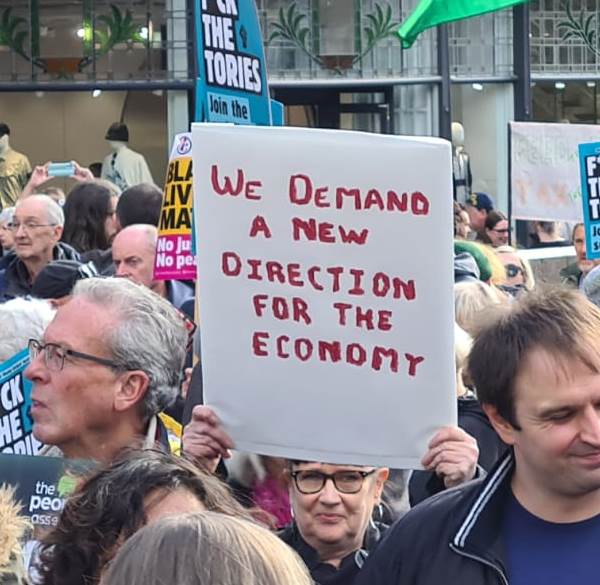
As part of the run-up to the Westminster Autumn Budget, to be unveiled by Chancellor Rachel Reeves on Wednesday, leaked details, predictions and a plethora of alternative budgets have been rife. The briefings to the press were so widespread that Commons Speaker Lindsay Hoyle admitted an urgent question on the leaks, saying to James Murray, the Chief Secretary to the Treasury, on November 17: "Minister, it isn't normal for a Budget to have been put in the press. It's the hokey-cokey Budget: one minute something is in, the next minute it is out. I am very worried. The previous government also had to be reprimanded for leaking. It is not good policy. At one time, a minister would have resigned if anything was released. This House should be sacrosanct, and all decisions should be heard here first."
This all reflects and adds to deepening the crisis of Party government. Briefings and leaks have become part of its modus operandi, intensifying the febrile atmosphere, creating so many diversions and ramping up political tension. The custom of announcing executive decisions first to the House of Commons has never been so disregarded and shows every sign of being persistently flouted, irrespective of the Speaker's admonishments. In other words, the fig-leaf of holding the government to account in Parliament itself has become a thorough-going charade.

Photo: Westbridgford wire
In the November 17 debate on the briefings to the press on the content of the Budget, the Chief Secretary to the Treasury repeated again and again, in fact seven times, that the Budget would meet the government's "iron-clad fiscal rules". Overall, a House of Commons background briefing says, "it is likely that the Budget will need to increase taxes and/or lower spending to ensure that the fiscal rules are met". The government's fiscal rules, introduced in the Autumn Budget 2024, require that: the current budget (day-to-day spending minus revenues) to be in surplus by 2029/30; and, public sector net financial liabilities (PSNFL) to be falling as a share of GDP in 2029/30. It should be evident that these invented "iron-clad fiscal rules" have nothing to do with the well-being of the people and how to apply fiscal policy to advance the economic well-being of society. Even less do they recognise the ensemble of human relations pertaining in society. That is to say, what are often called the "hard decisions" of government actually pay-the-rich and the ultra-rich oligarchs, and the international financial oligarchy, known as "investors in government debt", while working people suffer the burden of economic crisis, known as "austerity", and are threatened by an economy which is ever more militarised.
Rather, what is called for is a Budget based on peace and justice, which sets the highest possible fulfilment of socio-economic development goals for the year which are achievable and are geared to improving the people's economic well-being, targets which society demands, and which people are empowered to fulfil and participate in formulating.
Instead of investing in social programmes, guaranteeing a decent standard of living for all, or using fiscal policy to achieve a redistribution of wealth and protect Mother Earth, the focus is on closing what is called a substantial "financial gap" or "budget deficit", which is said to be between £20 billion and £30 billion, while adhering to strict so-called fiscal rules and navigating the constraints of Labour's manifesto pledges, pledges which were couched in terms of "working people" in order to keep the organised workers' movement on-side in these "hard decisions". Calls for the full implementation of the Employment Rights Bill, and the wider plan to "Make Work Pay" are just, but Rachel Reeves is not their champion and the direction suggested by the pre-Budget briefings shows the anti-social, anti-worker nature of the system where the working class and people are denied their voice. The November 26 Budget will be a budget of a government in crisis, riven with factions and incoherence, but one which will also intensify the economic crisis.

According to the House of Commons briefing, the government's spending on debt interest for its existing stock of debt has more than doubled since 2019/20. £1 in every £12 the government spends is currently on debt interest. This is said to contribute to the government's "black hole", followed by the logic that "borrowing" to reduce the debt, and therefore debt interest, must be curtailed, and hence investment in the economy also curtailed. A moratorium on debt interest payments, however, could be implemented. But, who decides?
What should be emphasised is the way that Britain is based on a pro-war economy. It is a cheer-leader for the proxy-war against Russia in Ukraine, funnelling billions into this conflict, as well as for the Israeli genocide in Gaza and dispossession of the Palestinian people, and is complicit with its intelligence flights over Gaza. Meanwhile, the working class and people here are demanding that there be investments in health care, in education, and in public services. For all the government's talk about housing, homelessness is a scourge. Working people have their rights, such as the right to live in a safe natural and social environment, rights which should receive a guarantee from the government. Yet it is the profits of the armaments producers which take precedence. This must change.

The Spending Review 2025 dressed up the direction to a war-ready economy as "economic renewal", focused on "defence spending" and "intelligence agencies" [1]. The government's attempt to put Britain on a "war-fighting readiness" cannot be accepted and is causing immense damage to the natural and social environment and the people's well-being [2]. And the "Industrial Strategy" which was published in June as a Ten-Year Plan, focused on strengthening the British state under the guise of increasing business investment and growing the industries of the future in the UK [3]. As Workers' Weekly wrote at the time, "the talk of the Strategy of 'creating an enduring partnership with business', to which a whole section of the document is devoted, is the government's decision-making on behalf of the oligopolies. This is the 'muscular approach to government' which enshrines the cartel parties as an integral part of the state, in which people are sidelined, excluded, denied a role. What counts is pay-the-rich schemes, which is what this 'enduring partnership with business' means." This is the mind-set of Starmer and his Chancellor.
What all the commentaries, criticisms and "alternative budgets" do show is that the working class and people do not accept the direction that the Starmer government and its Chancellor are attempting to take the economy and society. But more than that. They are searching for an outlook of which an alternative budget would be an expression and practical project. In other words, it is not that Starmer or Reeves have no clue, or are incompetent, which few would argue against. Injustices, unfairness and inequalities are not a matter of bad policies of the cartel party in government, in this case Labour. They are inherent in the rule of an elite and the state organisations and institutions which divide society between those who are rich and privileged and consider it their destiny to govern and get richer, and those who are ruled over and kept disempowered and at the mercy of the rich.
The kernel to mobilise around is that political renewal is the order of the day, for which pro-social and anti-war programmes open the way. Let this coming Budget be the occasion for the working class and people to take up the conscious direction of empowering the people to take the decisions which affect their lives!
Notes
1. Spending Review 2025, Workers' Weekly, June 21, 2025
https://www.rcpbml.org.uk/wwie-25/ww25-14/ww25-14-01.htm
2. Strategic Defence Review, Workers' Weekly, June 7, 2025
https://www.rcpbml.org.uk/wwie-25/ww25-13/ww25-13-01.htm
3. Fraudulent Plan for "National Renewal", Workers' Weekly,
June 28, 2025
https://www.rcpbml.org.uk/wwie-25/ww25-15/ww25-15-01.htm
Stop the War Coalition, Newsletter, November 21, 2025

It is no accident that hysteria about military threats seem to be peaking in the run up to the budget. But as Chris Nineham says in his recent article, "The idea that Russia is a military threat to Britain is a complete fantasy. Russia's military power has been stretched to the limit fighting in Ukraine." Yet still Defence Minister John Healey announced a massive expansion of arms factories across the country. [1]
There is an escalating arms race in Europe and our government is playing its part, cynically ratcheting up the fear of war alongside people's concerns about jobs to justify hiking military spending.
And we're not just spending on conventional weapons, this spending spree has gone nuclear. On Monday StW Convenor, Lindsey German stood alongside CND, MPs and trade unionists to hand in a letter calling on the Prime Minister to rethink his decision to purchase 12 nuclear-capable F-35A jets. The jets have been designed to launch deadly US nuclear bombs and are to be stationed in the UK.
"Buying nuclear-capable F-35s to please Donald Trump and his belligerent foreign policy puts everyone in Britain at risk of being on the frontline of a nuclear war," said Lindsey.
At a time when public services are collapsing and millions are struggling to make ends meet, we need to fight for real security. We can only do this by tackling welfare cuts and breaking with decades of subordination to US foreign policy.
Join us at the eve of budget protest demanding Welfare not Warfare on Tuesday, November 25, 6pm outside Downing Street.
Workers' Weekly Note
[1] Sources say that defence spending is set to rise to 2.6% of GDP by 2027,
the largest sustained increase since the Cold War, with an ambition to reach 3%
in the next Parliament. The Ministry of Defence budget will reach £73.5
billion by 2028/29, with major investments in nuclear warheads (£15
billion), directed energy weapons (£1 billion), autonomous systems
(£4 billion), munitions (£6 billion), and military accommodation
(£7 billion). Intelligence and border security budgets are also being
increased.

In a post on his website, Craig Murray, historian and human rights activist, writes on November 20, 2025, that the entire British media, broadcast and print, corporate and state, is leading with a Ministry of Defence press release about a "Russian spy ship" inside "British waters".
Extracts from the post follow:
No British media appears to have been able to speak to anybody who knows the first thing about the Law of the Sea.
Here are the facts:
The Exclusive Economic Zone extends 200 miles from the coastal baselines. The Continental Shelf can extend still further, as a fact of geology, not an imposed maximum.
On the Continental Shelf the coastal state is entitled to the mineral resources. In the Exclusive Economic Zone the coastal state is entitled to the fisheries and mineral resources.
For purposes of navigation, both the Continental Shelf and Exclusive Economic Zone are part of the High Seas. There is freedom of navigation on the High Seas. Foreign ships. including foreign military ships, may come and go as they please. Nor is there any ban on "spying" - exactly as there is no restriction on spying from satellites.
The Territorial Waters of a state extend out to just twelve miles. These are subject to the internal legislation of the coastal state. There is freedom for foreign vessels, including military vessels, to pass through them but only subject to the rule of "innocent passage" - which specifically rules out spying and reconnaissance. In the territorial sea, vessels have to be genuinely just passing through on their way somewhere, otherwise they may need coastal state permission for their activity.
The Exclusive Economic Zone is subject to the rules of the coastal state only in relation to the reserved economic activities to which the state is entitled. Scientific research is specifically free for all states within the Exclusive Economic Zone.
The Russian ship Yantar has been just outside the UK territorial waters. It is therefore under "freedom of navigation" and not under "innocent passage". It is free to do scientific research.
I don't doubt it is really gathering intelligence on military, energy and communications facilities. That is what states do. The UK does it to Russia all the time, on the Black Sea, the Barents Sea, the Baltic, and elsewhere. Not to mention 24/7 satellite surveillance.
It is perfectly legal for the Yantar to do this. Personally I wish the entire world would stop such activity, but to blame the Russians given the massive levels of surveillance and encirclement they suffer from NATO assets is simply ludicrous.
Not to mention the ultimate hypocrisy that the UK has been flying intelligence missions over Gaza every single day and feeding targeting information to aid the Gaza genocide.
The UK's allies blew up Russia's Nordstream pipeline. The UK is now accusing the Yantar precisely of scouting this same kind of attack - which we endorsed when the pipeline was Russian.
For example HMS Sutherland, accompanied by Royal Fleet Auxiliary Tidespring, and two other NATO warships penetrated 160 miles into Russia's Exclusive Economic Zone and lingered 40 miles from Russia's Severomosk naval base. There was no pretence they were doing anything other than gathering intelligence and sounding out defences.
In armed forces media the UK boasted it was an assertion of freedom of navigation. Yet we harass the Russian vessel equally on the High Seas for exercising its freedom of navigation.
That was also perfectly legal. The idea that the same activity is worthy when we do it, but a pretext for war if the Russians do it, is so childish as to be beyond ridicule. But there is not one single mainstream journalist willing to call it out.
[...] The nonsense about dazzling pilots' eyes is sheer invention. Unless the plane is extremely, extremely low or a very long way away it is a physical impossibility to shine a laser into a pilot's eyes in a modern warplane, from below in a ship. The pilot won't be looking at the ship out of the window, but will be looking at his screens and the image from the cameras under the plane. These might be disrupted by the lasers - and a perfectly valid and sensible defensive measure that is too.
[...]
Most sinister of all is the universal state control of media that gets every single mainstream outlet booming out the propaganda narrative, all entirely without question.
This war talk is of course the normal refuge of extremely unpopular governments. But it is part of a wider tightening of the grip of the military industrial complex on the state. Starmer is committed to increasing military expenditure by tens of billions of pounds a year, while imposing austerity on the rest of the economy. In Scotland, we are told that the closure of major industrial sites like Grangemouth and Mossmorran will be compensated by opening new weapons factories.
Beating ploughshares into swords.
[...]
For the complete article, click here: https://www.craigmurray.org.uk/archives/2025/11/the-beat-of-the-war-drums/

A mass gymnastics and artistic performance "Long
Live the Workers' Party of Korea" celebrating the 80th
founding anniversary of the Workers' Party of Korea, May Day Stadium,
Pyongyang, October 9, 2025 - KCNA
The Co-ordinating Committee of Friends of Korea (Britain) organised a hybrid meeting with the above title on November 15, 2025. It was one in a series of occasional public meetings organised by Friends of Korea on the DPRK and the world situation.

Ri Yong Uk, First Secretary of the DPRK Embassy in London
speaking at the meeting
The DPRK and the Korean people have never wavered from defending their right to be and their own path of development, as well as striving for peace in the face of imperialist intervention by the US and its allies. The meeting discussed how, given the important geopolitical position of the country, the DPRK had adopted a militant and resolute approach towards defending its socialist path and maintaining political power in the people's hands. At the same time, the DPRK is making substantial progress in developing and consolidating its external relations. Contributions to the meeting from representatives of Friends of Korea elaborated the DPRK's historic contribution to implementing the common cause of humanity for independence, justice and peace at this defining moment in history. Ri Yong Uk, First Secretary of the DPRK Embassy in London, joined the meeting, giving a significant presentation. The meeting was chaired by Andy Brooks, Chair of Friends of Korea, and General Secretary of the New Communist Party.
Speakers included Dr Dermot Hudson, Chairman of Korean Friendship Association UK, who spoke of the striving of the DPRK for peace in the face of imperialist intervention by the US and its allies; the response of the DPRK to imperialist aggression and how this contributes to and guarantees peace; and the change in reunification policy which goes together with the whole question of the DPRK's enemies and those who are hostile to the DPRK. In speaking of his experience of recently visiting the DPRK, a country which he has visited many times, Dr Hudson referred to the advances the country has made and how its upholding of its independence and sovereignty as against the efforts for regime change is a positive contribution to peace and stability.

Left to right: Dr Dermot Hudson, Keith Bennett and
Michael Chant
International figure Keith Bennett, Deputy Chair of the Kim Il Sung and Kim Jong Il Foundation, spoke of how the DPRK is a symbol of resistance and resilience, taking a principled and anti-imperialist stand, and working for the unity of all anti-imperialist forces. He referred to the significance of the alliance of the leadership of the People's Republic of China, of the Russian Federation, and of the DPRK on the world stage, particularly as represented at the events on September 3 this year, marking the 80th anniversary of the victory of the Chinese People's War of Resistance against Japanese Aggression and the World Anti-Fascist War. Keith Bennett also spoke of the opportunity the mood of the people's movements gives to the anti-imperialist struggles in Britain, particularly that of standing as one with the Palestinian people, and how this is also favourable to the work of Friends of Korea.
Michael Chant, Secretary of Friends of Korea, and General Secretary of
RCPB(ML), after outlining the programme and work of Friends of Korea in the
context of further building friendship between the people of Britain and those
of the DPRK, acquainting people with the necessary information and analysis
regarding the DPRK, gave a presentation which we reproduce below.
The DPRK defends its socialist path and maintains political power in the people's hands

Kim Jong Un, General Secretary of the Workers' Party of
Korea and President of State Affairs of the DPRK
At present, there is a particular moment in history, chiefly how the people's movement to make history themselves comes up sharply against those in authority in the world determined desperately to hold back the growing people's movements. Therefore it is important to take advantage of this what can be called a transitional period, in order to assist the movement in being armed with the information as to how the DPRK fits in to the tide of the people's movements world-wide for peace, justice and sovereignty, and the striving for socialism.
In other words, the consideration of the DPRK cannot be looked at in isolation from the context of history and the people's strivings, a check-list of, say, what socialism is or is not, pro or con, but appreciated also in an international context, with the particularity of the DPRK. It is in this context, and in particular the consideration of where political power lies, that the outlook of the DPRK can be appreciated nationally and internationally.
Two very important anniversaries have taken place in 2025: the 80th anniversary of the final defeat of Japanese imperialism at the end of the Second World War, and the 80th anniversary of the founding of the Workers' Party of Korea. Perhaps others will talk more about the significance of the former.
To the great merit of the DPRK and the Workers' Party of Korea as the inspirer and organiser of the people to achieve their aspirations, the 80th anniversary celebrations of the WPK focused on the people throughout. The speech by Kim Jong Un, who is the General Secretary of the WPK and President of State Affairs of the DPRK, at the meeting to celebrate the anniversary, is worth studying in its entirety. But just to illustrate the significance of some crucial points from the speech. Firstly as to how Kim Jong Un puts the WPK and the government of the DPRK in the global context, both from the point of view of its global adversaries, and of the progressive and people's camp, he says:
"Our Party and government are still coping with our adversaries' ferocious political and military moves of pressure by pursuing harder-line policies, holding fast to firm principles and employing brave, unflinching countermeasures. This is powerfully propelling the growth of the progressive camp against war and hegemony, and the international prestige of our Republic as a faithful member of the socialist forces and a bulwark for independence and justice is further increasing with each passing day." He adds that there is a key to what brings victory to such as Party as the WPK. It is, he says, "in a nutshell .. that the Party has shared everything with a great people ... [a] history of relying on the strength of the people".
There is something else which Kim Jong Un mentions in passing, but perhaps is implicit in its whole argument. It is the issue of political power and who holds it. Without political power being in the hands of the people, it would not be possible for the Party to guide them in socialist construction and defence of the social system. As he says: "In fact, maintaining the political power and defending the social system was a miracle itself, but our Party has taken on all those important tasks; it has cleared an untrodden path for their implementation, writing a history of epochal transformations."
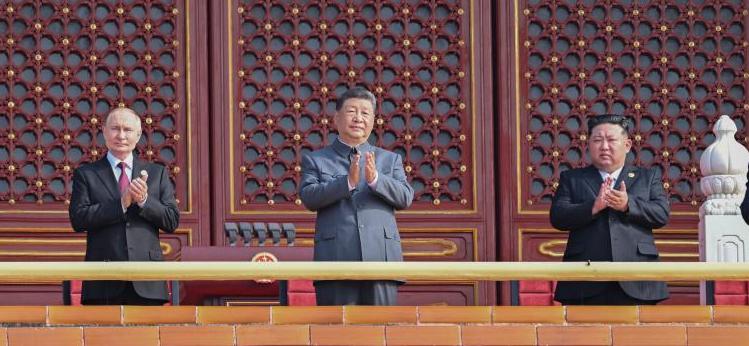
The leadership of the People's Republic of China, of the
Russian Federation, and of the DPRK at the events on September 3 this year,
marking the 80th anniversary of the victory of the Chinese People's War of
Resistance against Japanese Aggression and the World Anti-Fascist
War.
The work, of course, is ongoing. The Workers' Party of Korea recently announced the decision to convene the 13th Plenary Meeting of the 8th Central Committee of the WPK in mid-December to review the execution of the policies of the Party and state in 2025 and discuss and decide on a series of important issues including the preparations for the 9th Congress of the WPK.
On October 10, 1945, the WPK was founded with the fighters who had been tempered and trained during the anti-Japanese revolutionary struggle as its core and communists who had been active in various regions. The founding of the WPK enabled the Korean people to victoriously carve out their destiny and usher in a new era of epochal changes by relying on their own vanguard force.
As Kim Jong Un says, looking back on the 80 years of the WPK as a party of a new type, the leadership of which has been decisive in the achievements of the Korean people in socialist construction and self-reliance to the present: "The founding of our Party did not simply mean the birth of a political party in a country; it was a political event that signalled the emergence on the stage of history a new-type revolutionary party that would verify the righteousness of socialism and demonstrate its unique superiority and might."
Throughout, the DPRK has defended the dignity and interests of the state and its people. It has rebuffed the criticism of human rights coming from the United States as well as from Britain. For these governments basing themselves on so-called "representative democracy" and property rights, the collective and individual human rights of the people of the DPRK can never be appreciated, and they are clutching at straws in also fabricating disinformation about so-called "human rights abuses". It is important in this respect that the DPRK has structures that bind its society together, so that society is provided with an aim, the ever-rising levels of the people's well-being and their culture.
This is not to say that everything easily falls into place. But Kim Jong Un has been able to report in his speech how obstacles were overcome and advances made at every stage in its history.
Again, as spelt out by Kim Jong Un: "The past 80 years were really complicated and arduous, yet worthwhile and glorious.
"Those years witnessed a hard-fought war for repulsing the armed invasion by the allied imperialist forces and defending the land and dignity of the country, processes for building a country and creating a life again from scratch, and social revolutions that were accompanied by an acute class struggle and elimination of factions in the Party.

Kim Jong Un pays tribute to the Chinese People's
Volunteers
"Following the establishment of the socialist system in our country, we found ourselves standing at the forefront of the most acute confrontation between the progressive and the reactionary and between socialism and imperialism. Given the geopolitical position of the country, our Party had to adopt a more resolute approach towards performing its mission of defending socialism; it had to give a strong impetus to implementing the cause of building the country's self-reliant defence capabilities."
The DPRK has had to cope with the nuclear threat coming from US imperialism, in response combining making a leap forward in socialist construction with building up its own nuclear forces. One can look back at US-DPRK relations over the 21st century and how the US has always been the one to sabotage them. The national reality of the DPRK has therefore been addressed in the context of the international reality.
And internal problems are able to be predicted and guarded against, for instance, as Kim Jong Un says, by making sure "that an absolute spirit of serving the people prevails across the Party". Agricultural and industrial projects are underway, health care needs are given priority and public health care is being modernised, for instance with the building of the Pyongyang General Hospital as the backbone of the country's public health sector [1]. It can be seen how everything is held together through the unity and links of the Party and the people, where political power resides with the people where it belongs.
It is very tempting to compare the state's concern with modernising health care in the DPRK with the executive in this country taking charge of the NHS and consolidating its direction as crisis-ridden and towards the US system of private health care. In Kim Jong Un's speech on October 7, inaugurating the state-of-the-art Pyongyang General Hospital, he reviewed the issues of public health care, saying, for example: "We should go full steam ahead, without any further delay, with the work of fundamentally improving the established institutional mechanisms which, though remaining in force for several decades, have lost their vitality and bring no substantial benefit to the people, as well as the structural systems and irrational methods of operation which are not in keeping with the changing reality and hinder the development of the public health sector. [...] The word revolution itself means a struggle to replace everything old and backward with something new and advanced, and it inevitably goes with qualitative change.
.jpeg)
New Villages Thaehung-ri and Unha-ri in Yangdok County,
South Phyongan Province - KCNA
"We must solve this problem without fail if we are to ensure that the results of the public health revolution, which we achieve with so much effort, make a substantial contribution to protecting the people's lives and promoting their health, and to provide a guarantee for the sustained and long-term development of our socialist public health sector which is responsible for the health of the entire population."
Meeting the needs of the people can be seen as the number one priority in the DPRK. This extends, for example, also to the people's housing, education, and the mobilisation to achieve these ends. For example, among the decisions taken at the Eighth Congress of the Workers' Party of Korea (WPK) held in January 2021 was a plan to build 50,000 new apartment units in Pyongyang within five years. Providing modern housing developments suitable to the people's needs and tastes across the country was also addressed. It is reported that currently, housing construction and upgrading of existing housing are taking place in some 190 sites across the DPRK. Central to these achievements is the fact that decision-making is in the hands of the people. In this context, Kim Jong Un's remarks about being always aware of and guarding against the possible budding of authoritarianism and other problems which would be likely to separate the Party from the people as one generation is replaced by another, can be grasped. Kim Jong Un cites the aphorism, "Together with the people." Kim Jong Un's speech can be understood as a whole panegyric in praise of the people and their political power. The WPK is at one with the people being at the centre of considerations in everything, not private vested interests.
His remarks that, today, "our people are standing in front of the world as powerful beings who know no insurmountable difficulties and no unachievable cause," are not empty words. As well as the point that the WPK shares weal and woe with the people of the DPRK, the words capture that the people are the motive force in history, knowing no limitations on their power, and this fact should provide inspiration for the world's people working for the common cause of humanity of independence, justice and peace at this defining moment in history. In working in the service of its socialist cause, and with its internationalist spirit and adherence to principle, the DPRK deserves everyone's admiration and support.
Editorial Note
[1] Since the presentation was given at the meeting, Kim Jong Un has also
inaugurated the Kangdong County Hospital as part of the DPRK's "Regional
Development 20×10 Policy". The inauguration, expanding and promoting
the regional development programme of the Workers' Party of Korea on a
long-term basis, took place on November 19.
Receive Workers'
Weekly E-mail Edition: It
is free to subscribe to the e-mail edition
We encourage all those who support the work of RCPB(ML) to also support it
financially:
Donate to
RCPB(ML)
Workers' Weekly is the weekly on
line newspaper of the
Revolutionary Communist Party of Britain (Marxist-Leninist)
Website:
http://www.rcpbml.org.uk
E-mail:
office@rcpbml.org.uk
170, Wandsworth Road, London, SW8 2LA.
Phone: 020 7627 0599:
