
|
|
||||
|---|---|---|---|---|
| Volume 55 Number 29, November 22, 2025 | ARCHIVE | HOME | JBCENTRE | SUBSCRIBE |

Demonstration opposing the London arms show, September 9,
2025 - photo:PBI
The Budget speech on November 26 will be accompanied by the publication of the Office for Budget Responsibility (OBR) forecasts. The Budget statement initiates a four-day parliamentary debate, culminating in the approval of "ways and means" resolutions and the introduction of the Finance Bill, which enacts the Budget's measures into law.
As part of the run-up to the Westminster Autumn Budget, to be unveiled by Chancellor Rachel Reeves on Wednesday, leaked details, predictions and a plethora of alternative budgets have been rife. The briefings to the press were so widespread that Commons Speaker Lindsay Hoyle admitted an urgent question on the leaks, saying to James Murray, the Chief Secretary to the Treasury, on November 17: "Minister, it isn't normal for a Budget to have been put in the press. It's the hokey-cokey Budget: one minute something is in, the next minute it is out. I am very worried. The previous government also had to be reprimanded for leaking. It is not good policy. At one time, a minister would have resigned if anything was released. This House should be sacrosanct, and all decisions should be heard here first."
This all reflects and adds to deepening the crisis of Party government. Briefings and leaks have become part of its modus operandi, intensifying the febrile atmosphere, creating so many diversions and ramping up political tension. The custom of announcing executive decisions first to the House of Commons has never been so disregarded and shows every sign of being persistently flouted, irrespective of the Speaker's admonishments. In other words, the fig-leaf of holding the government to account in Parliament itself has become a thorough-going charade.

Photo: Westbridgford wire
In the November 17 debate on the briefings to the press on the content of the Budget, the Chief Secretary to the Treasury repeated again and again, in fact seven times, that the Budget would meet the government's "iron-clad fiscal rules". Overall, a House of Commons background briefing says, "it is likely that the Budget will need to increase taxes and/or lower spending to ensure that the fiscal rules are met". The government's fiscal rules, introduced in the Autumn Budget 2024, require that: the current budget (day-to-day spending minus revenues) to be in surplus by 2029/30; and, public sector net financial liabilities (PSNFL) to be falling as a share of GDP in 2029/30. It should be evident that these invented "iron-clad fiscal rules" have nothing to do with the well-being of the people and how to apply fiscal policy to advance the economic well-being of society. Even less do they recognise the ensemble of human relations pertaining in society. That is to say, what are often called the "hard decisions" of government actually pay-the-rich and the ultra-rich oligarchs, and the international financial oligarchy, known as "investors in government debt", while working people suffer the burden of economic crisis, known as "austerity", and are threatened by an economy which is ever more militarised.
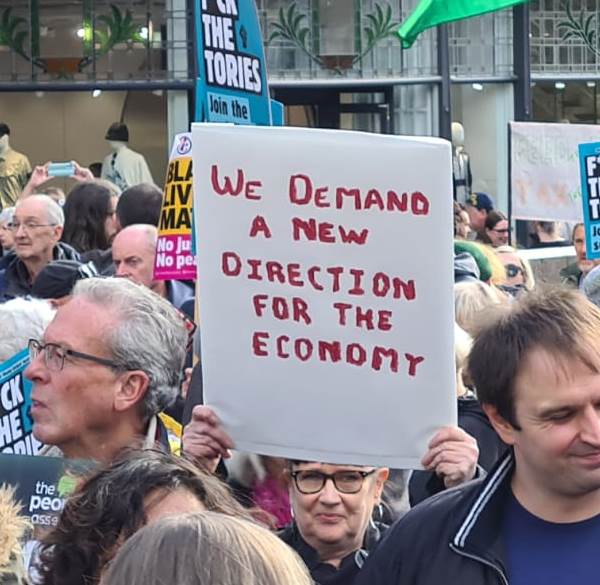
Rather, what is called for is a Budget based on peace and justice, which sets the highest possible fulfilment of socio-economic development goals for the year which are achievable and are geared to improving the people's economic well-being, targets which society demands, and which people are empowered to fulfil and participate in formulating.
Instead of investing in social programmes, guaranteeing a decent standard of living for all, or using fiscal policy to achieve a redistribution of wealth and protect Mother Earth, the focus is on closing what is called a substantial "financial gap" or "budget deficit", which is said to be between £20 billion and £30 billion, while adhering to strict so-called fiscal rules and navigating the constraints of Labour's manifesto pledges, pledges which were couched in terms of "working people" in order to keep the organised workers' movement on-side in these "hard decisions". Calls for the full implementation of the Employment Rights Bill, and the wider plan to "Make Work Pay" are just, but Rachel Reeves is not their champion and the direction suggested by the pre-Budget briefings shows the anti-social, anti-worker nature of the system where the working class and people are denied their voice. The November 26 Budget will be a budget of a government in crisis, riven with factions and incoherence, but one which will also intensify the economic crisis.

According to the House of Commons briefing, the government's spending on debt interest for its existing stock of debt has more than doubled since 2019/20. £1 in every £12 the government spends is currently on debt interest. This is said to contribute to the government's "black hole", followed by the logic that "borrowing" to reduce the debt, and therefore debt interest, must be curtailed, and hence investment in the economy also curtailed. A moratorium on debt interest payments, however, could be implemented. But, who decides?
What should be emphasised is the way that Britain is based on a pro-war economy. It is a cheer-leader for the proxy-war against Russia in Ukraine, funnelling billions into this conflict, as well as for the Israeli genocide in Gaza and dispossession of the Palestinian people, and is complicit with its intelligence flights over Gaza. Meanwhile, the working class and people here are demanding that there be investments in health care, in education, and in public services. For all the government's talk about housing, homelessness is a scourge. Working people have their rights, such as the right to live in a safe natural and social environment, rights which should receive a guarantee from the government. Yet it is the profits of the armaments producers which take precedence. This must change.

The Spending Review 2025 dressed up the direction to a war-ready economy as "economic renewal", focused on "defence spending" and "intelligence agencies" [1]. The government's attempt to put Britain on a "war-fighting readiness" cannot be accepted and is causing immense damage to the natural and social environment and the people's well-being [2]. And the "Industrial Strategy" which was published in June as a Ten-Year Plan, focused on strengthening the British state under the guise of increasing business investment and growing the industries of the future in the UK [3]. As Workers' Weekly wrote at the time, "the talk of the Strategy of 'creating an enduring partnership with business', to which a whole section of the document is devoted, is the government's decision-making on behalf of the oligopolies. This is the 'muscular approach to government' which enshrines the cartel parties as an integral part of the state, in which people are sidelined, excluded, denied a role. What counts is pay-the-rich schemes, which is what this 'enduring partnership with business' means." This is the mind-set of Starmer and his Chancellor.
What all the commentaries, criticisms and "alternative budgets" do show is that the working class and people do not accept the direction that the Starmer government and its Chancellor are attempting to take the economy and society. But more than that. They are searching for an outlook of which an alternative budget would be an expression and practical project. In other words, it is not that Starmer or Reeves have no clue, or are incompetent, which few would argue against. Injustices, unfairness and inequalities are not a matter of bad policies of the cartel party in government, in this case Labour. They are inherent in the rule of an elite and the state organisations and institutions which divide society between those who are rich and privileged and consider it their destiny to govern and get richer, and those who are ruled over and kept disempowered and at the mercy of the rich.
The kernel to mobilise around is that political renewal is the order of the day, for which pro-social and anti-war programmes open the way. Let this coming Budget be the occasion for the working class and people to take up the conscious direction of empowering the people to take the decisions which affect their lives!
Notes
1. Spending Review 2025, Workers' Weekly, June 21, 2025
https://www.rcpbml.org.uk/wwie-25/ww25-14/ww25-14-01.htm
2. Strategic Defence Review, Workers' Weekly, June 7, 2025
https://www.rcpbml.org.uk/wwie-25/ww25-13/ww25-13-01.htm
3. Fraudulent Plan for "National Renewal", Workers' Weekly,
June 28, 2025
https://www.rcpbml.org.uk/wwie-25/ww25-15/ww25-15-01.htm