
|
|
||||
|---|---|---|---|---|
| Volume 52 Number 27, November 5, 2022 | ARCHIVE | HOME | JBCENTRE | SUBSCRIBE |
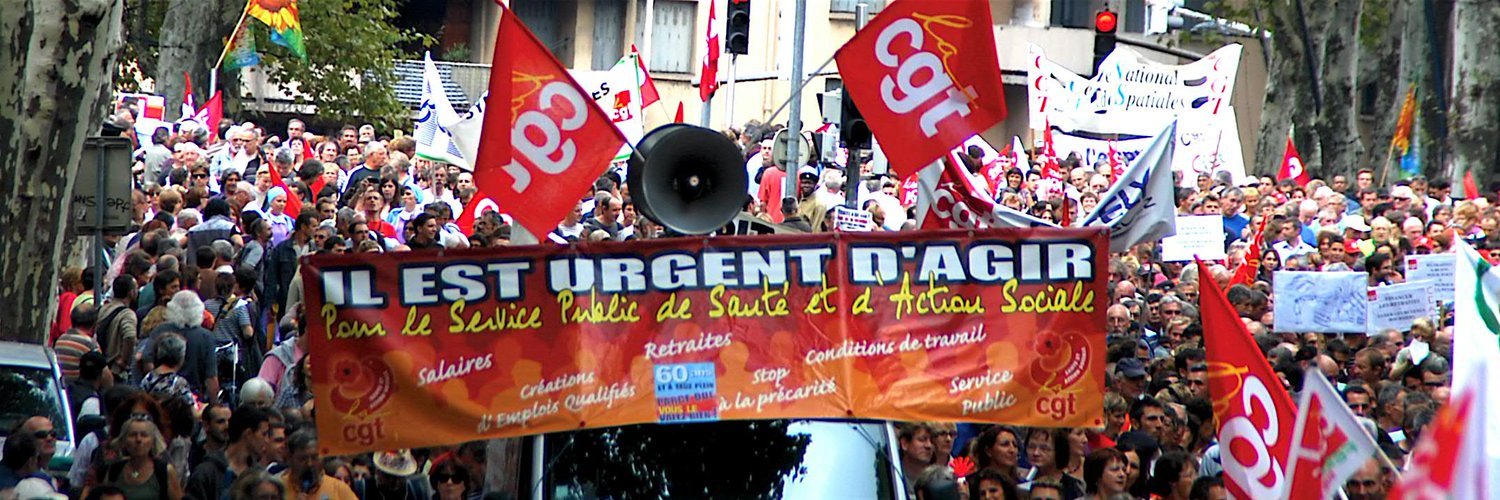
Massive strikes have been ongoing all year. Photo shows
health care workers strike in June organised by the CGT.
Refinery workers across France have been striking since the end of September in an action that has spearheaded generalised strikes in other sectors. In the context of a deepening political and economic crisis in France and across Europe including Britain, it has become part of a growing movement for a change in the direction of the economy that has crystallised around the critical matters of energy prices and the cost of living.
Beginning with a walkout by workers at TotalEnergies and Esso-ExxonMobil over pay, it grew to become what has been described as the largest and most significant wave of action in France since the "yellow vest" movement in 2018. By early October, it was being reported that almost a third of petrol stations were short of fuel. On October 11, the French government threatened to break the refinery strike. Workers immediately voted to continue action, defying the police powers, by which time six out of seven refineries had stopped production, according to reports. Police began to use their powers against strikers, such as by issuing requisition orders [1].
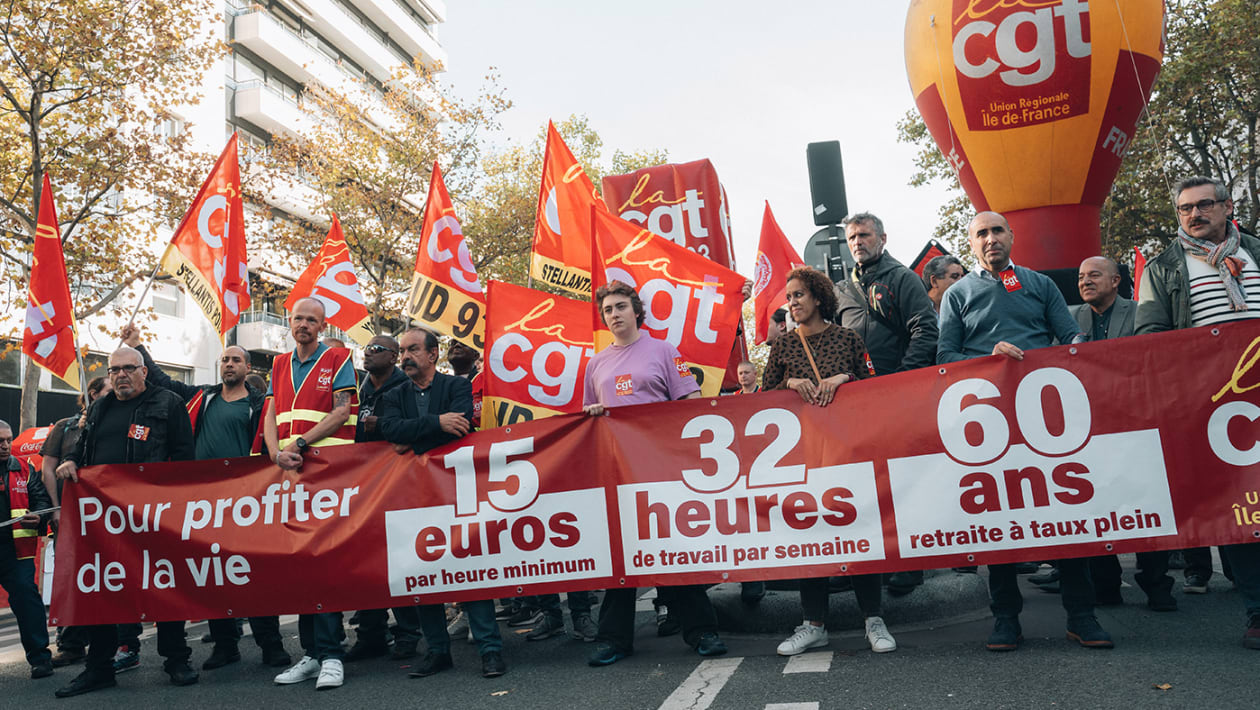
Mass demonstrations were held on October 16, with a 140,000-strong rally in Paris, two days before a national transport strike over levels of pay, pointing to the cost-of-living crisis that is affecting people in France similarly to here in Britain. It is reported that youth and student contingents in particular showed their opposition to the government's pro-war and anti-social policy. The following day, the government ordered further refinery strikers to return to work on the eve of the transport strike, which began on October 18. Strikes had already spilled over into other parts of the energy sector, reported Reuters, while civil service workers threatened action.
At the time of writing, while most refinery action has now ended, workers at the Feyzin refinery remain on strike.
Back in May, French President Emanuel Macron had managed to win a new term as president. Just one month later, he and his Prime Minister Elisabeth Borne lost their parliamentary majority, and have since been governing precariously. Borne survived two confidence votes in the National Assembly on October 24, but by a very small margin of just 50 votes. This has been accompanied by a wave of opposition to the economic and social crisis.
What seems to be clear is that, just as in Britain and elsewhere, the cartel party system in France is failing to keep a lid on the contradictions in that country within the ruling circles and amongst the various powerful private interests they represent, and between this elite and the majority of the population. The lack of any consensus is rendering parliament inoperative to the extent that Macron and Borne are resorting to open rule by police powers and exceptional measures. On October 19, Macron and Borne activated Article 49.3 of the French constitution to force the state revenues part of their 2023 budget through parliament without a vote after failing to win parliamentary approval, prompting the confidence motions. It is expected that they will repeatedly use this mechanism to push through further legislation over the next few weeks.
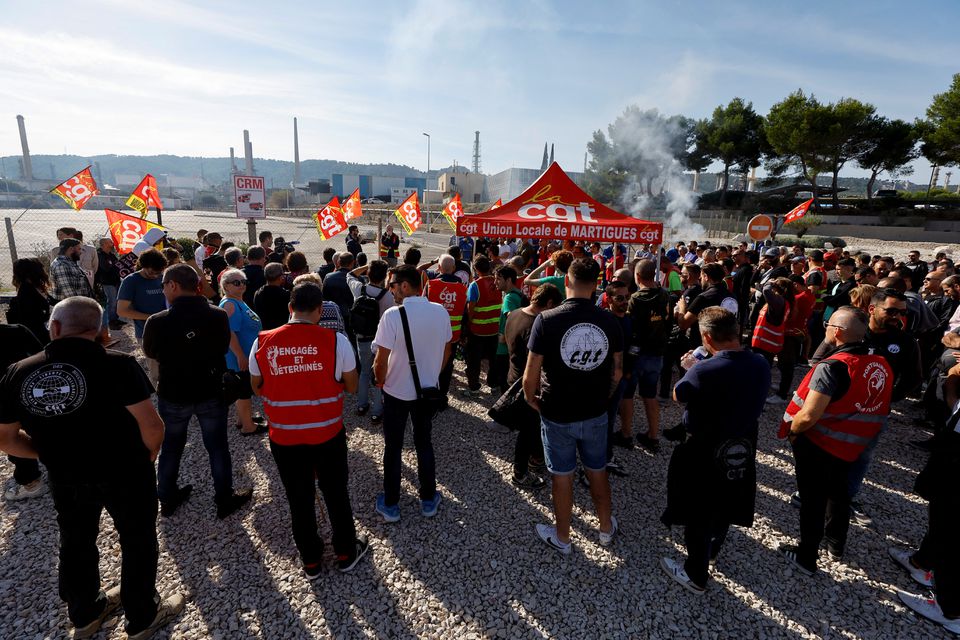
Total Energies and Esso Exxon Mobil workers' protest
outside Total Energies refinery in La Mede, France October 11, 2022: Photo:
REUTERS/Eric Gaillard
It is amid this crisis in governance and of the legitimacy of authority that the strikes have been taking place. The response of the government, which has only deepened this crisis further, has been to arbitrate on the side of the energy oligarchs by forcing strikers back to work.
At the same time, in the developing movement that is at one with the strike struggle, people are challenging the military direction that Macron's government has been taking France (announcing on October 13, for example, an increased French military presence in Eastern Europe). Meanwhile, France has been leading the establishment, on October 6, of the European Political Community, within which Britain has been playing its warmongering role while taking a stance of being an ally of France, to bolster France at this time. An overtly political visit by King Charles, his first international visit as monarch, is currently being organised in this context, in the midst of this political and economic crisis.
What is happening in France, where workers are demanding a say, demanding their rights, laying their claims on society, and in so doing challenging the authority of the French government, is part of a generalised crisis of governance in the big powers of Europe, including Britain.
The common demand of the people of Britain, France and elsewhere in Europe is for the economy to be directed to meeting the needs of the people, which means that working people have first claim on the social wealth, on the fruits of their work. The common demand is for an end to illegitimate governments that block people from any say over matters that affect their lives. The need for political power is posing itself ever more sharply on the working class across the continent, so as to set a new direction for the economy and bring the productive forces under their own control.
(Sources: AFP, EURACTIV.fr, France 24, Limited Times, MSN, Politico.eu, Reuters, WSWS)
Notes
1. For example, see: "Factbox: How France is forcing striking fuel staff
back to work", Reuters, October 12, 2022
https://www.reuters.com/markets/europe/how-france-is-forcing-striking-fuel-staff-back-work-2022-10-12
Such requisition orders are being considered for introduction in Britain as
part of new anti-strike legislation.