
|
|
||||
|---|---|---|---|---|
| Volume 52 Number 27, November 5, 2022 | ARCHIVE | HOME | JBCENTRE | SUBSCRIBE |
Workers' Weekly Internet Edition: Article Index : ShareThis
"Britain Is Broken"
The Way Forward Lies in the Fight for the Rights of AllWorkers' Movement:
RMT Secures Intensive Negotiations and Suspends Rail StrikesThe working class of Europe and the Need for Political Power:
Wave of Strike Action across France Amid Deepening Political and Economic Crisis
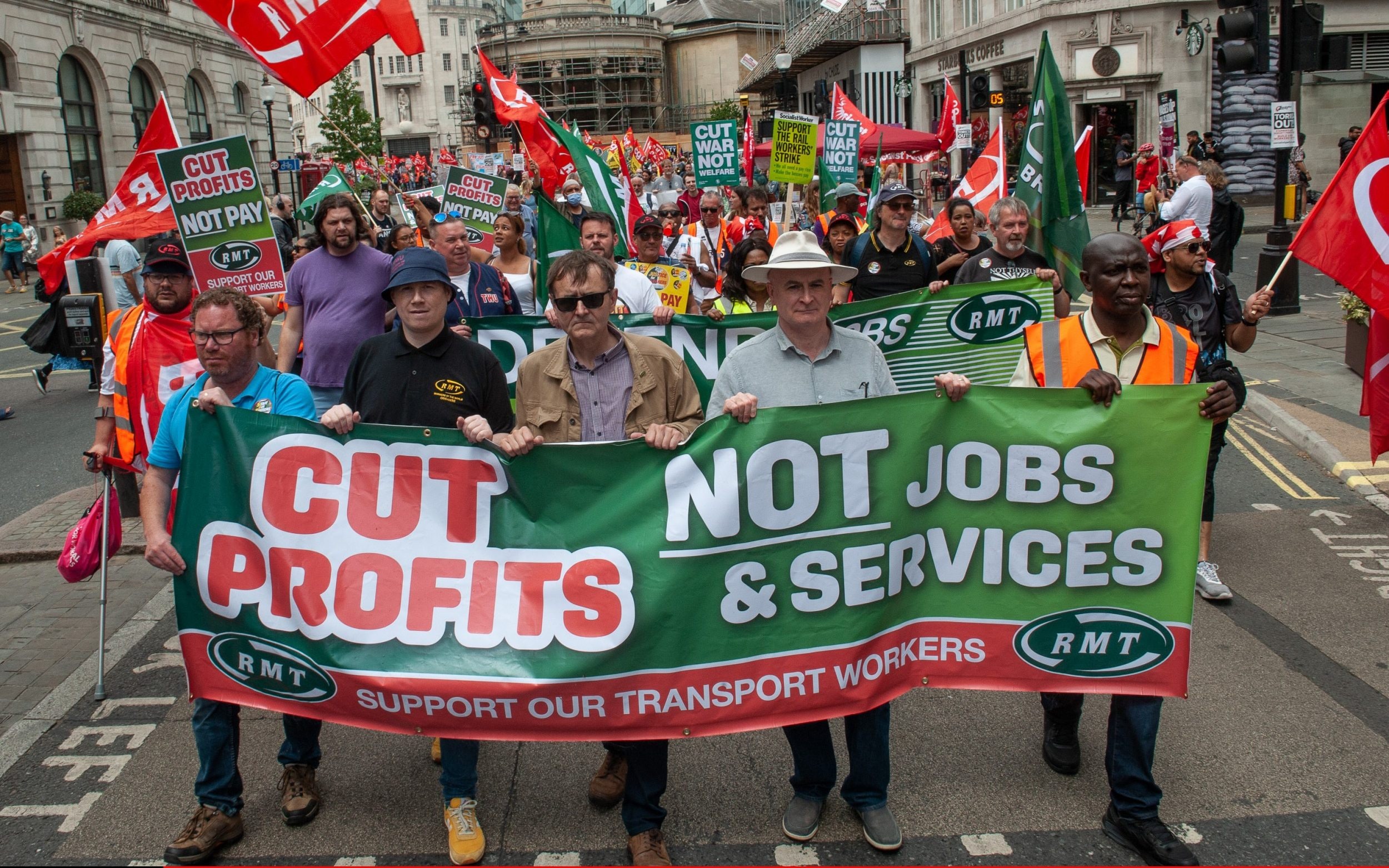
The "Britain Is Broken" demonstration is taking place today, Saturday, November 5. The demonstration will involve working people from unions, community groups, charities and other organisations with a common aim of demanding an end to austerity, supporting the rights of all, including workers and their unions taking strike action in defence of their members' pay, terms and conditions, and calling for an end to this present government which has neither credibility nor legitimacy. This is a movement in which working people from all walks of life are participating, and confirms that the way forward for the working class and people's movements lies in the fight for the rights of all.
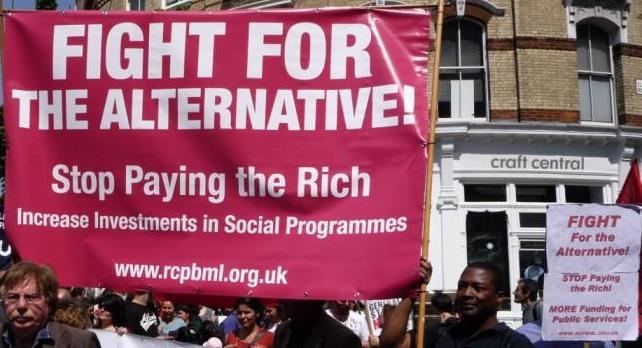
The demonstration comes at a time, not only when the workers' movement is
finding its voice and taking action to demand Enough is Enough! but when
there is widespread anger about the determination of the ruling elite to
perpetuate the old crisis-ridden constitutional order, when something new is
required and is the order of the day. A new constitutional order must be fought
for, based on sovereignty being vested in the people, which is to say that
arrangements must be brought into being so that people themselves are empowered
to speak and act in their own name, and crucially make the decisions which
affect their lives and how society is run. It is a time to do away with the old
governmental arrangements which no longer function and are causing such damage
to working people and to society as a whole. The
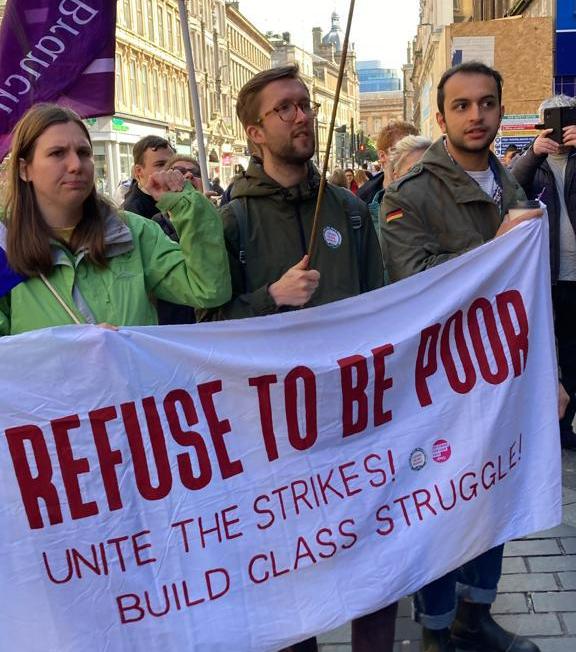 governance of
the rich for the rich and their global narrow private interests must be fought
and brought to an end. The working class have a crucial role in this and can
and must play its part in continuing its resistance, developing its own
political line, programme and vantage point, and leading society out of this
crisis of the worn-out capitalist system.
governance of
the rich for the rich and their global narrow private interests must be fought
and brought to an end. The working class have a crucial role in this and can
and must play its part in continuing its resistance, developing its own
political line, programme and vantage point, and leading society out of this
crisis of the worn-out capitalist system.
The old constitutional order is characterised by the obscene wealth measured in hundreds of millions of the present Prime Minister and King Charles III. At the same time, the plight of the ordinary people is characterised by the soaring cost of living on items such as energy, rent, mortgage payments, housing and food and necessities, costs which are rising on a daily basis. Meanwhile private interests are causing the breakdown of social programmes such as health and education. This is going hand-in-hand with an unsustainable budget for war production and escalating military spending, which besides being dehumanising and destructive, is a major factor in despoiling the natural environment, and furthermore is creating a very dangerous situation of the prospect of a nuclear war globally.
The demands being put forward by today's demonstration are just. They reflect that working people are laying the claims for an economy and political system in which human beings are put at the centre of considerations. Root and branch reforms are required. The working class and people must lay claim to political power that at present lies with vested private interests, which the political arrangements perpetuate no matter what party forms the government. The people themselves must keep the initiative in their own hands and themselves constitute the force for peace and for a cohesive society which provides stable working and living conditions, and for a new world order based on the peoples' right to be and their concerns, with an outlook of proletarian internationalism.
The way forward lies in the fight for the rights of all!
"Britain Is Broken" The Way Forward Lies in the Fight for the Rights of All - as a PDF
RMT Press Release, November 4, 2022
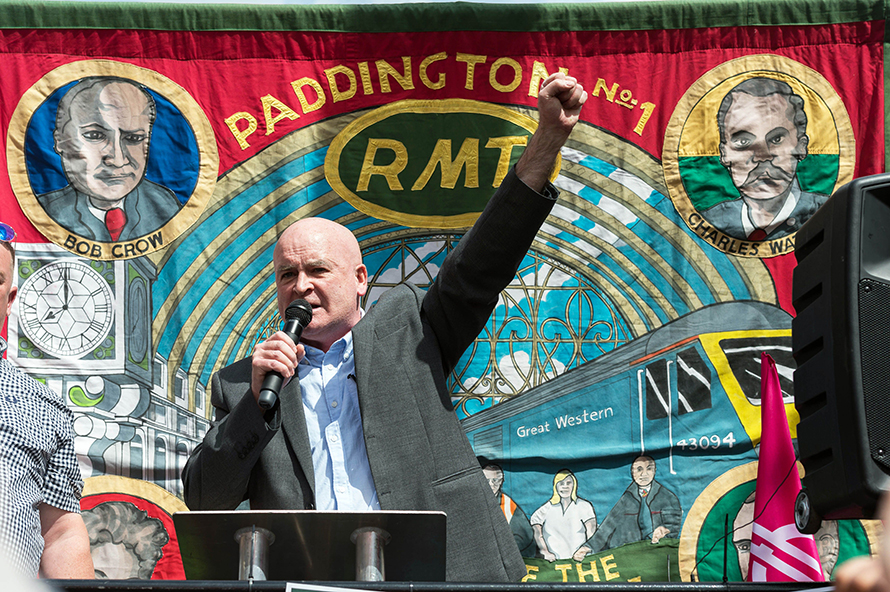
Mick Lynch, General Secretary of the RMT
Rail union RMT has suspended planned strikes on November 5, 7 and 9 and will now enter into a period of intensive negotiations with Network Rail and the train operating companies.
Through a strong industrial campaign so far, RMT has secured unconditional talks on Network Rail and the promise of an offer from the train operating companies who, up until this point, have made no offer of any kind to our members. Originally Network Rail had declared discussions and consultations closed and was intent on imposing changes to maintenance without agreement with RMT. They have now rowed back and will continue discussions on the basis that "nothing is agreed until everything is agreed". This takes away the reason for the current phase of action and means talks can continue without pre-conditions unilaterally set down by the company.
The current dispute remains very much live, and the union is continuing its re-ballot of members to secure a fresh mandate for action with the result due on November 15.
RMT general secretary Mick Lynch said: "The threat of strike action and our strongly supported industrial campaign has made the rail employers see sense. We have always wanted to secure a negotiated settlement and that is what we will continue to push for in this next phase of intensive talks. Our priority is our members, and we are working towards securing a deal on job security, a decent pay rise and good working conditions. Our re-ballot remains live and if we have to take strike action during the next six months to secure a deal, we will."
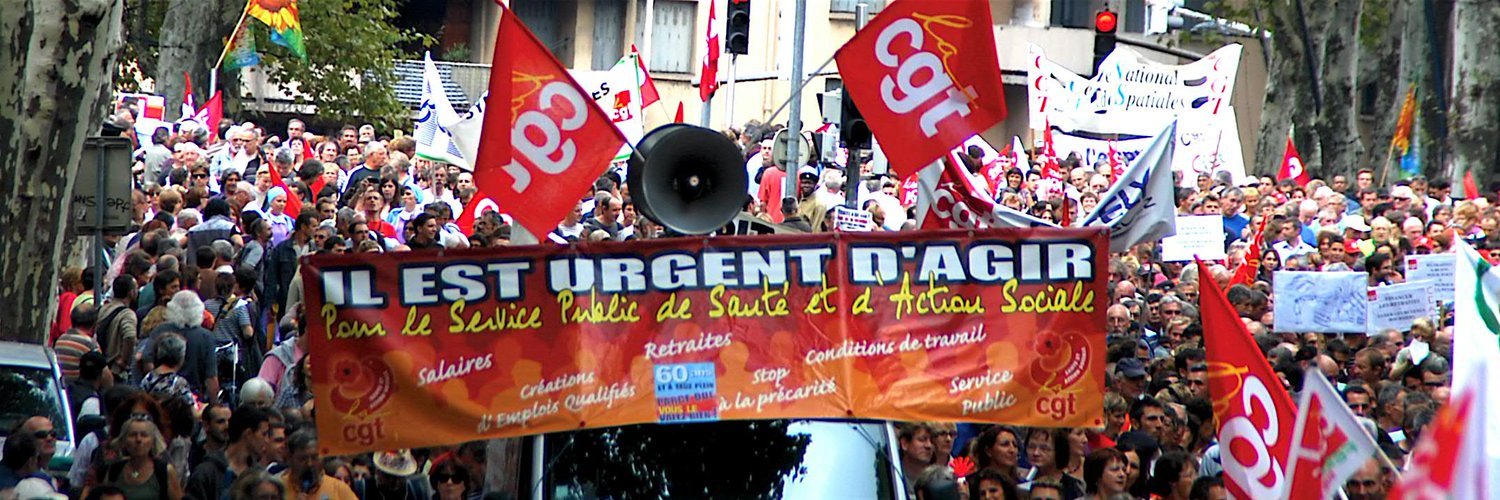
Massive strikes have been ongoing all year. Photo shows
health care workers strike in June organised by the CGT.
Refinery workers across France have been striking since the end of September in an action that has spearheaded generalised strikes in other sectors. In the context of a deepening political and economic crisis in France and across Europe including Britain, it has become part of a growing movement for a change in the direction of the economy that has crystallised around the critical matters of energy prices and the cost of living.
Beginning with a walkout by workers at TotalEnergies and Esso-ExxonMobil over pay, it grew to become what has been described as the largest and most significant wave of action in France since the "yellow vest" movement in 2018. By early October, it was being reported that almost a third of petrol stations were short of fuel. On October 11, the French government threatened to break the refinery strike. Workers immediately voted to continue action, defying the police powers, by which time six out of seven refineries had stopped production, according to reports. Police began to use their powers against strikers, such as by issuing requisition orders [1].
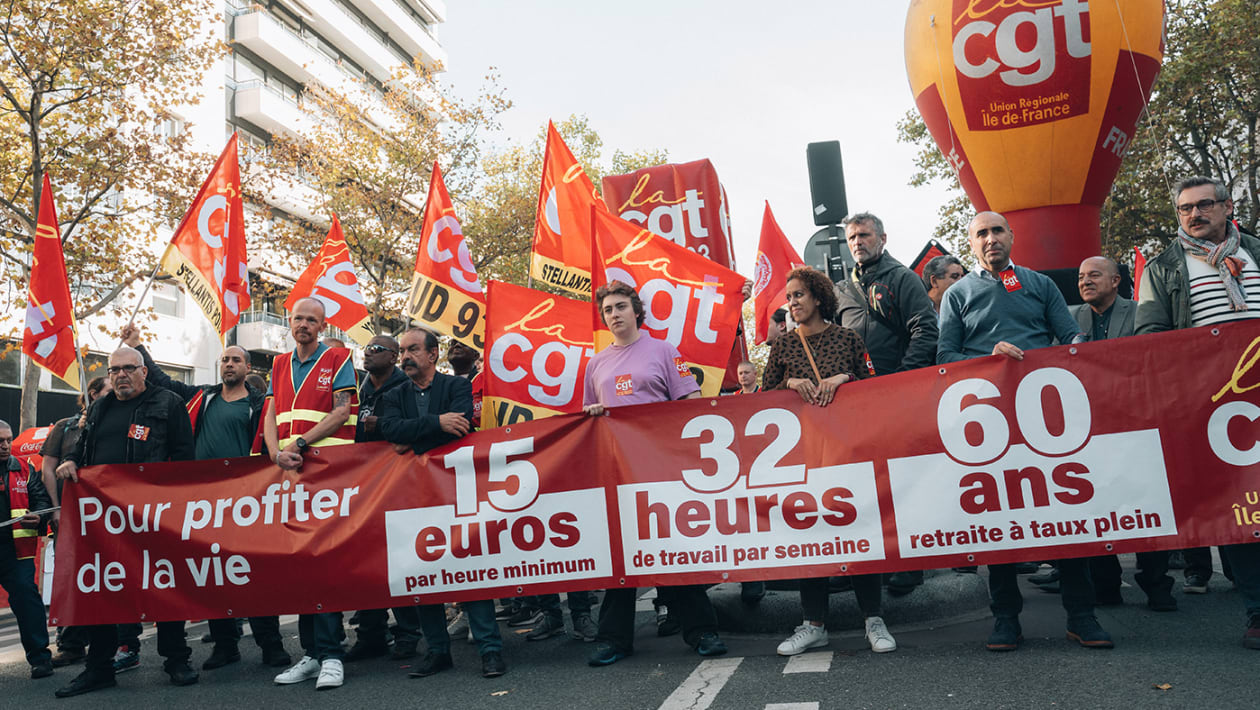
Mass demonstrations were held on October 16, with a 140,000-strong rally in Paris, two days before a national transport strike over levels of pay, pointing to the cost-of-living crisis that is affecting people in France similarly to here in Britain. It is reported that youth and student contingents in particular showed their opposition to the government's pro-war and anti-social policy. The following day, the government ordered further refinery strikers to return to work on the eve of the transport strike, which began on October 18. Strikes had already spilled over into other parts of the energy sector, reported Reuters, while civil service workers threatened action.
At the time of writing, while most refinery action has now ended, workers at the Feyzin refinery remain on strike.
Back in May, French President Emanuel Macron had managed to win a new term as president. Just one month later, he and his Prime Minister Elisabeth Borne lost their parliamentary majority, and have since been governing precariously. Borne survived two confidence votes in the National Assembly on October 24, but by a very small margin of just 50 votes. This has been accompanied by a wave of opposition to the economic and social crisis.
What seems to be clear is that, just as in Britain and elsewhere, the cartel party system in France is failing to keep a lid on the contradictions in that country within the ruling circles and amongst the various powerful private interests they represent, and between this elite and the majority of the population. The lack of any consensus is rendering parliament inoperative to the extent that Macron and Borne are resorting to open rule by police powers and exceptional measures. On October 19, Macron and Borne activated Article 49.3 of the French constitution to force the state revenues part of their 2023 budget through parliament without a vote after failing to win parliamentary approval, prompting the confidence motions. It is expected that they will repeatedly use this mechanism to push through further legislation over the next few weeks.
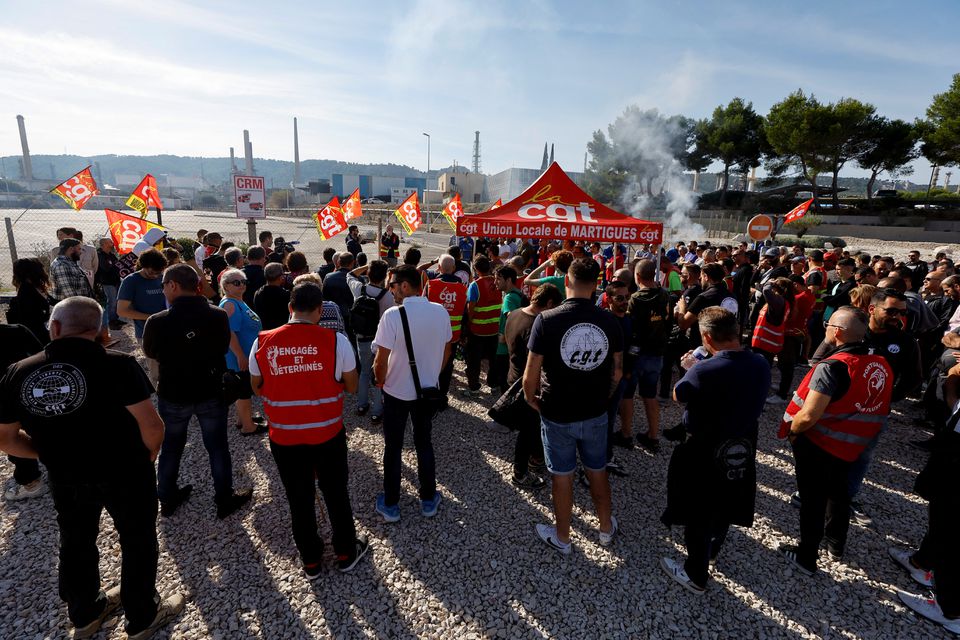
Total Energies and Esso Exxon Mobil workers' protest
outside Total Energies refinery in La Mede, France October 11, 2022: Photo:
REUTERS/Eric Gaillard
It is amid this crisis in governance and of the legitimacy of authority that the strikes have been taking place. The response of the government, which has only deepened this crisis further, has been to arbitrate on the side of the energy oligarchs by forcing strikers back to work.
At the same time, in the developing movement that is at one with the strike struggle, people are challenging the military direction that Macron's government has been taking France (announcing on October 13, for example, an increased French military presence in Eastern Europe). Meanwhile, France has been leading the establishment, on October 6, of the European Political Community, within which Britain has been playing its warmongering role while taking a stance of being an ally of France, to bolster France at this time. An overtly political visit by King Charles, his first international visit as monarch, is currently being organised in this context, in the midst of this political and economic crisis.
What is happening in France, where workers are demanding a say, demanding their rights, laying their claims on society, and in so doing challenging the authority of the French government, is part of a generalised crisis of governance in the big powers of Europe, including Britain.
The common demand of the people of Britain, France and elsewhere in Europe is for the economy to be directed to meeting the needs of the people, which means that working people have first claim on the social wealth, on the fruits of their work. The common demand is for an end to illegitimate governments that block people from any say over matters that affect their lives. The need for political power is posing itself ever more sharply on the working class across the continent, so as to set a new direction for the economy and bring the productive forces under their own control.
(Sources: AFP, EURACTIV.fr, France 24, Limited Times, MSN, Politico.eu, Reuters, WSWS)
Notes
1. For example, see: "Factbox: How France is forcing striking fuel staff
back to work", Reuters, October 12, 2022
https://www.reuters.com/markets/europe/how-france-is-forcing-striking-fuel-staff-back-work-2022-10-12
Such requisition orders are being considered for introduction in Britain as
part of new anti-strike legislation.
Receive Workers'
Weekly E-mail Edition: It
is free to subscribe to the e-mail edition
We encourage all those who support the work of RCPB(ML) to also support it
financially:
Donate to
RCPB(ML)
Workers' Weekly is the weekly on
line newspaper of the
Revolutionary Communist Party of Britain (Marxist-Leninist)
Website:
http://www.rcpbml.org.uk
E-mail:
office@rcpbml.org.uk
170, Wandsworth Road, London, SW8 2LA.
Phone: 020 7627 0599:
