
|
|
||||
|---|---|---|---|---|
| Volume 56 Number 30, October 17, 2026 | ARCHIVE | HOME | JBCENTRE | SUBSCRIBE |
Workers' Weekly Internet Edition: Article Index :
International News of Concern:
French School Students Fight for the Right to EducationGlobal Day of Action for Palestine:
Around the World, the Peoples Are Standing With PalestineIn the News:
Iranian Foreign Ministry Condemns British Government's Claim of Iranian Involvement in RAF Fairford Incident
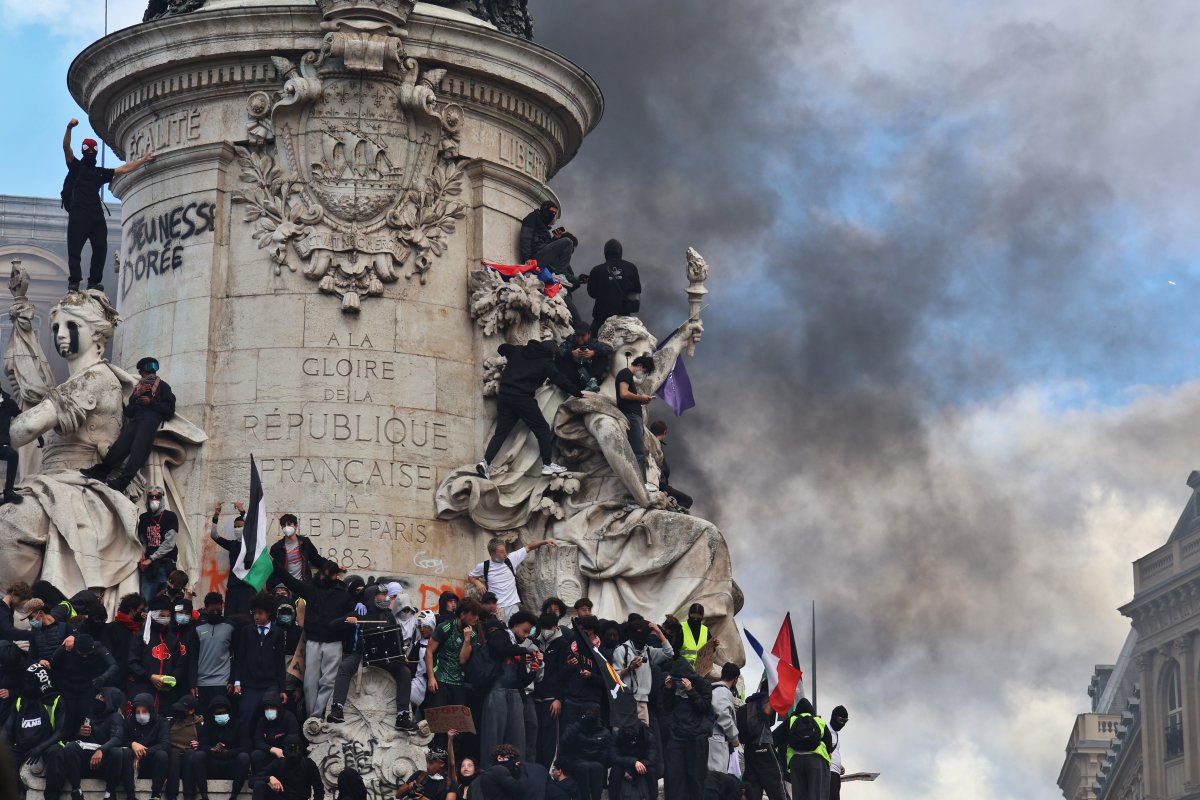
Paris, October 17 2026
French high school students have brought the crisis in education into the streets. Since mid-September, blockades, strikes, demonstrations and assemblies have spread from the Paris suburbs across the country. Students are demanding teachers, decent buildings, manageable timetables and equality between schools. The government has answered with limited concessions and a major police operation. University students, education workers, parents and trade unionists have joined the movement.
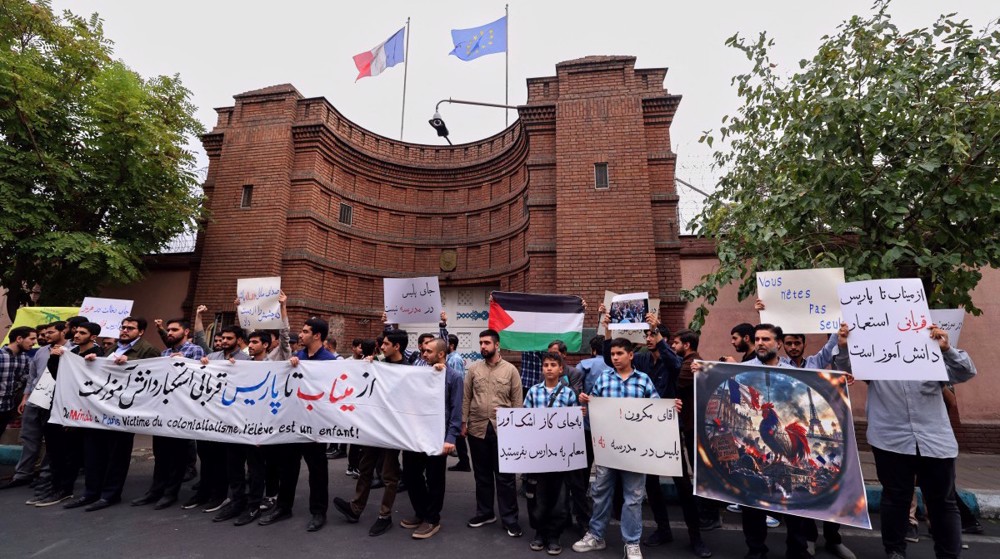
Tehran protests against French police
actions
The protests began at a lycée in Créteil, south-east of Paris, over unfilled posts and teacher shortages. Actions soon spread through the Paris region and then to Lille, Rennes, Nantes, Lyon, Marseille, Bordeaux, Strasbourg and many smaller towns.
Students report classes of 32 to 35, teachers absent without replacement, days lasting from 8 am until 6 pm and buildings with leaking roofs, mould and broken furniture. Their slogans include "Education is a right, not a privilege" and "More hours of lessons than sleep". They also demand changes to Parcoursup, the higher-education admissions system which they say reproduces inequalities.
Official figures show the breadth of the action. On October 1, the Interior Ministry said that 1,027 of France's 3,700 lycées had been affected. On October 6, classes were wholly or partly suspended in 891 schools. The Interior Ministry counted 266,000 demonstrators across France, while the organisers reported 450,000.
Nationwide marches, strikes and school blockades continued on October 13 in what students called "Act V" of their movement [1]. Greta Thunberg joined students at the Lycée Paul-Eluard in Saint-Denis, as pupils said they would maintain the movement until the government answers their demands.
The police response has included batons, tear gas, rubber-bullet launchers, stun grenades and thousands of arrests or detentions. A 15-year-old student in Lens lost a hand when an EF-SON grenade exploded during a school blockade on October 5. On October 7, Interior Minister Laurent Nuñez announced the temporary suspension of the weapon's use during the student protests and said that 18 investigations had been assigned to the police inspectorate. France's National Consultative Commission on Human Rights has warned against using violence at the edge of demonstrations to justify repression of the movement as a whole.
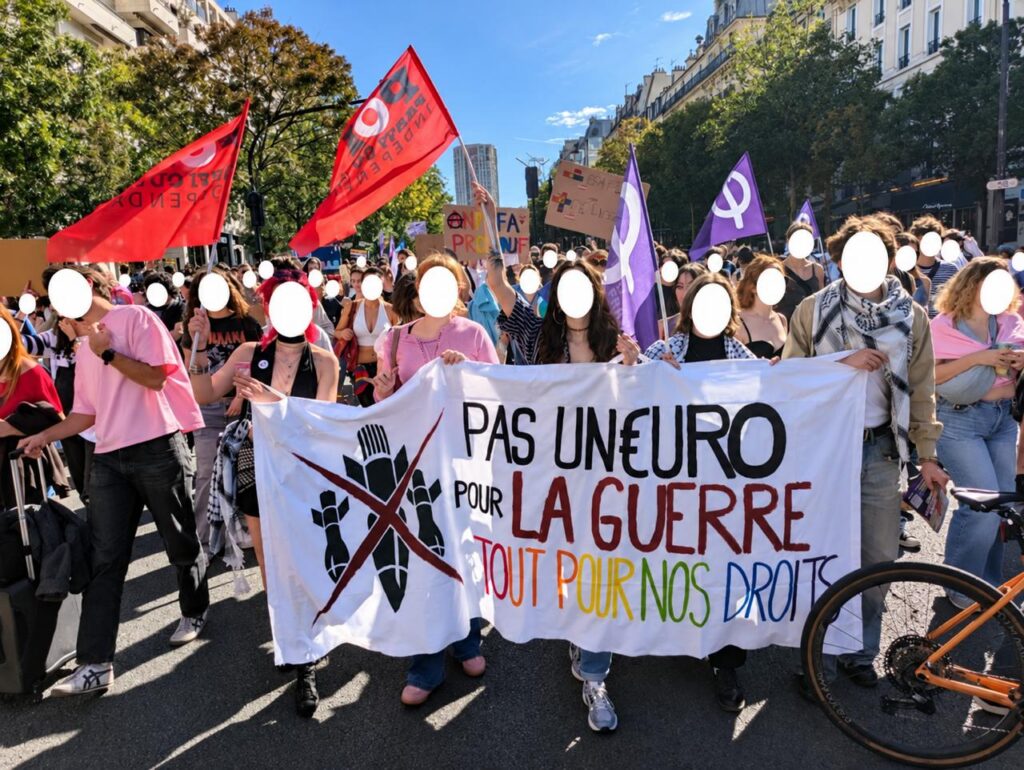
Not a euro for war, all for our rights - French student
actions
Some incidents have involved damage to schools and attacks on staff. Student organisations have called for peaceful action and separated their movement from those acts. Parents, trade unionists, human-rights campaigners and elected representatives have formed human chains between students and police at several schools.
Prime Minister Sébastien Lecornu has acknowledged that the students' anger is real, while Education Minister Édouard Geffray has announced the deployment of 3,000 replacement teachers. The ministry classified 114 lycées as "red" for unfilled posts, although it has not shown that the subjects taught by available replacements match those in which teachers are missing. A national consultation is running until October 23. Student organisations have advanced ten emergency measures which they estimate require 10 billion euros and are continuing the protests while they await concrete results.
Starting from their real-life experience, young people are developing forms of organisation and learning to act in their own name in this movement to defend the right to education. At Rosa-Parks lycée in Saint-Denis, 42 class delegates representing 1,150 students met to formulate demands, organise speaking turns and vote on whether journalists could attend. Students elsewhere have discussed electing delegates from every department.
The protests developed alongside opposition to the proposed 2027 budget and to deteriorating public services. The French General Confederation of Labour (Confédération Générale du Travail) reports that more than 300,000 public servants, firefighters and others demonstrated on September 29, joined by many school students. Public-sector unions oppose planned cuts and a further pay freeze. The fight over schools is therefore part of a wider struggle over the direction of the economy and safeguarding the future of social programmes [2].
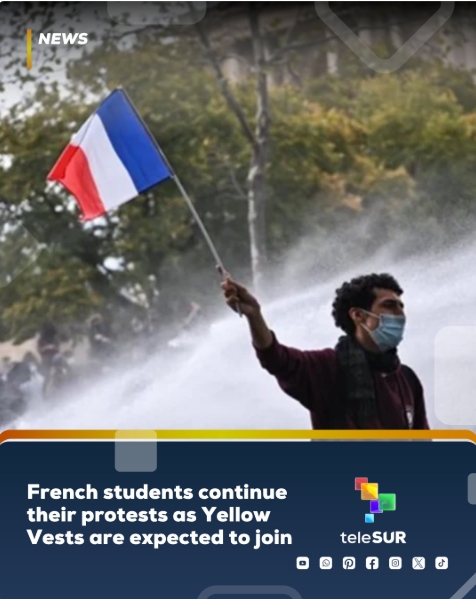
As the autumn school holiday approached, high school organisers appealed to university students and Yellow Vest activists to take up the torch. The Yellow Vest movement began in November 2018 against a fuel-tax rise and drew rank-and-file workers, the rural poor, unemployed people and students into countrywide actions centred on roads and roundabouts. Its demands broadened to tax justice, social provision and an end to the neo-liberal austerity agenda. The government withdrew the tax rise, yet the movement continued. The present students' assemblies and local co-ordination carry forward the initiative of people organising themselves and keeping control in the hands of participants [3].
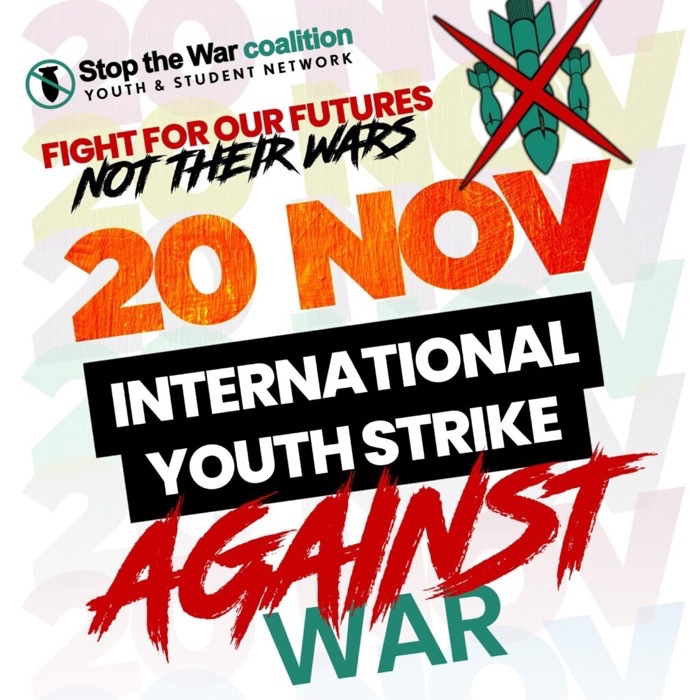
Education protests have also appeared in Belgium and Italy, and school students in Germany have called for an international youth strike on November 20 in solidarity with France. French students have made connections with youth movements in Morocco and India.
In Morocco, the Gen Z 212 movement began nationwide protests in September 2025 after eight women died while giving birth at a public hospital in Agadir. It demanded priority for health care and education and condemned spending on stadiums for the 2030 football World Cup. Amnesty International reported credible accounts that at least three protesters had been killed, dozens injured and more than 400 arrested during the crackdown.
In India, the "Cockroach" youth movement opposes a revision of electoral rolls which protesters say threatens mass disenfranchisement. Ahead of an October 10 demonstration in New Delhi, the authorities closed roads and Metro stations, cancelled trains and detained thousands of people. The movement brings together young people who identify with no party as well as student, trade union, left and opposition organisations. Protesters say that private discussions among friends and families and exchanges on social media have become collective action around the right to vote and against the criminalisation of dissent.
November 20 is now emerging as a point of convergence. German school students have called for an international strike in solidarity with the French movement. The international anti-war movement has designated November 20-22 for globally co-ordinated action against militarism and conscription, beginning with a Youth Strike on the Friday [4].
Britain faces its own connected crisis in education and other social programmes while the government pours resources into militarisation and war. Youth and students, together with the working class and people, have a crucial role in giving the united front against war and in defence of the rights of all direction as it grows from people's struggles and their work to unite around claims they themselves advance. Bringing together the struggles of youth, students, education workers and communities with the movement against war establishes the demand that the economy serve social need and that all people, young or otherwise, have the right to education, health care, housing and a future of peace. Through this work, working people can constitute themselves as the authority and open a path for society.
(Sources: Associated Press, Le Monde, Al Jazeera, The Guardian, TF1 Info, Euronews, Le HuffPost, CNCDH, French Ministry of National Education, Amnesty International, Hindustan Times)
Notes
1. The five numbered national days of action were: "Act I" on
September 29, called alongside the public-sector mobilisation; "Act
II" on October 1, when more than 900 actions and blockades were recorded;
"Act III" on October 6, when between 266,000 and 450,000 people
demonstrated; "Act IV" on October 8, when the Interior Ministry
counted 71,500 demonstrators; and "Act V" on October 13, when
estimates ranged from 161,500 to 480,000.
2. "Services publics: face à la colère, le gouvernement doit
revoir sa copie", CGT, September 30, 2026.
https://www.cgt.fr/actualites/france/services-publics/services-publics-face-la-colere-le-gouvernement-doit-revoir-sa-copie
3. "'Yellow Vest' Movement in France Escalates: Working People Protest
against Neo-Liberal Austerity Agenda", Workers' Weekly, December 15,
2018.
https://www.rcpbml.org.uk/wwie-18/ww18-24/ww18-24-09.htm
4. "All Out to Build the United Front against War and in Defence of the
Rights of All!", Workers' Weekly, August 29, 2026.
https://www.rcpbml.org.uk/wwie-26/ww26-25/ww26-25-04.htm
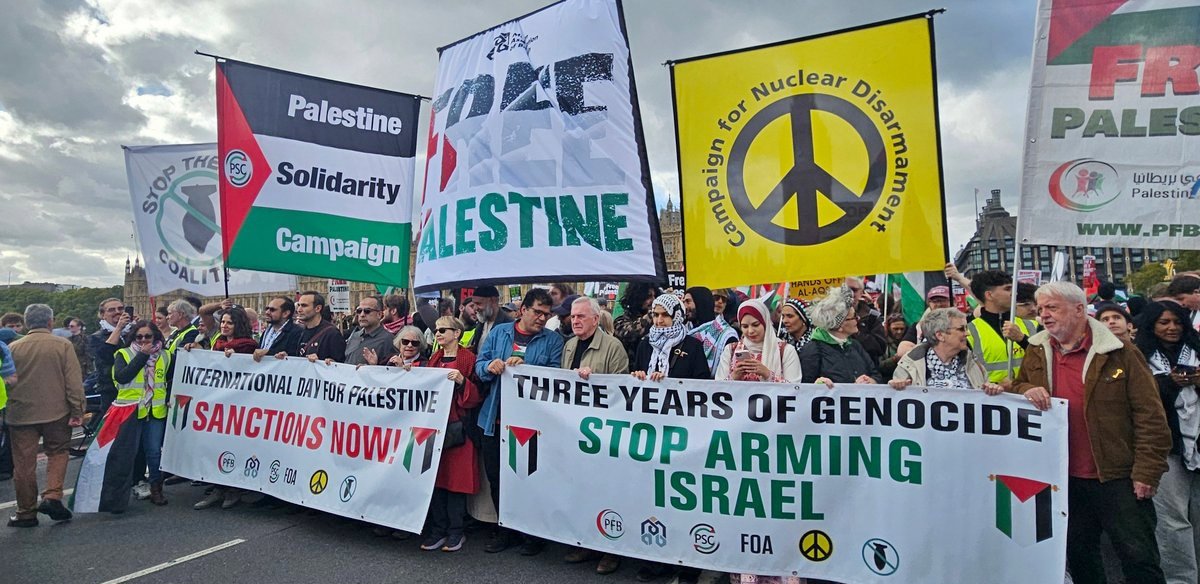
London, October 10 2026
Around the world, from October 3-11, millions of people participated in actions to mark the third anniversary of the Palestinian Resistance's Operation Al Aqsa Flood. With their actions the world's peoples called for an end to the US/Israeli genocide against Palestinians and an end to the occupation and the complete liberation of Palestine.
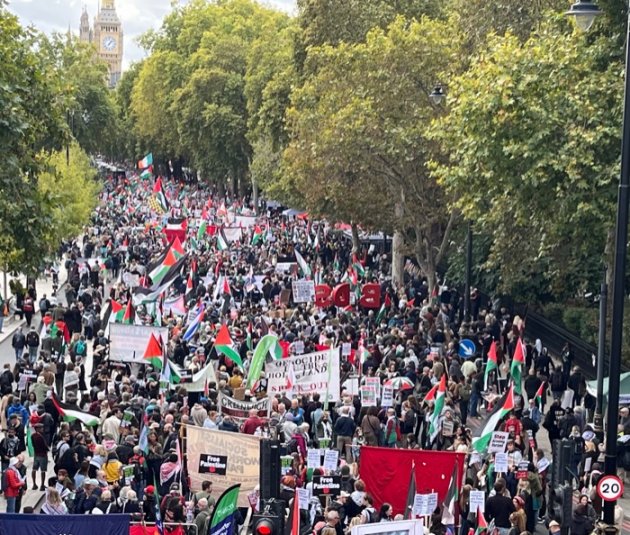
London, October 10 2026
In London on October 10 over 200,000 took to the streets, in the 37th national march called by the Palestine Coalition. They demanded that the government stop supplying arms to Israel and expressed solidarity with the struggle of the Palestinian people for an end to the occupation. Thousands also rallied in Edinburgh and in Dublin.
Marches and demonstrations were held across Europe - in over 50 cities in Italy including Rome, Milan, Turin, Naples and Bologna, in a number of cities in Germany including Berlin, in Zurich, Switzerland, Amsterdam, Netherlands and Athens, Greece. In Spain actions took place in over 40 cities and towns. In Paris where the students have been in action defending their rights the protest organised by Urgence Palestine collective was banned, but students found ways to make their stand in support of Palestine known. There were events in Eastern Europe and the Balkans, including a march in Warsaw, Poland, that ended in front of the US Embassy.
Many rallies and marches took place across the US and Canada. There were also actions in Mexico and in many countries in Latin America including Argentina, Brazil, Chile, Ecuador, Peru and Venezuela. In Colombia, hundreds of people, many of them university students, rallied in Bogotá opposing Colombia's new right-wing government's support for Israel.
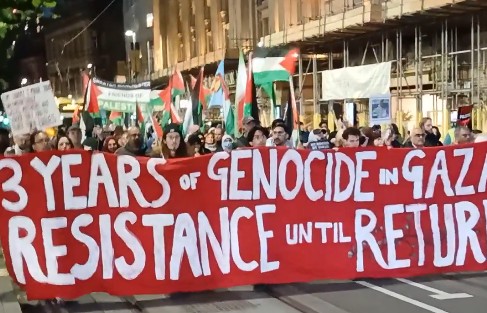
Manchester
In west Asia there were massive demonstrations in many cities in Yemen, including a million person march on October 9 in Sana'a, in solidarity with the people of Palestine and to announce a general mobilisation against Saudi attacks on the Yemeni resistance. In Morocco there were over 30 actions. As well there were marches in Istanbul and other cities in Türkiye and Karachi, Pakistan.
In Seoul, South Korea, there were several actions starting on October 3 and culminating on October 11 with protests near the US and Israeli embassies. In Tokyo, Japan, there were actions during the week including a demonstration on October 7 under the banner Stop Israel's Ethnic Cleansing of Palestine!
Large marches took place on both October 7 and 10 in Cape Town, South Africa. In Oceania there were marches and rallies across Australia and in New Zealand.
In addition to the rallies and marches, community, cultural and educational programmes took place from film screenings in Nigeria and commemorative vigils in the Democratic Republic of the Congo to student-led educational activities in Trinidad and Tobago, to days of action in Kuala Lumpur.
With these actions the world's peoples have reaffirmed that In Our Millions, in Our Billions, We Are All Palestinians!
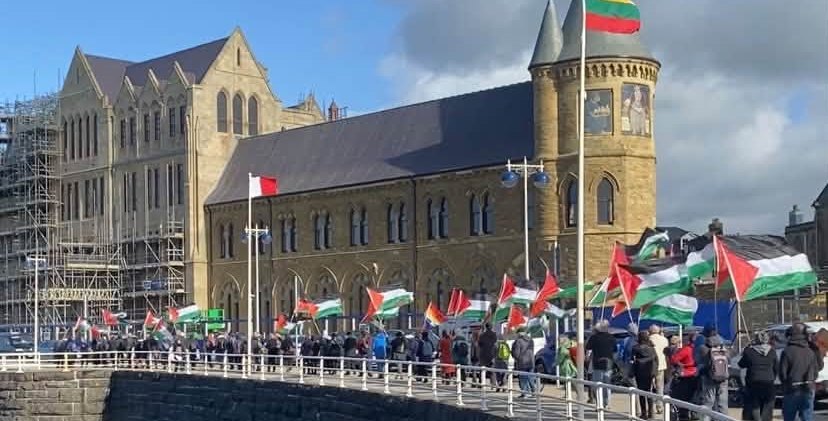
Aberystwyth, Wales
.jpeg)
London
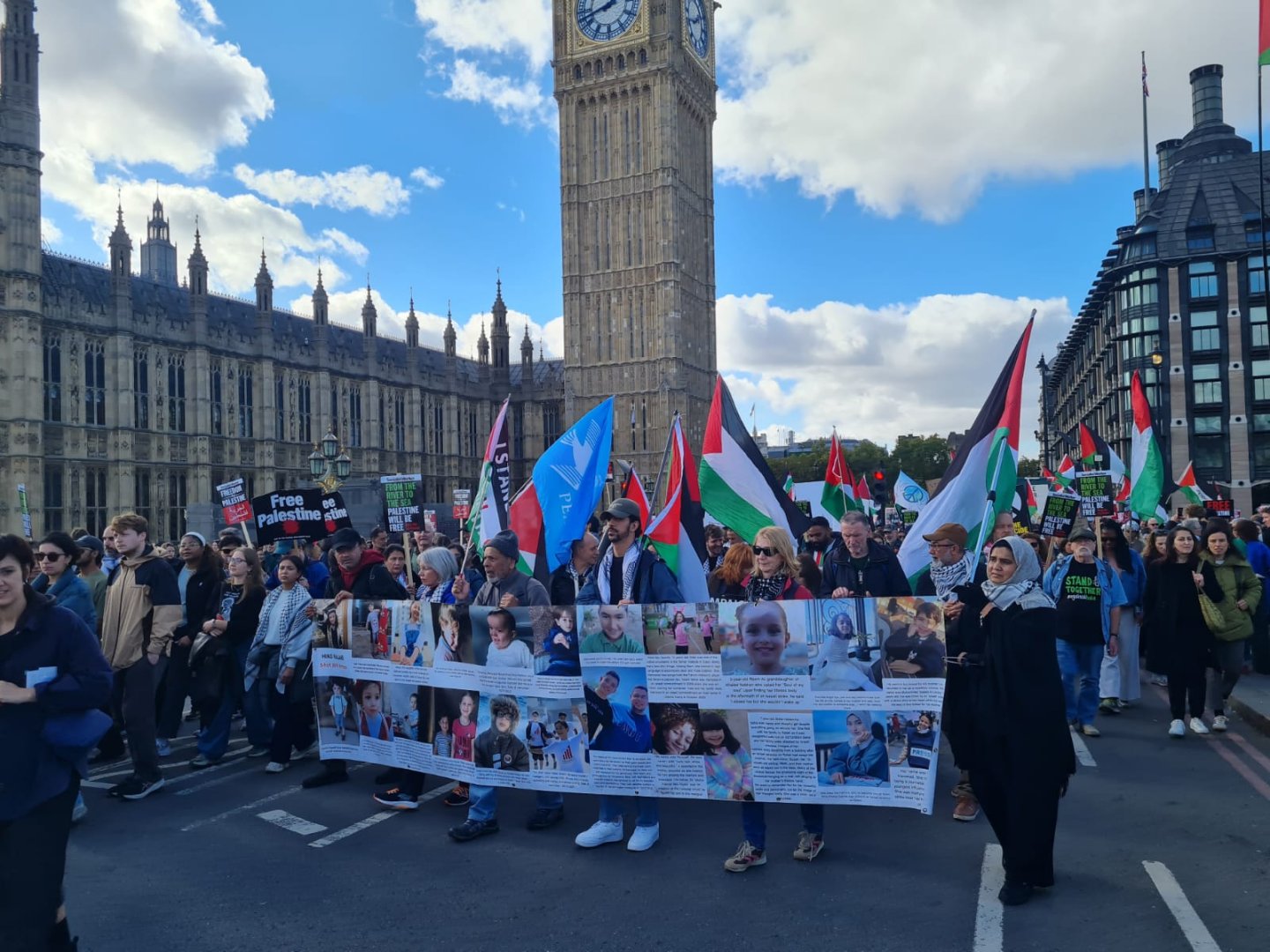
Newcastle PSC/StW and South Tyneside StW in London,
October 10
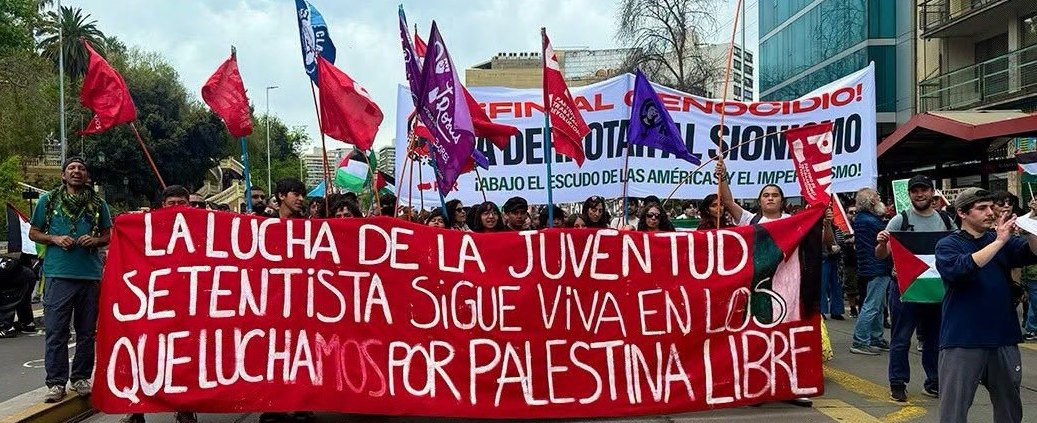
Santiago, Chile
.jpeg)
The Cradle, October 13, 2026
The Iranian Foreign Ministry strongly condemned claims by the British Prime Minister that Tehran was behind an alleged terror plot at the RAF Fairford Base, saying this is a "false-flag" scheme to push an "anti-Iran agenda".
"The British government cannot evade its political and legal responsibility for its claims and their potential consequences by hiding behind ambiguous language without providing solid evidence and substantiated reasons," the ministry stated.
The statement said London is leaning on phrases such as "highly likely" and "almost certainly" to make pinning the incident on Iran look convincing, in a transparent bid to avoid answering for groundless charges.
The ministry added that Britain has a known history of manufacturing security allegations against other states, some of which have fuelled destructive tensions in West Asia, and that London must answer for its persistent attempts at undermining international peace and security.
Tehran rejected the "baseless accusations" against it, saying the British government, along with those who devised and carried out the false-flag operation, will bear the consequences.
The Iranian response follows Andy Burnham's claim to Parliament that Iran's Islamic Revolutionary Guard Corps (IRGC) was "almost certainly" behind the suspected plot, as London slapped sanctions on two Iranian nationals over alleged "hostile activity".
"We will not tolerate these threats on our soil," Burnham said, vowing to go after Iran's use of criminal networks and the money behind them, and to roll out further sanctions.
London has yet to publicly produce any conclusive proof of Iranian involvement.
On September 30, Iranian Foreign Minister Abbas Araghchi told Burnham that he was "barking up the wrong tree", after the British PM cited "strong indications" of an Iranian role in a BBC interview without offering a shred of evidence, saying only that more would be revealed later.
The case dates back to September 27, when police arrested five British men near the base in the early hours on suspicion of terrorism and explosives offences, following reports of masked figures clustered around three white vans nearby.
A bomb disposal robot was sent in, and more than 85 nearby homes were evacuated, yet police found no explosives in the vans, only an unspecified amount of gasoline.
All five men were later freed on bail, a decision Burnham defended and US President Donald Trump publicly questioned.
Receive Workers'
Weekly E-mail Edition: It is free to
subscribe to the e-mail edition
We encourage all those who support the work of RCPB(ML) to also support it
financially:
Donate to
RCPB(ML)
Workers' Weekly is the weekly on
line newspaper of the
Revolutionary Communist Party of Britain (Marxist-Leninist)
Website:
http://www.rcpbml.org.uk
E-mail:
office@rcpbml.org.uk
170, Wandsworth Road, London, SW8 2LA.
Phone: 020 7627 0599:
