
|
|
||||
|---|---|---|---|---|
| Volume 56 Number 28, October 3, 2026 | ARCHIVE | HOME | JBCENTRE | SUBSCRIBE |
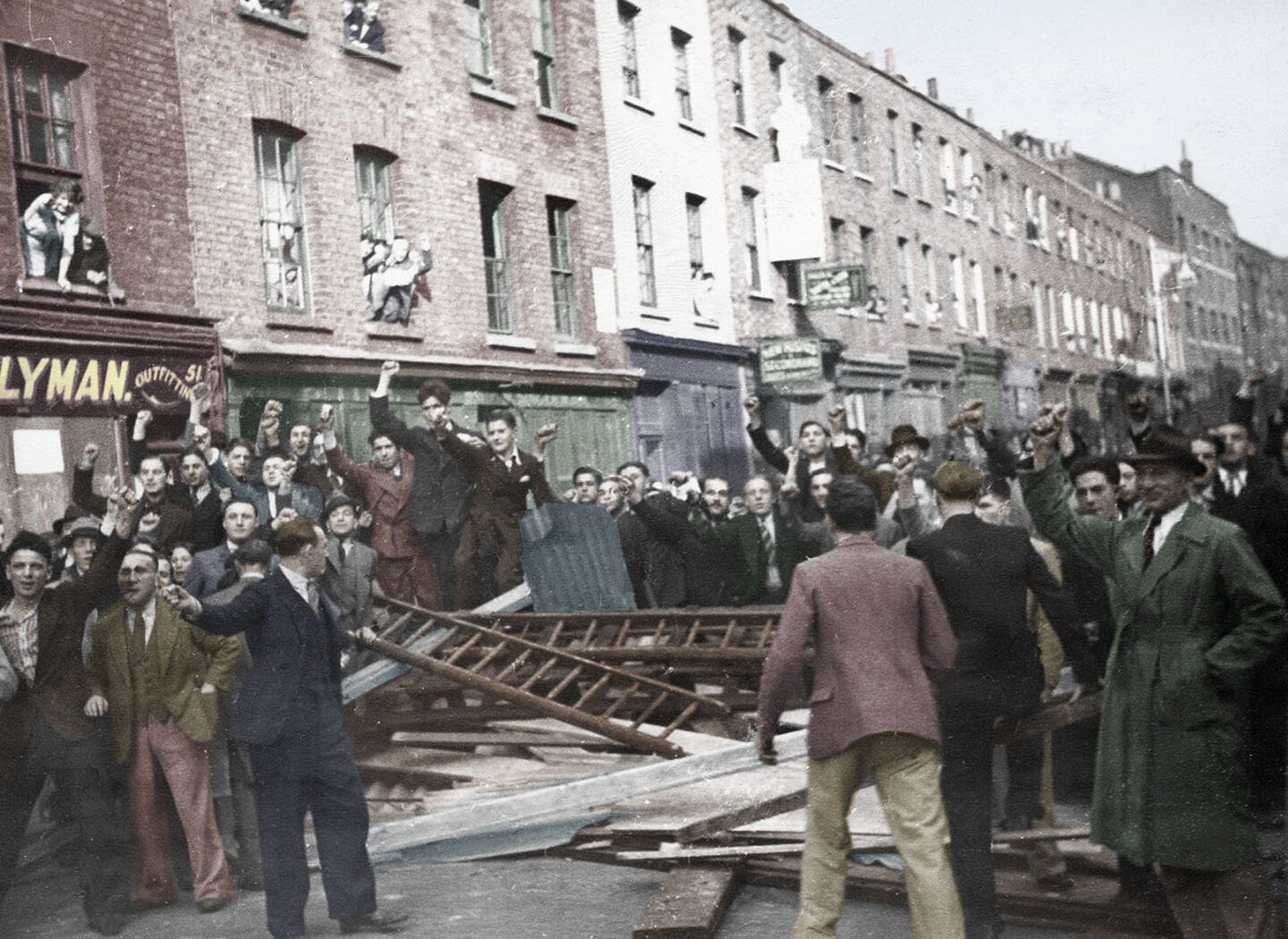
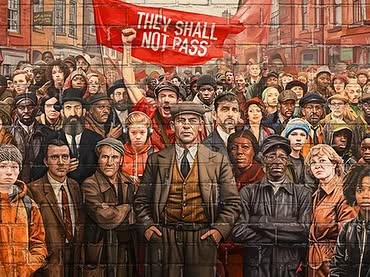
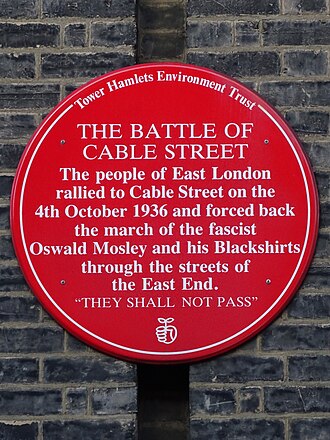
October 4 marks the ninetieth anniversary of the famous Battle of Cable Street in 1936. In this battle thousands of people organised themselves to prevent Oswald Mosley's "British Union of Fascists" from provocatively marching through East London, an area in which it was attempting to threaten violence and carry out racist attacks against the local Jewish population and emulating the pogrom and attacks that Hitler was carrying out in Germany against Jews, communists and other progressive forces. Those who took a stand at Cable Street in 1936 were working people from East London with differing religious and political allegiances, women, men and their youth who, led by the Communists, united in action to oppose racism and fascism and rallied and built the barricades under the militant slogan of the day "they shall not pass". This was also the call of the communist and democratic forces against the fascists in Spain ¡No Pasarán!
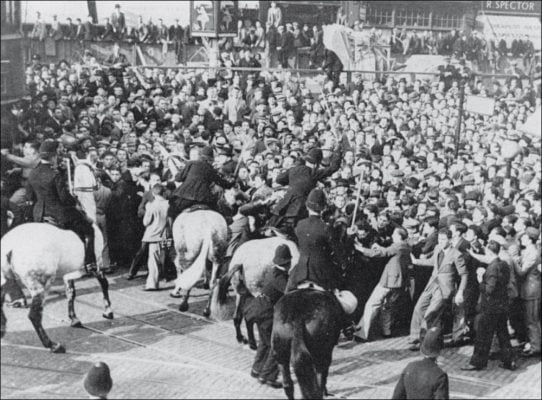
On October 4, 1936, a Sunday, 3,000 fascists gathered close to the Tower of London, with 7,000 police as protection. The fascists intended to march into Whitechapel. But a huge crowd of East Enders and anti-fascists had gathered to stop them, possibly as many as 100,000 although figures vary. Barriers were built from mattresses, corrugated iron and furniture by men, women and children on Cable Street and further north, at the junction of Leman Street and Commercial Road. A tram driver is said to have abandoned his tram in the middle of the road to help block the march. The police attempted to clear the barriers, and on horseback charged the protesters blocking the route. But they were pelted with missiles. The youth, some only 11 years old, threw marbles under the horses and the police were forced back. As a result of the police action, dozens of men, women and children were hurt and 15 were sent to hospital. Around 80 anti-fascists were arrested. At least 73 police officers were injured but the police and fascists were forced to abandon their original plan, with the police telling them to head back to central London.
The Battle of Cable Street is one of the most historic examples of the attempt by the British state to instigate fascism, and unleash violence on their communities. The people of East London had defended the rights of all against this onslaught of racism and fascism on their communities. In so doing, they had taken on the forces of the state that were deployed, resisting brutal police horse charges against the crowds of people gathered to stop Mosley and his blackshirts. It is this stand, as well as the famous victory it achieved on the day, which has been rightly celebrated and commemorated ever since.
Many of those who took a stand against the promotion of racism and fascism in East London, and many other towns and cities across Britain at that time, also took a stand against the spread of fascism in Europe in Spain, Italy and Germany. It was in this period that many workers and democratic people volunteered to join the International Brigades in order to fight against the fascist coup against the Spanish Republican government. Those who organised against Mosley, who was financed by Nazi Germany and Fascist Italy as well as the rich and powerful in Britain, clearly recognised that a wider international threat existed and called on people to oppose that threat at home and abroad.
There had also been widespread protests the previous year when the fascist government of Italy had embarked on its criminal invasion of Ethiopia with the connivance of the British government. The Conservative-dominated National Government declined calls to ban the British Union of Fascists' march through East London. A petition organised by the Jewish People's Council, signed by 100,000 people, was presented to the Home Office, but Home Secretary Sir John Simon refused to prohibit the procession. This revealed that the government of the day and its state was behind the fascist violence against the East London community. However, such was the opposition from the people that in order to save the face of the government the Foreign Secretary was forced to resign from office after the resistance stopped the march.
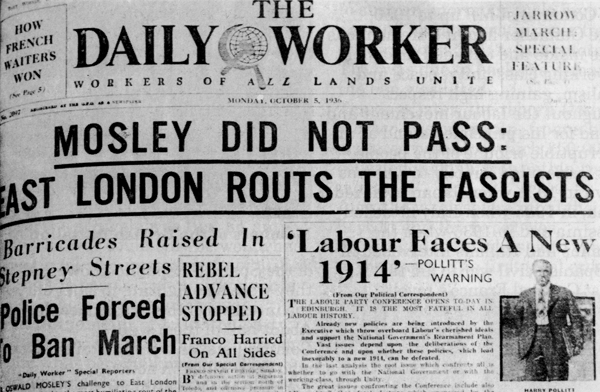
The Battle of Cable Street occurred at a time when a life and death struggle was facing humanity, a time when all democratic people had to take a stand. This resistance to fascism was crucially supported and inspired by the stand of the Soviet Union under J.V. Stalin's leadership and Georgi Dimitrov whose concluding speech before the Seventh World Congress of the Communist International (Comintern), became a battle cry against fascism in 1935 - Unity of the Working Class against Fascism. It put the international working class and their communist parties, including the Communist Party in Britain, at the centre of the proletarian front to build the popular front against fascism.
The struggles against fascism in East London, in Spain and Ethiopia, as well as elsewhere in the 1930s laid the ground for the working class and people to defeat fascism during the Second World War. The popular fronts of the working class and people supported the anti-fascist allies led by the Soviet Union both as joining the armed forces in the countries of the allies and as resistance fighters in occupied countries. This victory of the world's peoples created the conditions for the advancement of the working class and people's movement in Europe and all over the world. It contributed to the anti-colonial struggle in Africa, Asia and elsewhere, led to the emergence of people's democratic states in Europe and China and the consolidation of the building of a socialist system in the Soviet Union. It was a war in which states such as Britain, the US and others that had nurtured and financed fascism were then compelled to find common cause with the Soviet Union. When the United Nations Organisation was created at the termination of the war it enshrined in its Charter the aspirations of many to build a world in which the rights of men and women of all nations were recognised as equal, where freedom and social progress were promoted and machinery was put in place to "save succeeding generations from the scourge of war".
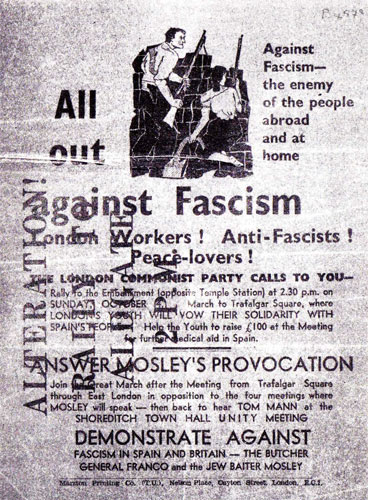
Cable Street poster
As is well known, the unity of the war-time allies did not last long and only a few months after its conclusion Britain, alongside the US and others, took up the fascist mantle shattering the peace with the Soviet Union that had sustained the anti-fascist alliance in World War II, and asserting that there are two extremes, "left" and "right", and of these the main danger comes from the "left". This was the essence of the so-called "Cold War". In 1946, Churchill gave his infamous "Iron Curtain" speech in Fulton, Missouri. This was followed in 1948 by the brutal expulsion of the Palestinian people from Palestine which became known to the Palestinians as the Nakba. The creation of the aggressive military alliance of NATO followed in 1949, and the genocidal war against the Korean people from 1950 to 1953 was perpetrated under the UN flag, where the US recruited 17 other countries, including Britain, to participate in the slaughter of more than 4 million Korean civilians until the US was forced to sign an armistice in 1953. These British and US wars across the world since were aimed at the then Soviet Union and the peoples' liberation forces. They were devastating wars against the people of Vietnam, and many countries of East and West Asia, Africa and South America.
Just in recent times, Britain with the US have armed and supported Israel in its genocidal wars against the Palestinians. Britain alongside the US and old EU powers played a leading role in the coup of 2014 in Ukraine, and the subsequent assaults on the Russian-speaking population of East Ukraine, which provoked Russia's response and Britain has since done everything to support the escalation of the war in Ukraine "to the last Ukrainian" to try and defeat Russia. All to serve the interests of British arms manufactures and other oligarchs in an attempt to "make Britain great again."
There have been attempts to revise and falsify the history of the struggle against fascism, to create confusion about the significance of the Battle of Cable Street and even World War II itself. In other words, to attempt to remove the historical context. What history has shown, time after time, is that it was the rich and their state, both in Britain and elsewhere, that nurtured and financed fascism in the 1930s and ever since have attempted to resurrect, succour and protect the organised fascists as it suits their purpose.
At the same time, it has been the role of successive governments and the state in Britain to create the conditions for racism and chauvinism with the demonisation of migrants, refugees, Asian, Irish, Muslims and other minorities; all with the promotion of so-called "British values" and the most backward views about other parts of the world which accompany attempts to realise the reactionary programme. Since the battle of Cable Street and World War II racism has remained one of the preferred policies of the ruling class and their state and is promoted and implemented to serve their interests. Racism is employed to create divisions amongst the working people, to act as diversion but also to attack one section of the people in order to attack the rights of all. It has also always been in their interests to promote the view that it is not the rich and their state but the workers who are the source of racism and that what is required is the implementation of police powers by the rulers, their state apparatus and cartel party governments.
What the Battle of Cable Street and history in general shows is that it is the working people of all nationalities that stand opposed to racism and fascism, which the working class has always seen as being inimical to its interests. The celebration and commemoration of the stand taking by working and democratic people in East London in the 1930s not only recall the victories of the past but also expresses the determination of progressive people that today too racism and fascism shall not pass.
It is an important reminder that it is the struggle of the masses of the people that can be the determining factor in history, that can usher in a new world in which the people will empower themselves and the scourge of racism, fascism and war will be finally eliminated.
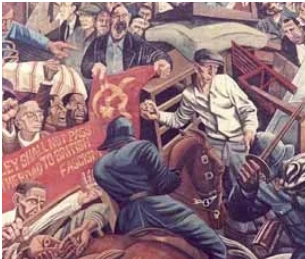
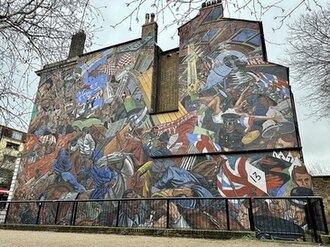
The famous Cable Street mural by artist Dave
Binnington
Sources: London Museum website: https://www.londonmuseum.org.uk/collections/london-stories/battle-of-cable-street/, Workers' Weekly, personal recollections of those that took part.