
|
|
||||
|---|---|---|---|---|
| Volume 56 Number 21, July 4, 2026 | ARCHIVE | HOME | JBCENTRE | SUBSCRIBE |
The new National Security (State Threats) Bill fast-tracked all its stages in the Commons from its Second to its Third Reading in one day, June 17, 2026. It then proceeded to the House of Lords. Why this haste? It is a hysteria of the government's own making suggesting there is an immediate threat to national security. This is bogus.
The alleged justification for this Bill put forward by the government is that MI5 has said the threat from foreign state activity in Britain is now as great as the threat from terrorism. The government has introduced new powers to address this, such as a register of foreign lobbying activities for those working for state governments and new offences for espionage and foreign interference.
The National Security (State Threats) Bill would allow the government to designate organisations as being associated with foreign state threat activity, and make it an offence to support or benefit from them. This is based on a similar power to proscribe terrorist groups.
The legislation would make it an offence to "support" a designated body. This would include arranging a meeting to be addressed by a member of such a body, where the support is for a "prohibited purpose" prejudicial to UK interests. It also criminalises obtaining "material benefits" from designated groups defined to include "information". As human rights campaigner Craig Murray pointed out: "It will be illegal to publish true casualty information from Iran, from Hamas run-hospitals in Gaza, or IDF assault details from the resistance in Lebanon."
The Bill amends the National Security Act 2023 to introduce a power for the Home Secretary to designate bodies involved in "foreign power threat activity" by regulation, if the government claims that it is necessary for the safety or interests of Britain.
In May 2025, the Independent Reviewer of Terrorism and State Threat Legislation, Jonathan Hall KC, reviewed existing counter-terrorism powers to determine if any should be emulated or adapted to deal with state threats. His report highlighted the alleged limitations of the terrorism proscription regime as it applies to state bodies, and how the National Security Act 2023, as drafted is less effective at disrupting proxies than foreign intelligence services. He recommended that the government introduce a new power to issue "Statutory Alert and Liability Threat Notices" against foreign intelligence services, equivalent to proscription under the Terrorism Act 2000. To put Jonathan Hall's antecedents in perspective, his father-in-law, Lord Dyson, is a patron of UK Lawyers for Israel.
As the House of Commons Research Briefing on the Bill says: "The Home Secretary would be able to designate bodies by regulation if they believe it is necessary for the safety or interests of the UK. The bill would create three new offences associated with designation, of supporting, assisting, or receiving material benefit from, a designated body. The offences would carry sentences of up to 14 years' imprisonment. There would be a process for applying to remove a designation and to have any associated convictions quashed. The Bill would come into force on the day it receives Royal Assent, and would extend to the whole of the UK. No legislative consent motions are required as the subject matter of the bill is reserved."
The "threats" singled out in the Bill's justification are those allegedly posed by Iran and the Islamic Revolutionary Guard Corps. The Intelligence and Security Committee (ISC) conducted an inquiry on Iran, taking evidence between 2021 and 2023, and publishing a report in July 2025. The report claimed that although hostile activity by Iran is on a smaller scale than that by Russia or China, it poses a wide-ranging and unpredictable threat to the UK and should not be underestimated.
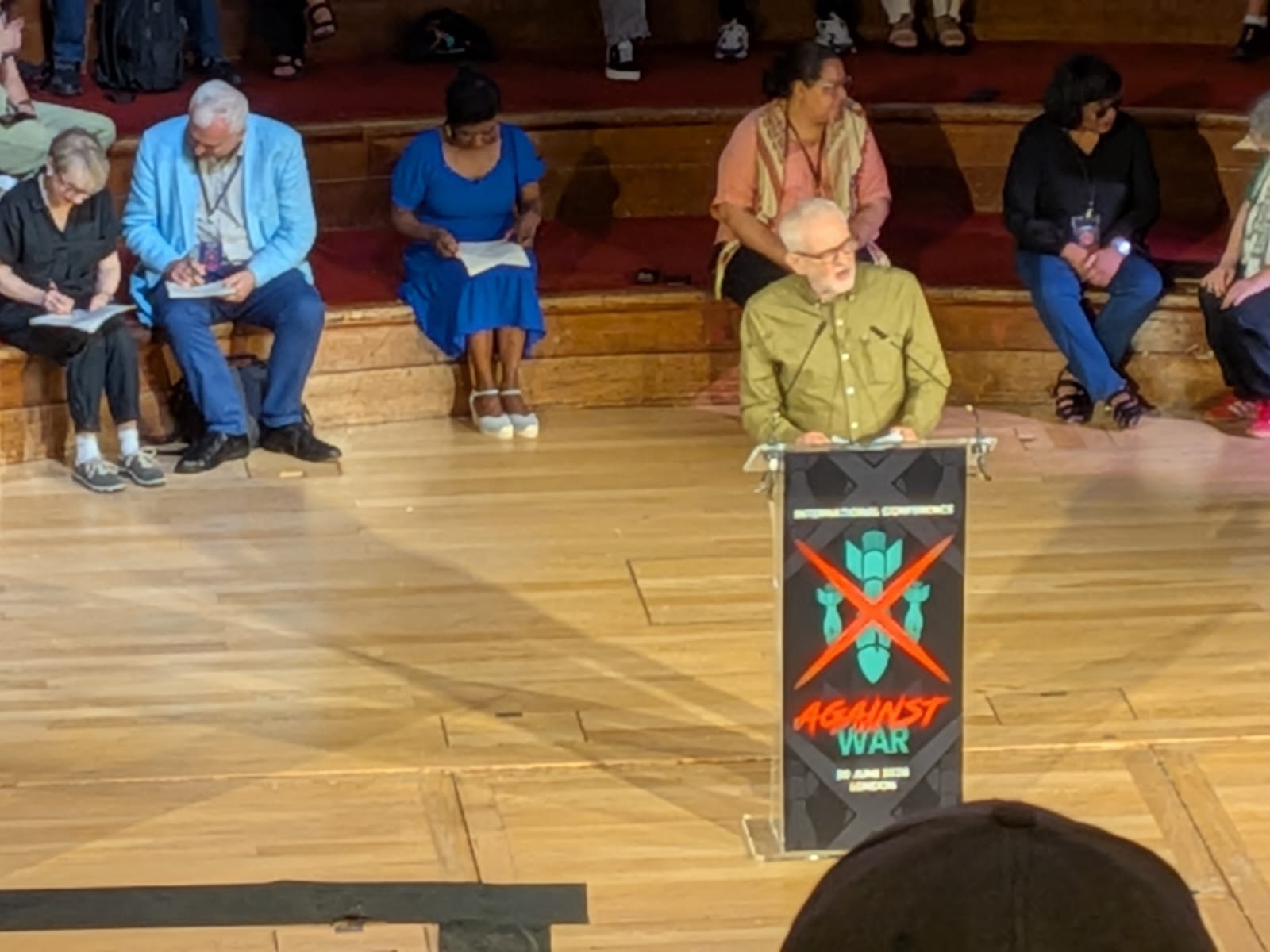
Jeremy Corbyn, independent MP speaking at the
International Conference Against War, June 20 - Photo:WW
According to the Research Briefing: "The National Security Strategy, published on 24 June 2025, reiterated the commitment to take the recommendations forward, and to draw up new powers, modelled on counter-terrorism, to tackle state threats. The 2026 King's Speech announced that the government would introduce legislation 'to tackle the growing threat from foreign state entities and their proxies'. It said the Bill would provide a 'powerful new tool to disrupt and deter the activities of state-linked entities and those acting in concert with them' based on the proscription powers in the Terrorism Act 2000."
Ashok Kumar, Green Party member and lecturer, said on X: "The only purpose of this law is to support more war crimes against the Iranian people and to round up anyone here who opposes those war crimes under the charge of terrorism."
The International Development Committee, chaired by Labour MP Sarah Champion, has formally written to Home Secretary Shabana Mahmood expressing "serious concerns" that the Bill could have catastrophic consequences for UK-funded humanitarian aid.
In the debate on the Bill in the House of Commons on June 17, Jeremy Corbyn, Independent MP for Islington North, put forward: "The Bill gives considerably more powers to the Home Secretary and the Government, so it results in greater Executive power. Further to earlier interventions, is she not concerned that the Executive, and this branch of the Executive, are to have much greater power, but there is no commensurate increase in bodies' accountability to Parliament for deciding what organisations and which individuals are to be sanctioned, and what the system will be for making those decisions? We have been through this process many times, going right back to the Prevention of Terrorism Acts in the 1970s. Does she not feel that there is a danger of our moving too far away from parliamentary and public accountability for the very important decision to deny liberty to various individuals, who will have difficulty challenging that legally?"
The Act when passed will constitute a further addition to the state's arsenal to arbitrarily criminalise the people's voice, and must be opposed.
(with material from Canary)