
|
|
||||
|---|---|---|---|---|
| Volume 56 Number 20, June 27, 2026 | ARCHIVE | HOME | JBCENTRE | SUBSCRIBE |
The Health Bill 2026 [1] was introduced in the King's Speech in the new legislative session on May 13 as the "NHS Modernisation Bill". It is said that it will abolish NHS England ("NHSE") and transfer the bulk of its functions to the Secretary of State for Health and Social Care (the "Secretary of State") and to integrated care boards ("ICBs"). As a result of the abolition of NHSE, the Bill proposes to transfer NHSE's property, rights and liabilities to various bodies including, primarily, the Secretary of State (SoS) and integrated care boards (ICBs).
Amongst the main measures of the Bill is the aim to "modernise the NHS in England" by "abolishing NHS England" creating a "Single Patient Record" (SPR), and "centralising certain powers under the Secretary of State". However, the then Secretary of State for Health and Social Care, Wes Streeting, who introduced the Bill to Parliament the next day on May 14, then on the same day resigned as the Health Secretary stating that "he had lost confidence in Starmer's leadership". This was in spite of the fact that over a year earlier he and the Prime Minister Sir Keir Starmer, who also resigned last week, were both the authors of this plan to put the NHS under the control of the Executive and to abolish NHS England. Now, the measures of the Bill are still the same as those put forward by Starmer and Streeting, even with the new Secretary of State for Health and Social Care James Murray, who introduced its second reading in the House of Commons on June 1.
In other words, Ministers come and go, and these days it is the same with Prime Ministers, so the working class and people have to ask why nothing changes for the better, and the crisis of government and the Westminster cartel party system goes on relentlessly. This happens whilst power is concentrated in those that control the Westminster government on behalf of the rich and private interests rather than public well-being. What has to be looked at with the Health Bill is its purpose in the context and aim of this system that is prioritising war over the health of the people and their interests.
It must be remembered that in March last year Starmer had set out this context of the NHS Health Bill [2]. Firstly, his remarks focused on trying to justify the massive increase in defence spending. He declared that "security" was increasing the expenditure on the arms industry, actively supporting the escalating war in Ukraine against Russia, alongside its support for Israel and its criminal war against the Palestinian people over the three years of genocide. This path is pursued without any hint from these warmongers of wanting to bring about real peace and security in Europe, either in Ukraine or in Palestine or elsewhere. This he had to admit was at the expense of investing in public services like the NHS and education.
Starmer claimed that this was now pressing "for greater urgency and to go further and faster on security and renewal". He tried to justify this "renewal" of the state by summoning up the spectre of what he called the "bureaucracy of the state". So, the context for this Health Bill was aimed at justifying making huge cuts to the "staffing in the NHS by 50%", claiming that this was just affecting "administrative" staff and "quangos" when in fact since the announcement it has also been aimed at further cutting health services and clinical staff.
Starmer claimed that the NHS would be brought back into "democratic control" by concentrating power back into "direct control by government" in the form of the Secretary of State and the executive power of the government. This was a lie, as this was not "democratic control" but, as the Bill shows, a central path to make further cuts to the NHS. This can be seen by looking at the Health Bill 2026 and its measures. It can be seen that it is not even about restoring the responsibilities of government for health care but to further ensure the other priorities for this warmongering elite. The Bill that the government hails as restoring "direct control by government" does not make the Secretary of State responsible for "a comprehensive health service" as stated in previous Acts since 1947. It does not recreate a non-delegable duty to ensure universal provision of health services for all who reside in the country.
Prior to the Health and Social Care Act 2012, the National Health Service Act 2006, Section 1, imposed a direct, personal, non-delegable duty on the Secretary of State. "The Secretary of State must continue the promotion in England of a comprehensive health service designed to secure improvement - (a) in the physical and mental health of the people of England, and - (b) in the prevention, diagnosis and treatment of illness." This was universally understood as the core constitutional duty: the Secretary of State was responsible for the NHS as a whole. The duty was direct, unqualified, and non-delegable. Ministers were accountable for the comprehensive health service itself. This is the duty of the foundation of the NHS as a universal, national service. With the Health and Social Care Act 2012 the Secretary of State's role became one of oversight, mandates, and regulations, not of direct responsibility. The 2012 Act severed the link between the Secretary of State and the duty to provide a comprehensive health service and put in place commissioning bodies including the central commissioning body NHS England. This is not reversed by the Health Bill 2026 as claimed by the government. The Health Bill 2026 "increases ministerial direction powers", but does not recreate the pre-2012 constitutional settlement where the Secretary of State was legally responsible for the NHS provision itself. It does not reverse the structural fragmentation into arms length unelected "commissioners" and "providers" introduced in the Health and Social Care Act 2012.
Instead, the Health Bill 2026 states in section 4-11 that the "Secretary of State's functions" are to be "duty to reduce inequalities", "patient involvement and choice", "promoting innovation." These "functions" also include a list of "directions" to Integrated Care Boards (ICBs) including powers on their failure. Most notably the Bill limits the Secretary of State's "duty as respects variation in provision of health services". The Secretary of State must not cause "a variation in the proportion of health services provided by the public or private sector", or the proportion of health services provided by "different kinds of legal entity [i.e. private companies [3]], unless the Secretary of State considers that to do so is in the interests of the health service". In other words, commissioners will be able to continue to privatise the NHS without the Health Secretary causing a "variation in the proportion of health services".
On creating a "Single Patient Record" (SPR), section 47 gives the Secretary of State mandatory powers to require NHS Trusts, Foundation Trusts, ICBs, and GP practices to share any patient data the Secretary of State specifies. Through this undemocratic measure in the Bill, the government is trying to enforce GPs, hospitals and other providers to share patient data for the SPR contract with Palantir [4] and other data companies. This is part of the government's plan to embed Palantir and other data companies who are part of the war industries into the British state and with it control all of the NHS data of patients. This goes directly against the people's response that is No Palantir in the NHS! and opposing Palantir and the government's joint abuse of people's data, as well as demanding the right to privacy of patient and other data where only they can decide.
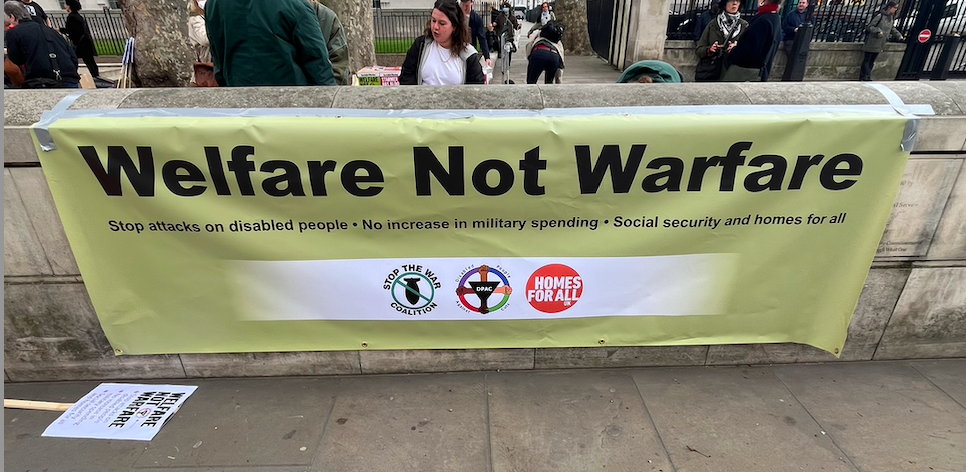
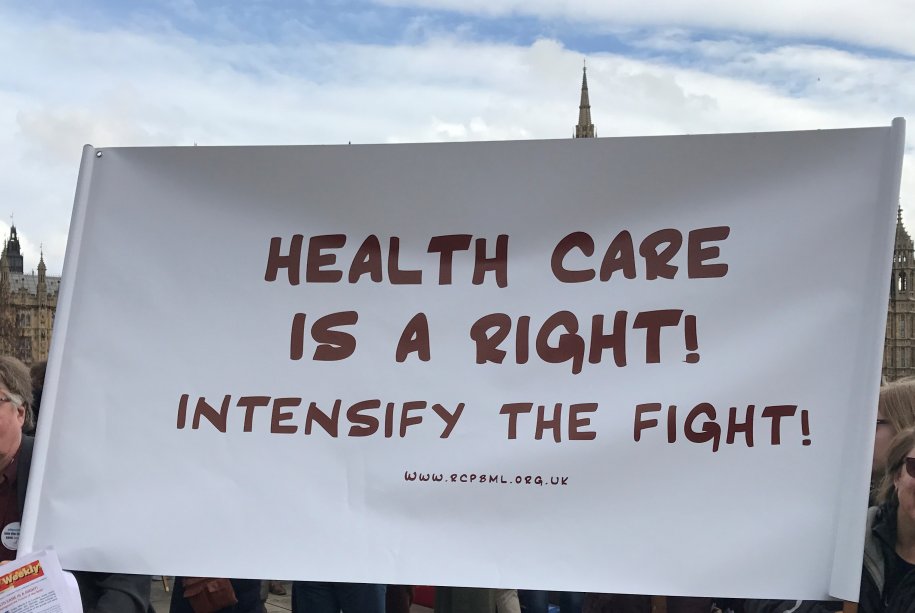
The Health Bill 2026 is not an "NHS Modernisation Bill" as claimed. It is a Bill to put the NHS under the Executive of government to enable the prioritisation of investment in war industries rather than the NHS. This whilst they try to maintain the illusion that they care about our health services and the NHS. However, this crisis will continue and the NHS Bill will be further exposed and increasingly opposed as has happened since Starmer and Streeting's announcement of it last year. This is further shown by the struggle of the doctors and other health workers against the attacks on their jobs, wages and conditions.
These struggles of health workers are continuing in the context of the growing broad unity of the people against war, and the right to resist the violence of war and militarism. Health workers and people in the communities should not become overwhelmed by this present situation but put their energy into discussing, planning and organising to resist cuts to their health services and oppose the militarisation of the economy that is destroying health services and peace and security.
Notes
1. Health Bill: A Bill to make provision about health and social care.
https://publications.parliament.uk/pa/bills/cbill/59-02/0009/260009.pdf
2. Putting the NHS under the Control of the Executive: On Starmer and
Streeting's Decision to Abolish NHS England, Workers' Weekly, March 16,
2025
https://www.rcpbml.org.uk/wwie-25/ww25-06/ww25-06-01.htm
3.In UK law, a "legal entity" is any organisation that has a legal
personality - meaning it can enter contracts, employ staff, hold property, sue
and be sued.
4. No Palantir in the NHS: Oppose Palantir and the Government's Joint Abuse of
People's Data, Workers' Weekly, May 16, 2026
https://www.rcpbml.org.uk/wwie-26/ww26-15/ww26-15-02.htm