
|
|
||||
|---|---|---|---|---|
| Volume 56 Number 6, February 28, 2026 | ARCHIVE | HOME | JBCENTRE | SUBSCRIBE |
Student resistance
Workers' Weekly Internet Edition: Article Index :
Student resistance:
Graduates Protest Student Loan ChangesA Significant Public Law Ruling:
Palestine Action Judgment
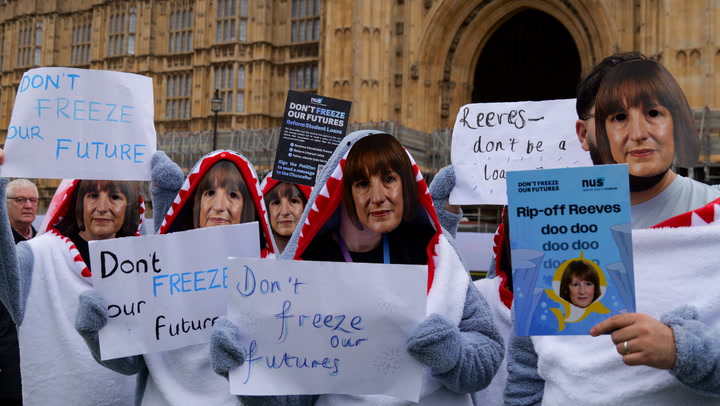
On February 11, several hundred graduates and current students gathered outside parliament to protest changes to the student loan repayment system that will further lock young people into long-term debt. Organised by the NUS alongside local student unions, graduate groups, Save the Student and other networks, the demonstration saw some wearing shark costumes and holding placards accusing the government of behaving like "loan sharks".

Graduates have taken to social media and other public spaces to describe their reality of loan balances that barely move despite years of repayments, and in some cases grow as interest accumulates. They point to their experience of juggling multiple part-time jobs to cover rent and basic living costs, working unpaid or precarious internships, and cutting back on essentials so monthly repayments can be met. For students and graduates this is not an abstract policy debate but the lived experience of the incoherence of the whole system.
The immediate trigger was a decision in the Autumn 2025 Budget to freeze the Plan 2 repayment threshold at the April 2026 level (£29,385) for three years from April 2027. Under Plan 2, graduates pay 9% of earnings above that threshold. Freezing the threshold means that as wages rise with inflation or pay growth, more of a graduate's income falls into the repayment band. In practice, many people will start repaying earlier after graduating and remain paying for longer, increasing lifetime repayments potentially by thousands for those on typical incomes. NUS has warned that the freeze will add "hundreds of pounds" to annual repayments for many Plan 2 holders [1].
Analysis by the Institute for Fiscal Studies suggests that the freeze will particularly affect graduates on middle incomes. Those who earn too much to have their loans written off quickly, but not enough to repay the full balance early, are expected to see lifetime repayments rise by several thousand pounds. Higher earners are less affected, as they typically repay their loans in full regardless of threshold changes [2].

Graduates have been burdened with an unpredictable and opaque system. They are particularly angered by the arbitrary and imposed nature of the recent changes, given that the terms they signed up to have been altered after the fact. This arbitrariness is not incidental: it is part of the concentration of power in a small executive able to reshuffle financial rules at will.
The policy is part of the broader framing of higher education as an individual transaction, creating a capital-centred system where students are made a target because education is thought of as something which students engage in for self-serving reasons, while at the same time are penalised not only financially but having to devote time to making ends meet, needing to work during study in insecure part-time jobs. Students are treated not as members of a society whose production and reproduction depends on education, but as fragmented consumers.
Responding to comments made by Chancellor Rachel Reeves defending the student loan system and threshold changes, NUS Vice President for Higher Education Alex Stanley said [3]:
"The student loan system isn't working for anyone. Not for students who are having to access foodbanks. Not for graduates who are paying back hundreds of pounds a month without touching the sides of the interest on their loans. And not for the Government as student debt is ballooning. Surely Reeves should be looking for a solution rather than doubling down on a broken system?

Students demonstrating, Gateshead, 2008
"Firstly, the Chancellor needs to stop playing politics with students and graduates. In the Autumn budget she effectively added hundreds of pounds to the amount Plan 2 loan holders pay back each year by freezing the thresholds from 2027. We went to university, signed a complex contractual agreement with the Student Loans Company, and now that loan is a political football impacting our bank balances each month.
"Students and graduates are gearing up to be a powerful electoral force. And with the polling in YouGov which finds there is growing support for measures including completely wiping off all student debt, it is time the Chancellor started looking at the practical solutions which would deliver for student and graduates.
"Anyone who went to University for free should not be able to call the current system fair."
Aside from the spurious economic logic that poses higher education as a cost and not something that is creating value in the economy - value that is used by but unrealised by the businesses that employ its end product, the graduates themselves - the issue throws into relief the way decisions affecting large sections of the population are made, and asks: who decides? The freezing of the repayment threshold is an example of an increasingly arbitrary form of governance, which destroys all the accepted arrangements as it suits those in power. From this perspective, the protests, social-media testimony and union campaigns are not merely pleas for better terms; they are aimed at political agency, challenging the authority as it exists. Demonstrators are speaking and acting in their own name, highlighting the gap between the authority and its institutions, and the lived economic realities of graduate workers. Resistance is not limited as opposition to this specific policy, but is part of the struggle to assert direct influence over decisions that shape their lives.
Notes
1. Plan 2 itself sits within a broader history of student finance reform
stretching back to the Dearing Report of the late 1990s and the 2010 Browne
Review. Those policy shifts reframed higher education funding around fees and
income-contingent loans, normalising the idea that graduates carry the bill.
Changes since then - variable fees, marketisation of universities, and new
repayment plans - have layered complexity and cohort differences onto the
system, while generally increasing costs to the individual massively. The
mechanics of Plan 2 mean repayments depend on income rather than outstanding
balances, while interest accrues at rates tied to inflation. For numerous
borrowers, monthly payments fail even to cover interest, so balances can grow
despite decades of payments. By the late 2010s official forecasts (OBR)
indicated a large share of post-2012 loans would be unlikely to be fully repaid
and therefore expected to be written off, such was the state of the crisis at
that time. Th e newest regime, Plan 5, applies to students who started courses
from autumn 2023. Plan 5 lowers the repayment threshold, changes interest and
repayment rules, and extends the repayment/ write-off period to 40 years. The
current protest, however, centres on Plan 2 borrowers (those who began courses
between 2012 and 2023 - i.e., starters before the Plan 5 regime introduced in
autumn 2023), who face the immediate impact of the threshold freeze.
2. Kate Ogden, "How do Plan 2 student loans work, and how have they
changed over time?", Institute for Fiscal Studies, February 6, 2026
https://ifs.org.uk/articles/how-do-plan-2-student-loans-work-and-how-have-they-changed-over-time
3. "Stop the Plan 2 repayment threshold freeze; response to Rachel Reeves'
comments", NUS, February 4, 2026
https://www.nus.org.uk/stop-plan-2-repayment-threshold-freeze
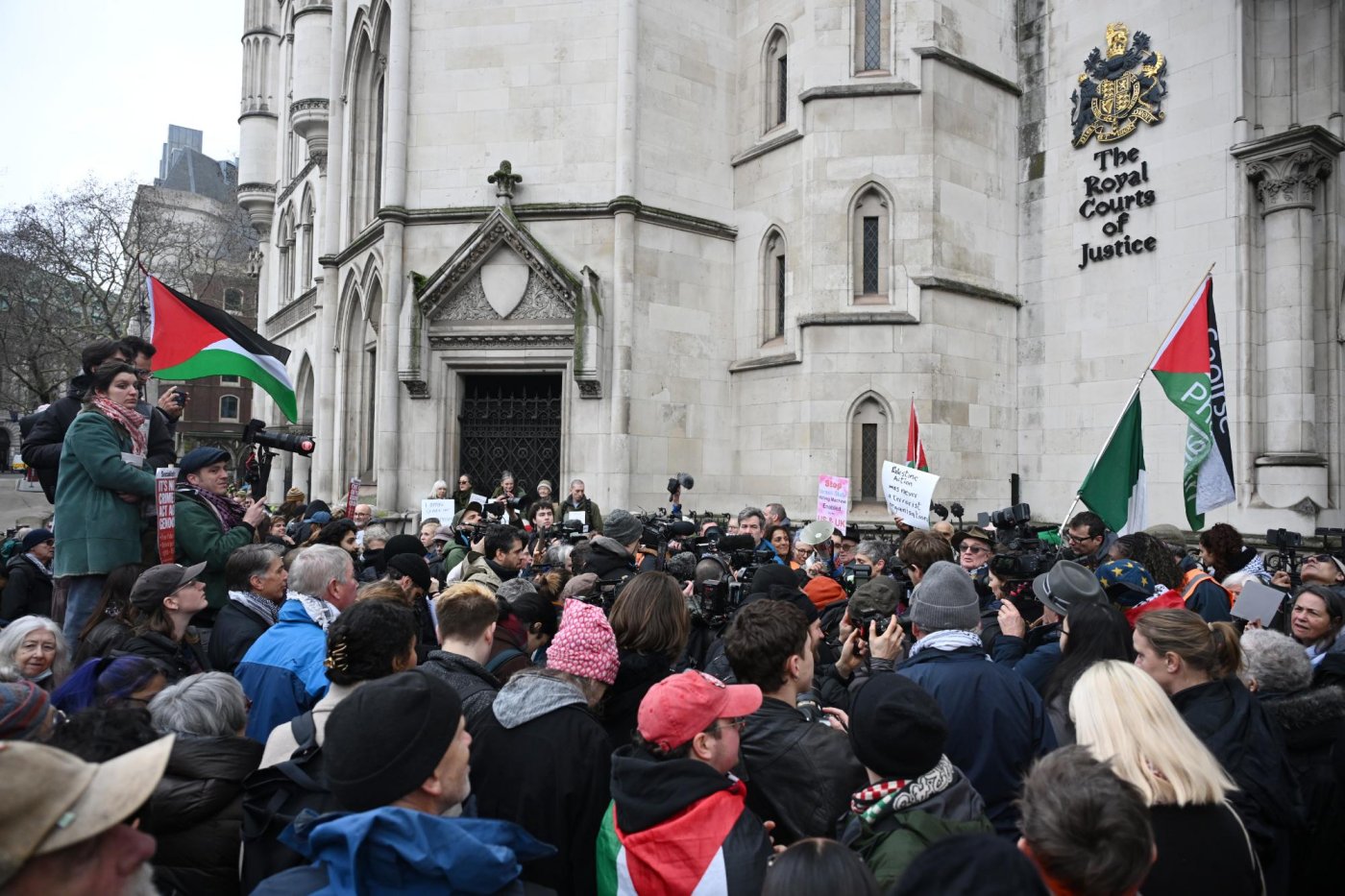
People welcoming the news outside the High Court, London,
February 13, 2026
Paul Heron, solicitor at the Public Interest Law Centre (PILC), has published an analysis of the decision in the recent Palestine Action judgment. He writes:
"The Court allowed a challenge to the Home Secretary's decision to proscribe Palestine Action under the Terrorism Act 2000, finding the move unlawful and disproportionate. Yet", he says, "the victory, whilst extremely important, is partial and potentially very fragile. Palestine Action remains proscribed pending further order, and the Court accepted that a small number of its actions fell within the statutory definition of terrorism."
Paul Heron points out that "terrorism" is, under the Terrorism Act 2000, defined broadly, as the use or threat of action designed to influence the government for a political cause, involving serious violence or serious damage to property.
"The Home Secretary," he writes, "reached an 'unchallenged conclusion' that Palestine Action was concerned in terrorism. The claimant did not dispute that some activities could fall within broad definition of section 1 [where terrorism is defined]. Instead, the challenge focused on whether proscription, with its sweeping criminal consequences, was lawful and proportionate.
"The proscription order, approved by Parliament and in force from 5 July 2025, made it a criminal offence to: Belong or profess to belong to Palestine Action; Invite support for it; Express supportive opinions recklessly; Organise or address meetings connected to it. Thus, the order doesn't just ban specific acts of damage. They restrict people from organising, speaking, and associating under a political banner."
Of a number of grounds for the challenge to proscribing Palestine Action, the High Court considered four main grounds, ultimately ruling that the proscription of Palestine Action was unlawful on two of them.
Paul Heron explains: "The first successful ground of challenge concerned the Home Secretary's own policy on proscription. That policy states that proscription requires both a belief that the organisation is concerned in terrorism and that it is proportionate to proscribe. It also directs consideration of factors such as the nature and scale of activity and the threat posed to the UK.
"In deciding to ban the group, the Home Secretary argued that proscription would make it easier to prosecute supporters and give the authorities stronger powers to disrupt them. The Court said this went against the purpose of the policy, which was meant to limit when proscription could be used. It wasn't enough to say that a ban would be useful, there had to be clear reasons why it was truly necessary.
"In effect, the executive was caught using proscription as a tool of political convenience rather than necessity. The Court did not question Parliament's broad terrorism framework. Instead, it insisted that if the government promises restraint, it must demonstrate it."
The second successful ground was under the Human Rights Act 1998, and concerns the issue of freedom of expression and association..
Paul Heron explains: "The Court rejected the argument that Palestine Action's conduct was civil disobedience and confirmed that the HRA does necessarily protect violent or non-peaceful protest. However it accepted that a 'very small number' of the group's activities amounted to terrorism as defined in the Act.
"But the Court reframed the key issue. The interference to be justified was not the restriction on criminal damage. It was the criminalisation of peaceful protest and expression carried out under the Palestine Action banner."
In other words, the proscribing of Palestine Action, the judgment says, still seriously interferes with people's rights to free expression and protest under Articles 10 and 11 of the European Convention on Human Rights.
"The Court looked not just at the alleged offences," Paul Heron explains, "but also at the wider impact of proscription. It recognised that banning a group can create a 'chilling effect' meaning people may hold back from taking part in lawful political protest or speech because they fear being associated with a banned organisation or risking prosecution." This of course has been the effect of proscribing Palestine Action, in particular for the demand that the genocide in Palestine be ended, while the resistance has grown and mass arrests have taken place.
"Most importantly," says Paul Heron, "the Court found that the group's activities had not reached the level, seriousness, or sustained scale that would justify treating it as a terrorist organisation. The Court were of the view that ordinary criminal laws can already be used to prosecute any specific unlawful acts, a full ban was not considered necessary or proportionate."
Paul Heron affirms: "This distinction matters. Criminal law deals with individual offences. Proscription changes the legal consequences of simply being linked to a group, even in lawful activity."
In summing up, Heron offers a word of caution, in saying that "the judgment is not a sweeping denunciation of executive power. The Court attached 'real weight' to the Home Secretary's responsibility for public safety. It rejected a discrimination claim under Article 14. It did not disturb the assessment that some conduct met the statutory terrorism definition." And he underlines: "This is constitutional caution. The judiciary has drawn a line, but a very thin one."
From a public lawyering perspective, three dynamics stand out.
"First, the elasticity of terrorism law. It is a shifting sand. The statutory definition treats serious damage to property, when politically motivated, in much the same way as violence against people. That breadth allows militant protest to be recast as a matter of national security.
"Second, Government response intensified in the context of the Gaza war protests. Direct action against arms companies and supply chains received heightened scrutiny. Proscription indicated a shift toward treating such protest activity as a matter of national security.
"Third, the judiciary as a contradictory arena. The Court accepted part of the terrorism case but pushed back on its broader consequences. It upheld the right to organise and protest, while leaving the underlying counter-terrorism framework unchanged."
In dealing with the "chilling effect" of proscribing, the judgment recognises that proscription does not merely punish organisers. It deters students hosting meetings, trade unionists organising events, and activists expressing solidarity.
Paul Heron concludes, in raising the issue from the perspective of the peoples' movements: "But the big question remains: who defines terrorism, and how expansively? The Terrorism Act endures. The executive may reconsider or appeal. Parliament may legislate further. ... Litigation can expose overreach and defend political campaigning but it operates within legal boundaries shaped by the state and thus the establishment itself. Judgments like this can slow the machinery of bad law occasionally. It does not challenge or dismantle it."

Latin American conference, London, February
2026
On the morning of February 25, 2026, a speedboat was detected violating Cuban territorial waters. The vessel, registered in Florida, approached up to one nautical mile north-east of the El Pino channel, in Cayo Falcones, Corralillo municipality, Villa Clara province.
When a surface unit of the Border Guard Troops of the Ministry of the Interior, carrying five service members, approached the vessel for identification, the crew of the violating speedboat opened fire on the Cuban personnel, resulting in the injury of the commander of the Cuban vessel. As a consequence of the confrontation four aggressors on the foreign vessel were killed and six were injured. The injured individuals were evacuated and received medical assistance.
The Cuba authorities have confirmed that they are investigating this armed attack against a patrol vessel of the Border Guard Troops of the Ministry of the Interior. In a statement on February 26, the Cuban Ministry of the Interior reported that the intercepted speedboat, registered in the state of Florida, was carrying 10 armed individuals who, according to preliminary statements by those detained, intended to carry out an infiltration for terrorist purposes. Assault rifles were seized, along with sniper rifles, pistols, Molotov cocktails, multiple tactical assault gear including night vision equipment, bulletproof vests, assault bayonets, camouflage clothing, ammunition of various calibres, combat rations, communication equipment, and a significant number of monograms from counter-revolutionary terrorist organisations.

All participants are Cuban nationals residing in the United States. Most have prior records involving criminal and violent activity, including Amijail Sánchez González and Leordan Enrique Cruz Gómez, who appear on Cuba's National List of individuals and entities designated pursuant to United Nations Security Council Resolution 1373, international law, and Cuban domestic legislation. They are currently under criminal investigation and are wanted by Cuban authorities for their alleged involvement in the promotion, planning, organisation, financing, support, or execution of terrorist acts in Cuba or abroad.
In addition, Cuban national Duniel Hernández Santos was arrested within Cuban national territory. He had allegedly been sent from the United States to facilitate the landing and reception of the armed group and has confessed to his role.
A statement by the Deputy Foreign Minister of the Republic of Cuba, Carlos Fernández de Cossío, pointed out that from the very outset, upon determining that the vessel had departed from United States territory, the Cuban authorities have maintained communication with their US counterparts - including the Department of State and the Coast Guard - regarding this terrorist attempt. An investigation is currently underway to fully clarify the facts with the utmost rigour. The Cuban government, the statement said, is willing to exchange information with the United States government concerning this incident.
The statement continued: "Among other requests, we will ask the US authorities - through the existing mechanisms between the two countries - for information about the individuals involved, the vessel used, among other details. US government authorities have expressed their willingness to co-operate in clarifying these regrettable events."
The statement of the Cuban Deputy Foreign Minister went on to emphasise that this is not an isolated act. He pointed out: "For over 60 years, Cuba has been the victim of aggression and countless terrorist acts, most of them have been organised, financed, and carried out from United States territory.
"In recent years, Cuban authorities have denounced the increase in violent and terrorist plans and actions against Cuba, as well as the prevailing sense of impunity among the organisers and perpetrators in the face of inaction against them. Cuban authorities have regularly provided the US government with information on individuals who in recent years have been involved in promoting, financing, and organising violent and terrorist acts against Cuba.
"This information includes the National List of individuals and entities that have been subject to criminal investigations and are wanted by Cuban authorities due to their participation in acts of terrorism. It is compiled in accordance with United Nations Security Council Resolution 1373, the norms and principles of international law, and domestic legislation."
Carlos Fernández de Cossío clarified that anti-Cuban groups operating in the United States resort to terrorism as an expression of their hatred to Cuba and the impunity they believe they enjoy. Cuba, he said, reaffirms its absolute and categorical commitment against all terrorist acts, methods, and practices in all their forms and manifestations. "Our country," the Deputy Foreign Minister said, "maintains an exemplary record in combating terrorism and has fulfilled - and will continue to honour - the commitments it has undertaken in this area. Cuba is a State Party to the 19 international conventions on terrorism and has accordingly implemented legal and institutional measures aimed at effectively combating this scourge. Cuba has the duty and responsibility to protect its territorial waters."
In the face of the current challenges the country, its government and its people are facing, Cuba is reaffirming its determination to protect its territorial waters, safeguarding its sovereignty and ensuring stability in the region.
The statement concludes by emphasising: "Our actions are consistent with the international law, which applies to all countries, including the United States itself. Furthermore, they are part of the Cuban state´s national defence as an indispensable pillar for safeguarding our sovereignty, as well as the lives, security, and well-being of Cubans."
(Cubaminrex)
Receive Workers'
Weekly E-mail Edition: It is free to
subscribe to the e-mail edition
We encourage all those who support the work of RCPB(ML) to also support it
financially:
Donate to
RCPB(ML)
Workers' Weekly is the weekly on
line newspaper of the
Revolutionary Communist Party of Britain (Marxist-Leninist)
Website:
http://www.rcpbml.org.uk
E-mail:
office@rcpbml.org.uk
170, Wandsworth Road, London, SW8 2LA.
Phone: 020 7627 0599:
