
|
|
||||
|---|---|---|---|---|
| Volume 55 Number 33, December 20, 2025 | ARCHIVE | HOME | JBCENTRE | SUBSCRIBE |
Palestine Action hunger strikers
Government Must Urgently Accede to the Just Demands of the Hunger Strikers
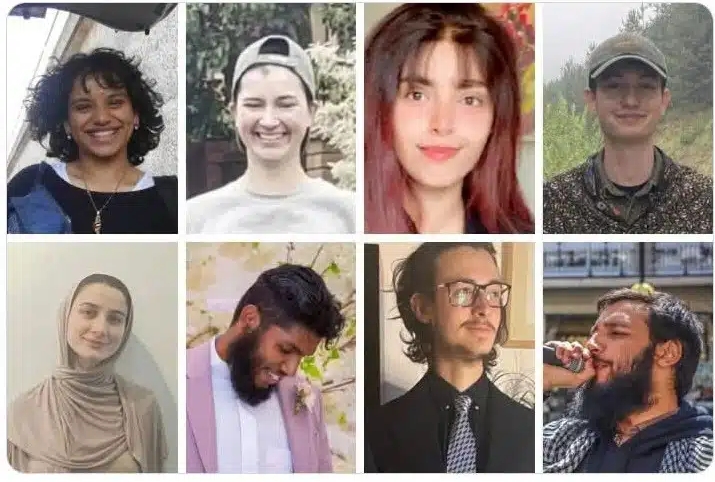
The hunger strike of the eight heroic imprisoned
activists reaches a crucial period - Photo: The Canary
The fight to overturn the proscription of Palestine Action has become ever more urgent as the hunger strike of the eight heroic imprisoned activists reaches a crucial period.

Irish solidarity protest outside the seat of the
Oireachtas, the parliament of Ireland, Leinster House, Dublin
None of the hunger strikers has been convicted of anything at all. They are all on remand. And as well as the life threatening danger to the hunger strikers, there are thousands of people who have been arrested and are facing terrorism charges arising out of the government's quite outrageous proscribing of Palestine Action. The people's resistance is mounting, and the government looks the other way, even having claimed that they were unaware of the hunger strike.
The demands of the hunger strikers largely refer to the draconian prison conditions in which they are kept, despite the fact that none of them have been convicted and none of them have previous convictions, or can reasonably be said to present a danger to the public, or be a particular flight risk. Most have already been held on remand far longer than the normal six-month maximum which the law allows before trial. The demands are:
.png)
Lawyers representing the hunger strikers have said that they are likely to die without the intervention of Justice Secretary David Lammy. Solicitors have written to David Lammy requesting an urgent meeting before their clients' health deteriorates "beyond any possible recovery". A subsequent letter said that his reply "does not directly address our request".
The lawyers' letter to the Justice Secretary, as reported in the Guardian, says: "You are uniquely placed in that as a senior government minister with oversight of His Majesty's prison service, you can bring about a resolution of the situation, such that the increasing deterioration of our clients' health does not lead to their death. We make clear that our request for a meeting is in an effort to seek to resolve the immediate situation and prevent the loss of life. Unless you tell us, we cannot see any reason why you would not want to engage in this process."
Hardly any of this has reached the mainstream news media. Journalist Matt Kennard revealed earlier this year that British "counter terror" policing was in November 2024 added to the "D Notice" system - effectively a system of military censorship of the Britain's media.
At the time of writing, two of the hunger strikers - Jon Cink, who was in hospital, and Umer Khalid, who has muscular dystrophy - are reported to have ended the strike. The other prisoners refusing food are Amu Gib, Qesser Zuhrah, Heba Muraisi, Teuta "T" Hoxha, Kamran Ahmed and Lewie Chiaramello, who has diabetes. The first three of those six have been on hunger strike for over a month. [2]

A delegation from Derry in the north of Ireland took part
in demonstrations in London, Westminster, December 15
Protests have taken place demanding that the government release the prisoners and meet their demands. A demonstration at Downing Street on December 16 condemned the repressive and inhumane conditions of the detention in the prisons. A further demonstration at the BBC condemned the broadcaster's silence on the hunger strikes.
A delegation from Derry in the north of Ireland took part in demonstrations in central London, and demonstrations have also taken place in the Irish capital Dublin. Irish activists reported: "We stand in support of the anti-genocide activists on hunger strike in English jails. The British establishment has attempted to criminalise a non-violent protest movement, and are now prepared to let these people die. As Irish activists we understand the courage and determination a hunger strike involves, and we also know the risks these brave activists are facing." The memory of the Irish people is still strong regarding the ten Irish freedom-fighters who died after going on hunger strike in the H-blocks at the Long Kesh prison in 1981. Prime Minister Margaret Thatcher refused to grant the prisoners' "Five Demands" and also refused to restore political status. Bobby Sands was the first to die after 66 days on the strike on May 5, 1981. Thatcher branded the martyrs terrorists and criminals.
In opposition, an Early Day Motion on the Palestine Action hunger strike was tabled in the House of Commons on December 1, which, at the time of writing, has been signed by 62 MPs. Tabled by John McDonnell, it reads: "That this House expresses its extreme concern that six prisoners associated with Palestine Action have felt that they had no other recourse to protest against their prison conditions but to launch a hunger strike; and calls upon the Secretary of State for Justice to intervene urgently to ensure their treatment is humane and their human rights are upheld."
.png)
John McDonnell, in a point of order on December 10, said that he had had no response to a letter to the Justice Secretary requesting a meeting on the Palestine Action prisoners, a lack of action that Speaker Lindsay Hoyle called "totally unacceptable". And on December 17, MP Jeremy Corbyn urged the Prime Minister to meet with representatives of the hunger strikers, saying: "Yesterday the minister of state for Justice declined a meeting with the representatives of a number of hunger strikers in prison at the present time. These are all remand prisoners. They're not convicted of anything. [...] Will he make arrangements for the Ministry of Justice to meet representatives of the hunger strikers to discuss these breaches of the conditions that they're experiencing at the present time?" To which Keir Starmer shamelessly replied: "He will appreciate there are rules and procedures in place in relation to hunger strikes and we're following those rules and procedures."
The hunger strike amounts to violence against the prisoners by the state. The mainstream media with its news blackout has also studiously ignored these prisoners and their protest. The government has a moral responsibility to accede to the just demands of the hunger strikers and provide them now with the necessary health care they so urgently need.
The Palestine Action prisoners are determined to win, despite their degrading and inhuman treatment, as part of the movement to stand with Palestine and condemn the British government for its complicity in the US/Zionist genocide. The callousness and criminality of the government is unspeakable. It must urgently accede to the just demands of the hunger strikers.
Stand with the hunger strikers! Stand with Palestine!
Notes
1. As summarised by Craig Murray,
https://www.craigmurray.org.uk/archives/2025/12/hunger-strikes-and-court-cases/
2. For details of all the eight prisoners, their statements and the lengths of
the respective periods refusing food, please visit the website of Prisoners for
Palestine:https://prisonersforpalestine.org/
Prisoners for Palestine is a prisoner-led collective in Britain representing
all those detained under charges related to Palestinian liberation.