
|
|
||||
|---|---|---|---|---|
| Volume 55 Number 31, December 6, 2025 | ARCHIVE | HOME | JBCENTRE | SUBSCRIBE |
Workers' Weekly Internet Edition: Article Index :
Government's Newly Announced Asylum Policy:
An Attack on Asylum Seekers and Working Class and People as a WholeThe right to a home:
Refugee Homelessness Doubles in Two YearsInspiring resistance of Palestinian people:
Worldwide Actions Mark International Day of Solidarity with the Palestinian People
Militant General Strike in Italy Stands with PalestineCrisis of party government:
Budget Leaks Underscore Need for Democratic Renewal

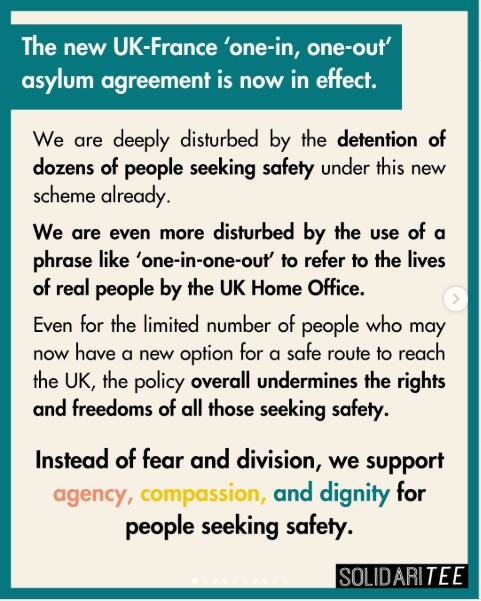
On November 17, 2025, Home Secretary Shabana Mahmood, speaking in the House of Commons, announced new plans that would create more difficulties for people seeking safety in Britain. She posed her statement in the context of "how we restore order and control to our borders. I do so as this Government publish the most significant reform to our migration system in modern times."

The proposals she refers to are contained in the Government paper "Restoring Order and Control". As the charity Right to Remain points out, "As with many previous Home Secretary announcements, these plans focus on enforcement rather than addressing the real reasons people seek protection or the basic reality that migration is a normal part of life." The continual emphasis on "restoring order and control" serves to divert from taking up for solution the causes of migrants seeking asylum, and is an attack on the working class and people as a whole in that it seeks to divert them from self-reliantly taking action to take up the solution to the problems they themselves face. As part of this diversion, the posing of the problem as the danger of the "far-right" contributes to divisions among the people and blunting the sense that the government must be held accountable for its attacks on the rights of all.
In her asylum policy announcement, Shabana Mahmood announced that refugee status would be made temporary, extending the wait for settlement to 20 years, while restricting family reunion, and removing the legal duty to provide housing and allowances. Rights groups, charities, and critical MPs have been quick to point out that these measures are punitive, destabilising, and risk breaching international obligations, leaving asylum seekers in prolonged insecurity and hardship.
The key policy changes, defined as reforms since, according to the Home Secretary, the asylum system is "out of control and unfair", include:The government can unilaterally announce and enact such measures without the people's determined opposition and resistance to them being backed by any constitution defined by the people themselves. Such cruel measures intensify the problems that those vulnerable to the state's whims already face by leaving vulnerable people in limbo, destitution, or subject to wrongful removal. Far from the government being obliged to guarantee protection to those fleeing persecution, war and aggression, it is asserting and promoting that it is responding to the people's concerns, and itself is taking racist stands and denying the rights that people have by virtue of being human. The whole outlook is a remnant and continuation of a colonialism which should be rejected and eliminated.
Voices against the proposals

The Refugee Council has warned that temporary status would trap refugees in decades of insecurity and injustice. It pointed out that removal of guaranteed housing and allowances would further risk increasing homelessness and destitution. The Refugee Council further criticised the proposed restrictions on family reunion, noting that 90% of visas previously went to women and children.
Amongst other comments, the Albanian Prime Minister Edi Rama accused Shabana Mahmood of "ethnic stereotyping" in singling out 700 Albanian families to justify ending the right to family reunions.
Amnesty International UK condemned the reforms as hostile and punitive. Amnesty said that the reforms represented a historic weakening of refugee protection, including turning refugee status into a temporary and precarious system, removing the state's duty to support people who would otherwise be destitute, and signalling a new willingness to remove families even where children have grown up and put down roots in Britain. Steve Valdez-Symonds, Amnesty International UK's Refugee and Migrant Rights Director, said: "The Home Secretary's immigration and asylum plans are cruel, divisive and fundamentally out of step with basic decency. Forcing refugees into endless short-term applications, denying visas to partners and children and stripping away support for people who would otherwise be destitute will only deepen chaos, increase costs and hand greater power to people smugglers."

The Immigration Law Practitioners' Association (ILPA) highlighted the risks of breaching international law obligations, including the Refugee Convention's principle of non-refoulement [1]. The ILPA criticised the use of "illegal migration" as a label incompatible with the right to seek asylum.
These proposed government measures do nothing to resolve any problem in the real world. They are completely vindictive and will exacerbate both the denial of rights to asylum seekers and the denial of rights to all members of civil society, no matter from what background.
As the Institute of Race Relations (IRR) comments, the measures will "further hardwire hostility towards asylum seekers and (low-paid) migrant workers into state policy". The IRR continues: "Asylum seekers will face the prospect of being denied all support, for 'non-compliance' or disobedience; having jewellery snatched to pay for their upkeep (involving who knows what intrusive searches), and an appeal system designed to get them out as quickly as possible. Low-paid workers, in particular health and care workers, will face at least 15 years on rolling 30-month visas (a lot longer if they have claimed any benefits) for the possibility of settlement - and benefits and social housing will be for British citizens only. These are the conditions in which refugees and migrants are being told they must 'integrate'.
"Key workers - nursing assistants, transport workers, prison officers - already fear deportation for not earning enough after the recent income threshold rise. The loss of key workers will damage society and the economy. It is the divisive and dishonest narrative that paints asylum seekers, refugees and migrant workers as taking advantage, that tears the social fabric, and creates, in Mahmood's words, a 'Littler England'."
The proposals in the light of the ECHR
Nor does the Home Secretary give anything but scant respect to the European Convention on Human Rights (ECHR), again reinforcing that there is a necessity for a constitution in Britain that recognises the rights and duties of citizens, one that exists more than on paper, such as the Human Rights Act of 1998, which the government is free to ignore as it pleases. In the maelstrom of comment on Mahmood's statement, it has been pointed out that the "Restoring Order and Control" document proposes to "limit the right to respect for private and family life in Article 8 ECHR in domestic law; re-examine the interpretation of 'inhuman or degrading treatment' for the purposes of Article 3 ECHR as part of international initiatives; and bring forward legislation on modern slavery."
In his contribution to the House of Commons debate on November 17, Jeremy Corbyn, now an independent MP, said: "Nowhere in the Home Secretary's statement does she put this into any kind of global context. Millions of people have become refugees or homeless all around the world, and more than two thirds of them are housed by the southern countries-the poorest countries in the world-with the least resources to do it. She is putting in draconian measures against refugees trying to come to this country, failing to recognise that more than 6,000 of those who have crossed the channel this year come from Afghanistan, a war-torn country that we helped to make into a war-torn country. She is instead trying to appease the most ghastly right-wing, racist forces all across Europe in undermining and walking away from the European convention on human rights-a convention created by the post-war Labour Government. Does she not recognise that history is going to be a harsh judge of this Government for undermining the global humanitarian principles behind the ECHR and the universal declaration of human rights?"
Government's proposals must be rejected and the rights of all respected and guaranteed
Again, to quote Right to Remain on the government's statement: "It deliberately hides the real human experiences, stories, barriers, and systemic problems that people face every day - issues that, as a community, we have been consistently raising while campaigning for alternatives that are rooted in humanity, compassion, care."
It is important that the government's proposals and the outlook behind them are challenged and rejected. They constitute an attack not only on people seeking asylum, who are refugees from their dangerous or ravaged countries, or who have been forced to or chosen to migrate, but on the rights and dignity of the working class and people as a whole.
Note
[1] Wikipedia defines non-refoulement as a fundamental principle of
international law anchored in the 1951 Convention Relating to the Status of
Refugees that forbids a country from deporting ("refoulement") any
person to any country in which their "life or freedom would be
threatened" on account of "race, religion, nationality, membership of
a particular social group or political opinion".
The Canary, in an article dated December 4, writes that:

Refugee homelessness doubles in two years
Thousands of refugees in Britain are facing an increasing homelessness crisis, according to Naccom, the national charity of 140 frontline refugee and migrant organisations. The charity's annual briefing found that government policy is causing an "entrenched migrant homelessness crisis".
Additionally, its data underscores the profound trauma and injustice endured by people in a punitive, failing system who are rendered homeless and without adequate means of support due to their immigration status.
Over the last two years, the number of refugees experiencing homelessness has more than doubled. Naccom members accommodated 4,434 refugees and migrants in 2024-25, which is the largest number on record. Of these, 2,008 were refugees - a 106% increase on the previous year. In total, 829 people were sleeping rough at the time they accessed services. This is higher than the previous year's figure of 378. An additional 3,450 refugees and migrants experienced homelessness, but Naccom was unable to accommodate them. This figure is also likely to be a huge underestimate, due to the number of people who never seek help.
The charity blames the increase on "constant, reactive policy changes" and the introduction of eVisas, which some refugees are unable to activate. This means they cannot access important services and support. Importantly, the number of people accommodated by charities immediately after leaving Home Office accommodation or support rose to 944. This represents a 150% increase since 2022-23.
The report also highlights the move-on period for refugees. This is the time allocated for them to find safe and secure housing after the Home Office makes a decision on their claim and asks them to leave its accommodation. The Home Office temporarily extended it from 28 to 56 days between December 2024 and September 2025 as part of a pilot. However, it ended in September. This means the 28-day period now applies again. According to the Guardian, more vulnerable groups, including disabled, elderly and sick people, are also set to have their move-on period reduced to 28 days by the end of December.
The report states that while extending the move-on period is not the only thing needed to improve positive move-on experiences from Home Office accommodation, the pilot has been shown to decrease rates of rough sleeping and ensure refugees are able to move on with their lives and integrate into their communities.
The data in the report also shows that member organisations accommodated 1,509 people with restricted eligibility or No Recourse to Public Funds (NRPF) in 2024/2025.
It adds that migrants who are denied access to some or all public funds - such as homelessness assistance, social housing, and mainstream benefits - are particularly vulnerable to destitution and may face other structural barriers that prevent them from moving on from homelessness. The survey shows that the most commonly supported group (912 people) were adults who have been refused asylum and are considered "appeal rights exhausted" by the Home Office.
An increasing refusal rate, decreasing availability of legal aid, and errors in Home Office decision-making combine to create a risk of catastrophic legal injustice. People refused asylum after appeal often face extreme hardship, including destitution, homelessness and declining physical and mental health.
The Naccom report calls for reform of the legal aid system. A shocking 64% of member organisations reported being unable to meet the rise in demand for legal advice. In total, they provided legal advice to 5,875 people in 2024/2025.
The report says that ensuring that all people can obtain free, good-quality legal advice is a central part of any fair and functional asylum and immigration system. However, this is increasingly difficult due to the ongoing legal aid crisis. As the government ramps up the pace of asylum decision-making, as well as enforcement, pressures on frontline services are growing increasingly unsustainable. It also notes that visa fee increases, longer routes to settlement, complex immigration policies and increased refusals all create more traps for migrants to fall into destitution and homelessness.

Demonstration outside the Royal Court of Justice in
support of lifting the ban on Palestine Action
as a terrorist organisation at the Judicial Review, November 26 - Photo:
AA
The Palestinian people, their Resistance and their historic defence of the right to be in the face of the barbarity of the US/Zionist genocide continues to inspire the peoples of the world. The peoples of the world are acting with similar conviction, providing a deep reservoir of moral, political and financial support and declaring they stand as one with the Palestinian people. Altogether, this makes for a quality that the US imperialists, Israeli Zionists and their accomplices in genocide can never defeat.

International campaign to demand the release of jailed
Palestinians, London, November 29 2025 - Photo: Workers' Weekly
This was fully evident with events at the November 29 International Day of Solidarity. Actions were held worldwide to mark the day, which was designated by the UN General Assembly in 1977 because 30 years earlier the same body had passed Resolution 181, officially sanctioning the carving up of Palestinian lands. These were followed by many protests on December 1, "Cyber Monday" targeting Amazon and Google for their support of US/Zionist genocide. No Tech for Genocide! End Surveillance Contracts Now! were among the demands.
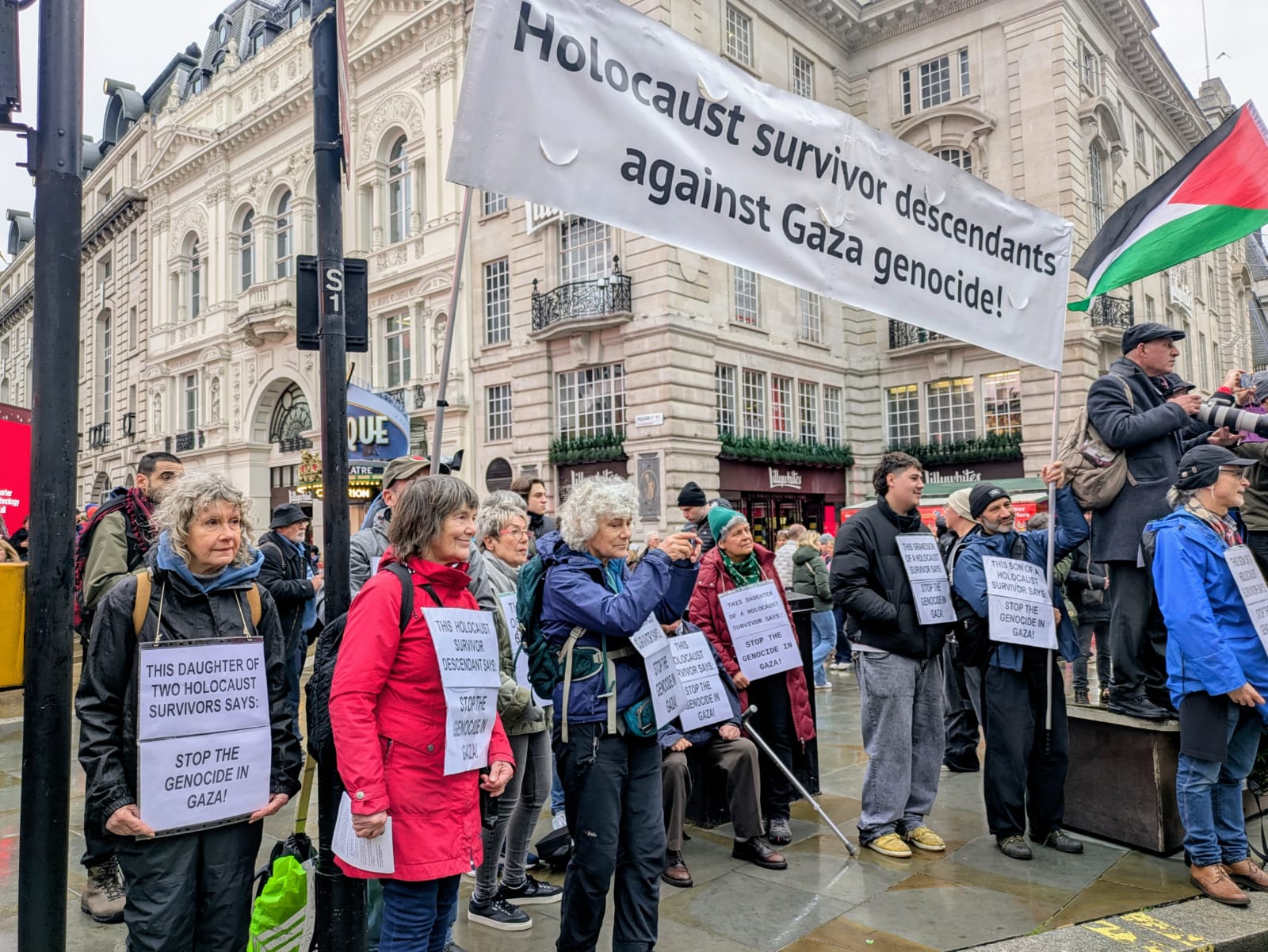
Over 100,000 marched in London. The mood was militant and determined as protesters opposed the Gaza "peace plan" as a scheme for continued occupation that denies Palestinians any agency.
The International Day of Solidarity also saw the launch of an international campaign to demand the release of jailed Palestinian leader Marwan Barghouti, who has been in Israeli detention since 2002. According to the Quds News Network, the campaign aims to make Barghouti's release a central demand in the next phase of Gaza ceasefire negotiations. Israel denied his release during the first phase of the current ceasefire.
The campaign, being led by Barghouti's West Bank-based family with UK civil society support, is seeking to put the 66-year-old's fate at the centre of the next stage of the ceasefire. Murals with the words Free Marwan, co-ordinated by Calum Hall, the founder of Creative Debuts, a creative consultancy and art platform, have started to appear in London, and a huge public art installation appeared in the village of Kobar, near Ramallah.
Demonstration on November 29, London - Photo: Workers'
Weekly
An event was also held in France, the country that granted Barghouti "honorary citizenship" in more than 50 of its municipalities. In Italy, activists, including UN Special Rapporteur Francesca Albanese and Greta Thunberg, participated in a conference in support of the call to free Barghouti and all Palestinian political prisoners. In Cape Town, South Africa, hundreds of people formed a human chain along a promenade at the coast, calling for his release. Barghouti was captured when Israeli soldiers disguised in an ambulance seized him in Ramallah, where he was serving as a political leader and elected parliamentarian. "He was taken to Israel in violation of the Geneva Conventions and later convicted in a trial widely condemned as illegitimate and politically motivated," the website freemarwan.org states.

General Strike standing with Palestine in Italy, Rome
demonstration, November 28 2025 - photo: i Diario Spain
On Friday, November 28, a general strike was organised in Italy in which hundreds of thousands of working people also took to the streets. Massive rallies demanded an end to rearmament plans and to the war budget introduced by the Italian government and they also stood with Palestine. In Genoa, Bologna, Turin, Milan and elsewhere, workers and protesters took action -- shutting down airports, stopping military cargo trains, blocking Israeli-bound shipments at ports, and more.

Strike demonstration in Genoa, November 28 2025 - photo:
@zairabiagini
The strike was called by the Unione Sindacale di Base (USB), Confederazione dei Comitati di Base (Cobas), and other labour unions, reviving the slogan "Blocchiamo Tutto" ("Shut Everything Down") - the same slogan that characterised September and October's protests against Israel's war on Gaza and attacks on the Global Sumud Flotilla. Those protests blocked ports, transportation and logistical hubs across the country. Workers stressed that their mobilisation is tied both to the war plans of the Italian government and to the struggle of the Palestinian people - whose fate is inseparable from Europe's expanding war economy.
At the demonstrations, banners, chants and public statements denounced Italy's role in supplying weapons to Israel and the government's political and material support for the ongoing US/Israeli genocide.
Genoa was among the focal points of the November 28 mobilisation. From early morning, thousands gathered in Piazza Verdi, where international activists, including Francesca Albanese, UN Special Rapporteur on the Occupied Palestinian Territories, as well as Greta Thunberg and Thiago Ávila from the Global Sumud Flotilla, joined the demonstrators.
The Friday strike actions across Italy were followed by a national march for Palestine in Rome the next day, November 29, attended by 100,000 people.
On the same dates, the US organisation Disarm Genocide Now along with others organised nationwide boycotts and rallies in solidarity with the Italian general strike and Palestine. "Workers sit at chokepoints of the economy. When we refuse to build the weapons, move the cargo, or staff the supply chains, the machinery of genocide grinds to a halt," said Chris Smalls, of the Amazon Labor Union and participant in the Global Sumud Flotilla.

Rachel Reeves' 2025 Budget, the first full financial statement of the Labour government, had been framed as a return to order after years of turbulence. Instead, it was marked by leaks that marginalised Parliament and added to market instability.
The media has been drip-fed disclosures for weeks before the Budget. In the run-up to November 26, newspapers reported a series of supposed policy decisions - from income-tax threshold freezes to a pay-per-mile levy for electric vehicles - in a stream of disinformation even reflected in markets. City analysts said speculation around tax rises caused more damage than confirmed measures, with firms delaying investment and some individuals drawing down pensions early. In a sign of just how sensitive the situation had become, the Financial Conduct Authority sought details from the Treasury about what information had circulated [1].
By Budget day, the sense of disorder was so acute that Commons Speaker Sir Lindsay Hoyle questioned whether there was any point delivering the statement at all.
About an hour before Reeves delivered her speech, the OBR posted its full Economic and Fiscal Outlook online - a market-sensitive assessment normally released alongside the Chancellor's statement. Journalists quickly downloaded and shared it.
By the time Reeves rose in the Commons, much of her Budget had already been analysed on social media and broadcast channels. Opposition MPs accused her of overseeing an "unprecedented leak". The OBR removed the document and apologised, calling it a "technical error".
The Speaker called the behaviour "appalling", a breach of the ministerial code and disrespectful to MPs, who are supposed to hear Budget decisions and other important policy statements first.
In the past, he said, "if you were leaking a Budget, you would've been sacked," adding: "You would've been asked to resign."
"The fact it's had an effect on the markets is very, very worrying," he said. He told BBC Radio Lancashire: "I find it appalling that what we've seen is kite-flying of different issues for people to say, 'I like that' or 'I don't like that'. You can't run a Budget in a way that you do opinion polls. It shouldn't be like that. The Budget is something special that should be released to MPs at the moment they go into the chamber. The Chancellor stands up for the first time to tell the audience - and the audience is MPs, not the BBC or Sky News. This is about an audience for MPs." [2]
This was not a new accusation. Only a year earlier, Reeves had been rebuked for announcing fiscal-rule changes to the media rather than MPs. The Conservatives had also faced similar criticism when in power previously.
Following the breach, the OBR launched an internal inquiry, and soon after, its chair Richard Hughes resigned, taking responsibility for what he called the worst publication failure since the OBR's creation.
Reeves later authorised a formal Treasury leak inquiry led by top civil servant James Bowler. It is examining the chain of events behind both the speculative briefings and the OBR's release, including document-handling, digital-security protocols and ways to prevent future exposure of market-sensitive information.
As they have been presented, the inquiries now under way - both at the Treasury and the OBR - will determine how the failures occurred and whether they stemmed from human error, flawed systems or the growing culture of "media-first" governing.
What can be said though is that the leaks are entirely consistent with the decaying state of the cartel-party system and the prevailing conditions of chaos and crisis. Even the leaks have been framed in terms of the effects on "markets", i.e. the financial oligarchy, not the people's well-being or the norms of democratic behaviour.
While Budget leaks are not new, it is the scale and nature of this year's disclosures that have taken things significantly further. As the Speaker and others point out, at this scale parliament has been effective cut from the picture, with all decision-making held in the hands of the executive and accountability undermined. As government further moves to openly arbitrary rule, it undermines the system's own norms, flouting even its own Ministerial Code as amended by Keir Starmer a year earlier. The scandal further exposes the dysfunctionality of the party system, where the cartel parties no longer even function as parties in the proper sense but as amalgamations of warring factions representing admixtures of competing interests. The ministers of the executive are in increasing contradiction with MPs at large, even those in their own party ranks.
The blatant "kite-flying" is similar in this respect to the Cambridge Analytica affair, which led to legitimising the micro-targeting of individuals through regulations as a means of extracting votes [3]. Or to the so-called "Nudge Unit", which is aimed at guiding the population's behaviour through subtle influences [4]. Each is a form of disinformation that profoundly marginalises people from politics, that disorients people and wrecks public opinion, and so further contributes to the prevailing chaos and anxiety.
People need to draw the warranted conclusions about the need for democratic renewal. As Workers' Weekly said itself leading up to the Budget, "the kernel to mobilise around is that political renewal is the order of the day, for which pro-social and anti-war programmes open the way... empowering the people to take the decisions which affect their lives!"
Notes
1. "Investigation into pre-Budget leaks is under way, MPs told", Josh
Martin, BBC News, December 4, 2025
https://www.bbc.co.uk/news/articles/c4g9e7wp79zo
2. "Speaker writes to PM about 'worrying' Budget leaks", Graham Liver
and Gina Millson, BBC News, November 26, 2025
https://www.bbc.co.uk/news/articles/cd745xdqlwgo
3. "The Cambridge Analytica affair underscores the need for democratic
renewal", Workers' Weekly, April 14, 2018
rcpbml.org.uk/wwie-18/ww18-10/ww18-10-06.htm
4. "Herd Immunity and Social Experimentation", Workers'
Weekly, May 16, 2020
https://www.rcpbml.org.uk/wwie-20/ww20-18/ww20-18-06.htm
(Other sources: Politico, New Statesman, The Independent, The Guardian)
Receive Workers'
Weekly E-mail Edition: It is free to
subscribe to the e-mail edition
We encourage all those who support the work of RCPB(ML) to also support it
financially:
Donate to
RCPB(ML)
Workers' Weekly is the weekly on
line newspaper of the
Revolutionary Communist Party of Britain (Marxist-Leninist)
Website:
http://www.rcpbml.org.uk
E-mail:
office@rcpbml.org.uk
170, Wandsworth Road, London, SW8 2LA.
Phone: 020 7627 0599:
