
|
|
||||
|---|---|---|---|---|
| Volume 55 Number 27, November 8, 2025 | ARCHIVE | HOME | JBCENTRE | SUBSCRIBE |
Workers' Weekly Internet Edition: Article Index :
Resident doctors to strike:
The Fight for Jobs and Pay to Provide the Care that People NeedResident Doctors' Full Walk-Out Scheduled for Mid-November
Balfour Declaration:
Palestinian Resistance Vows Continued Struggle against Occupation and Zionist CrimesResounding Victory for Cuba again at United Nations:
UN General Assembly Vote Condemns US Blockade of CubaHurricane Melissa:
Stand with the Peoples of Cuba, Haiti and Jamaica in Efforts to Make Good the Massive Hurricane Damage

Junior doctors strike actions in 2023 - Photo:
BMA
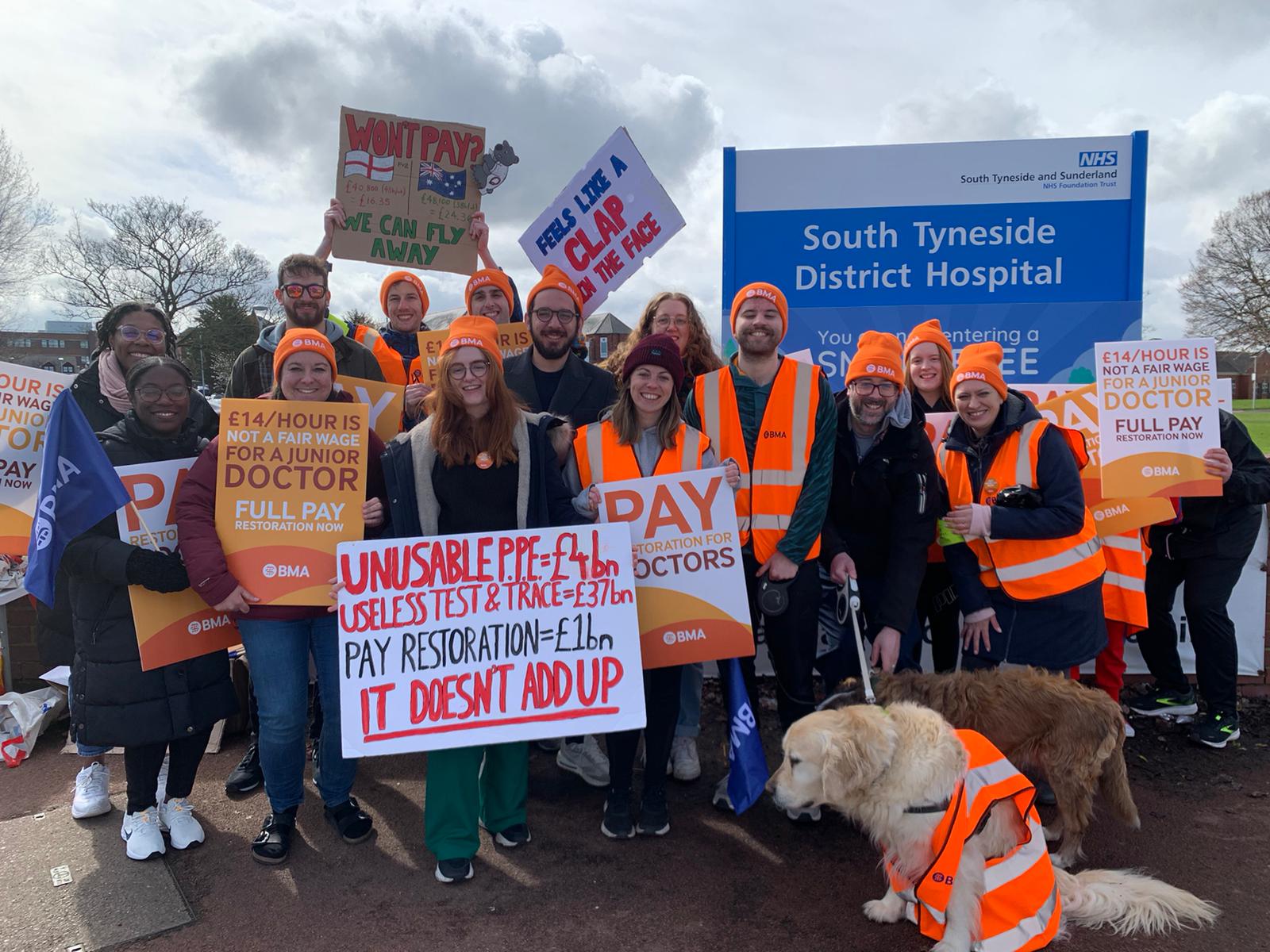
Resident doctors in England, members of the British Medical Association, are set to walk out from 7a.m. on Friday, November 14, for five days. Previously known as junior doctors, resident doctors are taking action over the government's failure to agree to a plan for jobs in the NHS and pay restoration. The lack of jobs in the employment crisis, the latest crisis of which has been caused by government-imposed cuts on NHS Trusts, was revealed by a recent BMA survey. The survey of 4,401 resident doctors showed that 34% of respondents say they have been unable to secure substantive employment or regular locums in time for August next year. Additionally, the government declined to discuss pay solutions, despite doctors' pay being eroded by 21% since 2008.
Since the resident doctors took up their fight to restore their pay under the previous government two years ago, this was their struggle taken up as part of the whole working class actions over recent times that Enough Is Enough! That the junior doctors were speaking out and smashing the silence on their working conditions was a step towards solving the crisis in the NHS, making sure that doctors are there to help tackle the waiting lists and provide the patient care that people need. In other words, the fight of the resident doctors is a fight to provide the care that people need as part of the overall health team. This is precisely what the big cartel parties now represented by the Labour government have proved that they are unable to do, or refused to solve, with their preoccupations of paying the rich and basing the economy on their unjust war preparations at the expense of public services. This has only increased this crisis further since the present government came to power.
Junior doctors strike actions in 2023 - Photo:
SSTHC
What is so noticeable now is that the fight of the doctors today is also about the whole plan for jobs and pay investment in the NHS and therefore in patient care. The doctors face another government that refuses to negotiate even a reasonable plan for jobs and pay, a government that is deliberately forcing NHS Trusts to impose "vacancy controls" and reduce vital clinical and administrative jobs further - wrecking the NHS - in favour of their schemes to pay the rich.
The government's 10-year plan for the NHS is part of this. Billed as a plan to cut "bureaucracy" and "invest in community care, AI and prevention", instead it is forcing NHS Trusts to cut eye-watering sums from their budgets, directly affecting their services and staffing levels. This is not about ending "bureaucracy" as the Prime Minister and Health Secretary Wes Streeting claimed earlier in the year. Rather it is about real cuts to clinical services and clinical staffing supposedly in favour of more "care in the community".
But, with these lies, what money is being invested by the government is flowing to the private sector. This will have little effect on the backlog of the 7.5 million people waiting for procedures, or any significant impact in improving services. The private sector has no significant capacity, unlike the public sector Trusts which have the capacity but lack the investment. The private sector is also exacerbating the situation, as they take vital clinical staff away from the NHS. Equally, they do not contribute anything towards the cost of training new doctors. By not restoring resident doctors' and GP jobs, nor their level of pay, it has also been noted that the government is deliberately and cynically enabling the transfer of doctors and medical staff to their friends in the private sector in search of better pay and conditions.
In fact, the big cartel party system treatment of the NHS has forced the issue of who decides on health care as on everything else. It reveals that the solutions to the problems in the NHS lie with the health workers themselves whose interest lies in building a modern health service which improves the conditions of patient care. The just struggle of the resident doctors, who are refusing to be ignored and negotiate their plans for jobs and restoration of their pay must be upheld. The need is for everyone to support the resident doctors and take up the fight against the jobs cuts and support a plan for jobs and pay restoration. The aim must be for a new situation where decision-making involves doctors, nurses and all health workers, along with communities and people as a whole, speaking and acting in their own name.

Junior doctors strike actions in 2023 - Photo:
PersonnelToday
Resident doctors in England are poised to strike starting November 14 due to ongoing disputes over job security and the restoration of pay that have yet to be resolved. This decision comes after the British Medical Association (BMA) urged Health Secretary Wes Streeting to resume negotiations to avert the strike [1].
The BMA Resident Doctors Committee England (RDC) says that the dispute centres on two connected issues. The first is pay erosion: the real-terms value of resident doctors' pay has fallen significantly, and the government has not committed to a credible path to restore it. Secondly, specialist training places and substantive posts remain insufficient, leading to unacceptable career uncertainty for resident doctors.
The BMA reports an August survey revealed that some 34% of resident doctors struggled to secure stable employment. The committee is advocating for a multi-year pay deal or targeted improvements for the current year to relieve the financial pressures that many doctors are facing.
Since 2008, there has been a significant 21% decline in real-term salaries for resident doctors.
Further, despite the government's recent announcement of an additional 1,000 specialty training positions, many in the medical community view these efforts as inadequate and slow in addressing the pressing needs within the healthcare system.
The BMA points out that despite over 90% of members voting in favour of action regarding both pay and training disputes, the government has shown unwillingness to address these critical issues. Following a meeting on October 13, the Health Secretary's lack of a comprehensive plan to tackle these challenges has prompted the decision for a full walk-out.
Resident doctors are instructed not to start shifts from 7 a.m. on November 14. Emergency cover will be maintained during the strike, although there will be a complete withdrawal of substantive duties.
Speaking out to make the NHS fit for doctors and patients, Resident Doctor Committee chair Dr Jack Fletcher stressed that he hoped that the government would recognise doctors' concerns by providing a mandate for a multi-year pay deal, or by agreeing to targeted in-year improvements to resident doctors' pay [2]. The BMA through its negotiations said that the government had pledged to create an additional 1,000 speciality training places, but doctors had warned that this increase is insufficient. Dr Fletcher said: "Sadly, the Government has not been willing to offer the kind of radical plan needed that would keep doctors in work and reduce waiting lists. Strike dates are the only possible outcome."
The RDC Chair emphasised that it remains possible to resolve the situation through renewed negotiations. The BMA has urged the government to prevent the strike by proposing a viable plan for pay restoration and implementing immediate reforms to expand training programmes and alleviate bottlenecks. Until then, the RDC warns a full walk-out is unavoidable. The RDC accused the government of undermining the NHS, suggesting that a reasonable proposal from Health Secretary Streeting was necessary to avert the impending strike.
Dr Fletcher said: "This is not where we wanted to be. We have spent the last week in talks with government, pressing the health secretary to end the scandal of doctors going unemployed ... a situation which cannot go on.
"We talked with the government in good faith - keen for the health secretary to see that a deal that included options to gradually reverse the cuts to pay over several years, giving newly trained doctors a pay increase of just a pound an hour for the next four years.
"We hoped the government would see that our asks are not just reasonable but are in the best interests of the public and our patients and would also help stop our doctors leaving the NHS.
"Better employment prospects and restoring pay - are a credible way forward that would work for doctors, work for government and work for our patients. Sadly, while we want to get such a deal done, the government seemingly, does not, leaving us with little option but to call for strike action."
He added: "That is disappointing, but it is not irredeemable. Wes Streeting inherited an NHS falling apart through decades of under-investment, but restoring our pay over several years, along with concrete plans to create more jobs and training place would go a long way towards the start of a new and better health service.
"We need the health secretary to step up, come forward with a proper offer on jobs, on pay. We need him to embrace change and make an NHS fit for doctors and fit for patients."
The strike date serves as a stark reminder of the untenable nature of the current situation and a call for essential change to sustain the medical workforce in England. The BMA remains willing to negotiate while prioritizing the recovery of the value of doctors' pay and the future of medical training.
On November 5, the BMA rejected a fresh offer from Wes Streeting, an offer which took no cognisance of the thrust of the resident doctors' demands. The Health Secretary was provocative in saying that the strike was "unnecessary", and missed the doctors' point about how damaging the government's wrong direction is to the NHS by saying that the strike would "harm the NHS's recovery and mean that at least some part of this offer becomes unaffordable".
In response to this provocation, RDC Chair Dr Jack Fletcher said that, even with the expansion of training places offered by Streeting, resident doctors would still be left without a job at a crucial point of their training. Dr Fletcher said: "We have also been clear with the government that they can call off strikes for years if they're willing to offer a multi-year pay deal that restores pay over time. Sadly, even after promising a journey to fair pay, Mr Streeting is still unwilling to move."
Resident doctors in Scotland are also preparing to strike in response to the Scottish government's failure to uphold a pay agreement, with formal disputes initiated by BMA Scotland. Furthermore, the TUC Congress unanimously supported motions for a weekend demonstration against Labour austerity, indicating escalating trade union actions related to ongoing healthcare sector challenges.
The stand taken by the resident doctors calls for immediate and meaningful dialogue aimed at safeguarding to the future of the NHS by taking steps that align with the needs of its workforce. A failure to engage constructively will lead to further disruptions, risking both the morale of healthcare professionals and the well-being of patients across the country. The doctors' voice must be heard.
Notes
1. Source: BMA.
Main reference: "Resident doctors set strike date", Tim Tonkin,
October 23, 2025
https://www.bma.org.uk/news-and-opinion/resident-doctors-set-strike-date
2. Resident doctors announce five-day strike as government talks collapse,
Open Access Government, October 27, 2025
https://www.openaccessgovernment.org/resident-doctors-announce-five-day-strike-as-government-talks-collapse/200424/

On November 2, the 108th anniversary of the Balfour Declaration [1], Palestinian Resistance organisations issued a joint statement affirming that they will continue their struggle against Israeli occupation and Zionist crimes.
They condemned the Balfour Declaration as "the gateway to oppression, crime, terrorism, and Zionist genocide" against the Palestinian people, their land, holy sites and national rights.
The Palestinian Resistance said that the same powers that backed the Balfour Declaration "continue to protect the Israeli occupation and its leaders from accountability, supplying them with weapons used to kill our civilians". They described this as "a reflection of their detachment from humanity, and a complete contradiction of the values and morals they claim to uphold".
The Resistance reaffirmed that the Balfour Declaration remains an unforgivable crime, and that its impact has not been lessened with time, stressing that the Palestinian people will continue to stand firm on their land and confront all US-Zionist schemes aimed at uprooting them. They vowed that not "a single grain of Palestinian soil" would be conceded, regardless of the sacrifices made.
Emphasising the importance of unity, the Resistance organisations described national unity as a strategic necessity and "the optimal path to liberate Palestine". They urged all components of the Palestinian people to work toward genuine national partnership, stating that "true unity means shared goals and joint resistance to achieve freedom and independence".
The statement further underscored that the Palestinian people "will remain committed to resistance in all its forms, foremost among them armed resistance, to confront the crimes of the Israeli occupation", affirming their unwavering right to struggle "until the defeat of the enemy and the end of aggression".
In conclusion, the Resistance called on "the peoples of the Arab and Islamic nations and the free people of the world" to continue active pressure and mobilisation in support of the Palestinian cause.
The statement by the Palestinian Resistance affirming the necessity to continue the struggle for Palestinian liberation comes amid the continuation of the more than two years of genocide in Gaza, while the latest ceasefire agreement, which came into effect on October 10, continues to be violated by Israel.
As part of the deal, Hamas released all 20 surviving Israeli captives held since October 7, 2023, in exchange for Israel's release of 1,718 detainees from Gaza and 250 Palestinian prisoners serving long-term sentences.
Meanwhile, Israel continues to breach the truce by conducting daily attacks and large-scale demolitions across the Gaza Strip, including new operations in Khan Younis and Gaza City that levelled dozens of residential buildings on November 1.
According to Gaza's Government Media Office, these assaults have compounded the humanitarian crisis and further added to the over 20,000 unexploded munitions scattered throughout neighbourhoods, endangering civilians and obstructing relief efforts.
(Al Mayadeen)
Notes
1. The Balfour Declaration was a letter sent in 1917 by the then British
Foreign Secretary Arthur Balfour to a prominent British Zionist leader
promising land in Palestine for foreign settlement.
See Workers' Weekly:
https://www.rcpbml.org.uk/wwie-23/ww23-30/ww23-30-02.htm

As Cuba faced down Hurricane Melissa, the world united to condemn the US blockade of Cuba at the United Nations for the 33rd consecutive year.
On October 28 and 29 the United Nations General Assembly (UNGA) deliberated on resolution A/80/L.6 entitled Necessity of ending the economic, commercial, and financial embargo imposed by the United States of America against Cuba. Voting took place on October 29 with the resolution adopted with 165 votes in favour, seven against, and 12 abstentions [1].
Thus the UNGA again voted overwhelmingly to stand with Cuba, to call for the immediate lifting of the US blockade on Cuba and to remove Cuba from the US List of State Sponsors of Terrorism. The vote results defeated the vicious US campaign organised through its foreign embassies, consulates and missions, according to which Cuba was recruiting mercenaries to fight on the Russian side in the US/NATO proxy war against Russia in Ukraine, along with other malicious disinformation to get UN members to vote against the resolution. Some of the countries which abstained, including Poland and Romania, cited this outright lie about Cuba being involved in Ukraine as the reason for their abstention.
The vote demonstrates the overwhelming consensus of the world that the blockade must end. As Cuban Foreign Minister Bruno Rodríguez Parrilla affirmed, Washington's lies, threats and manipulation reveal its fear of the truth that the world stands with Cuba and against the blockade. The vote is a reflection of the world's peoples' stand that justice and sovereignty must prevail, and that the cruel US blockade of Cuba must be ended.
RCPB(ML) sends its heartfelt congratulations to the leadership and people of Cuba and their United Nations delegation for this important victory on the world stage.
Note
1. Last year, the resolution passed by 187 votes with two against (US and
Israel) and just one abstention (Moldova). This year, with concerted open
threats issued by the United States, voting against the resolution in addition
to the US and Israel were Argentina, Hungary, Paraguay, North Macedonia, and
Ukraine. The 12 countries which abstained also reveal the extent of the US
dictate against them: Albania, Bosnia and Herzegovina, Costa Rica, Czechia,
Ecuador, Estonia, Latvia, Lithuania, Morocco, Poland, Moldova and Romania.
Cuba montage dealing with the effects of the
hurricane
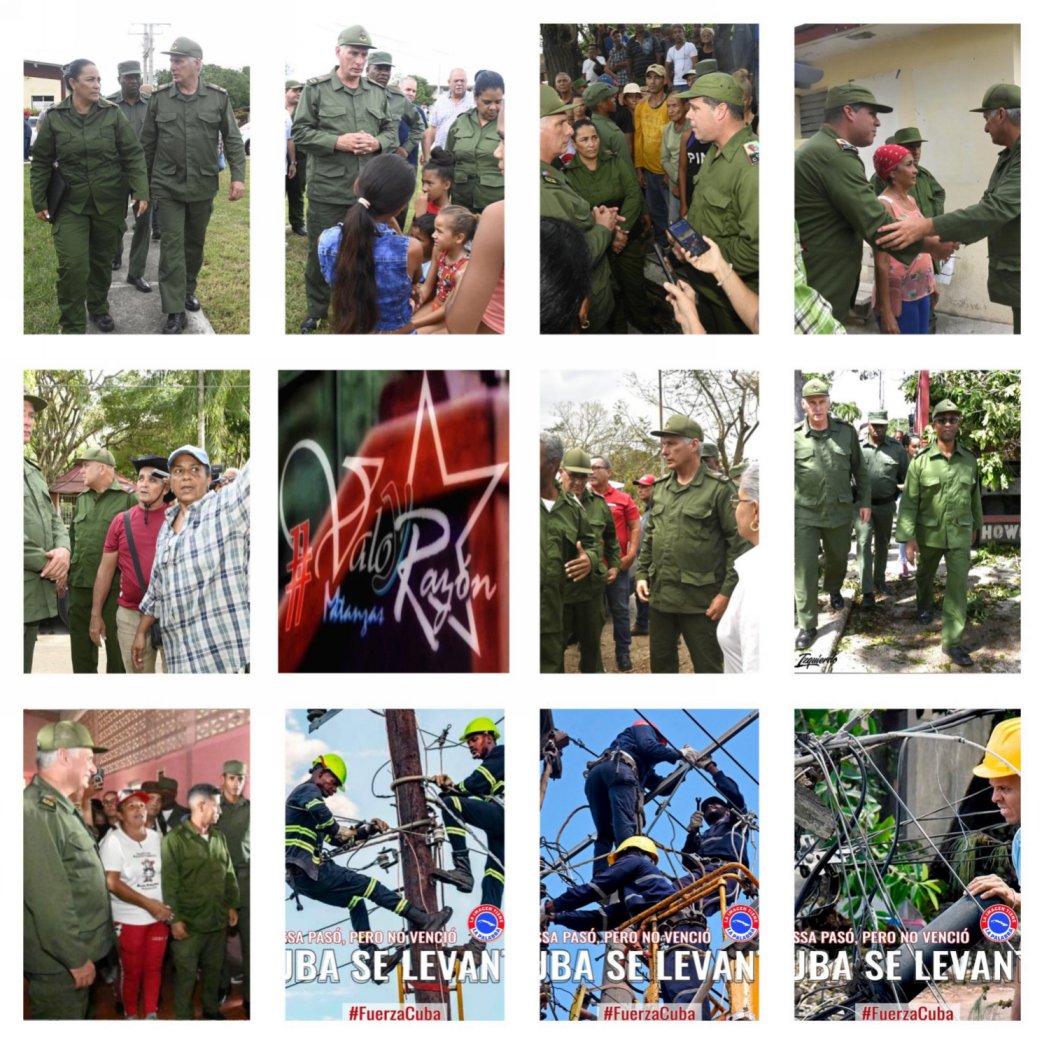
Hurricane Melissa caused widespread devastation across the Caribbean, including in eastern Cuba.
As the Cuba Solidarity Campaign (CSC) writes in its Cuba update:
"As they always have done, the Cubans mobilised en masse ahead of the storm in defence of human life. Over 735,000 Cubans were evacuated by Civil Defence teams before Melissa made landfall and, thankfully, no deaths have been recorded in Cuba.
"However, the storm has wreaked havoc in the provinces of Santiago, Granma, Holguín, Guantánamo, and Las Tunas. Officials have reported extensive damage to property, infrastructure and agriculture, with many communities isolated as a result of heavy rainfall and flooding."
CSC writes in its campaign news:
In response to the devastating impact of Hurricane Melissa, the Cuba Solidarity Campaign took the immediate decision to donate £50,000 to Cuba's relief efforts.

CSC Patron Jeremy Corbyn MP joined CSC Director Rob
Miller to formally hand over the donation to the Cuban Ambassador, HE Ismara
Vargas Walter
The donation will be used directly by the Cuban authorities to provide urgent assistance with humanitarian priorities in the provinces most affected, including much-needed medical help.
"We hope this donation will go some way in helping the people of Cuba at this difficult time. The increasingly dangerous threats of hurricanes across the Caribbean makes international solidarity across borders more important than ever. I would urge countries across the globe to reject the policies of the climate change deniers and step up and do more to counter the impacts of global warming, which is clearly responsible for the increased dangers from such natural disasters," Jeremy Corbyn said.
Expressing gratitude on behalf of her country, Ismara Vargas Walter said: "We thank you all from the bottom of our hearts for this wonderful donation which will be put to immediate use in the relief effort. As Cubans always do we will work together to rebuild, but the assistance we receive by friends such as yourselves will make that battle a little bit easier."
CSC launched the Hurricane Melissa Relief Appeal in response to the devastation. All donations will go directly to relief efforts on the island.
DONATE to Hurricane Melissa relief:
Receive Workers'
Weekly E-mail Edition: It is free to
subscribe to the e-mail edition
We encourage all those who support the work of RCPB(ML) to also support it
financially:
Donate to
RCPB(ML)
Workers' Weekly is the weekly on
line newspaper of the
Revolutionary Communist Party of Britain (Marxist-Leninist)
Website:
http://www.rcpbml.org.uk
E-mail:
office@rcpbml.org.uk
170, Wandsworth Road, London, SW8 2LA.
Phone: 020 7627 0599:
