
|
|
||||
|---|---|---|---|---|
| Volume 52 Number 26, October 29, 2022 | ARCHIVE | HOME | JBCENTRE | SUBSCRIBE |
Workers' Weekly Internet Edition: Article Index : ShareThis
The People's Assembly National Demonstration - Next Saturday, November 5!
Workers' Forum:
Midwives in Scotland Vote to Take Industrial Action over PayCuba's Report to the UN Ahead of 30th Blockade Vote:
"The World Would Be Better Without the Blockade against Cuba" Foreign Minister SaysUnited Nations General Assembly plenary meeting:
The US Government Must End Its Illegal and Criminal Blockade of the People of Cuba!
Worldwide 24-Hour Global Online Picket in Support of Cuba and UN Vote on US BlockadeSolidarity with Cuba:
Reports from the TUC and Labour Party Conference fringe meetings
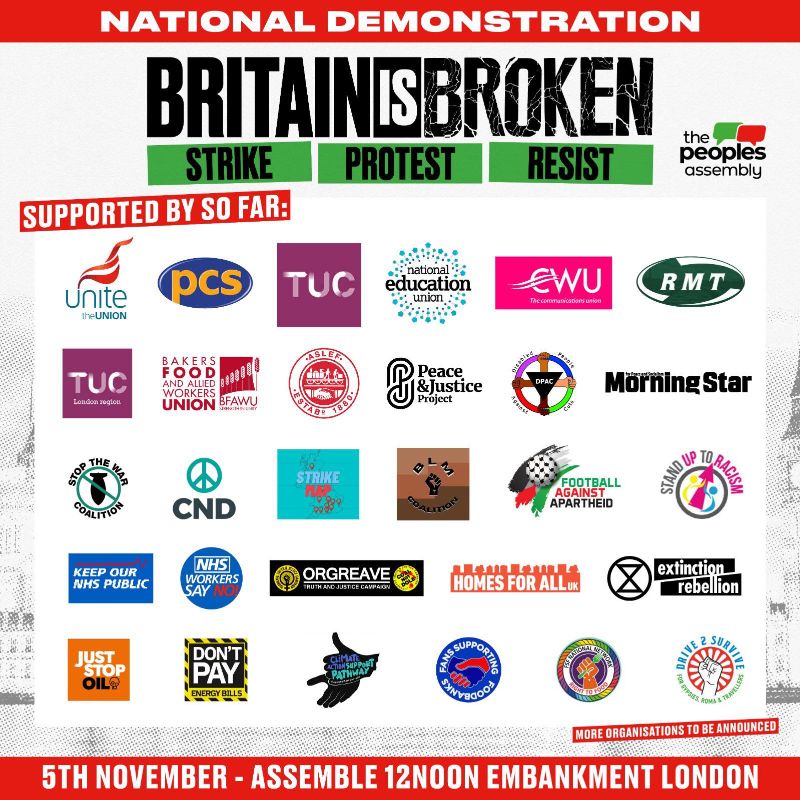
Assembling on the Embankment from 12.00 noon, the demonstration will include a march and rally.

The national People's Assembly is organising an important demonstration in London next Saturday, November 5.
The "Britain is Broken" demonstration will involve working people from unions, community groups, charities and other organisations with a common aim of demanding an end to austerity, supporting the rights of all, including workers and their unions taking strike action in defence of their members' pay, terms and conditions, and calling for an end to this Conservative government which has neither credibility nor legitimacy.

The demonstration will go ahead despite national strike action being called by the RMT union across the national rail network. Those wishing to attend are asked not to use the national rail network but to use other means of transport where possible. The People's Assembly website has details of coach transport from across the country [1].
Speakers at the rally will include Mick Lynch of the RMT, Jeremy Corbyn MP, Laura Pidcock and many more to be announced.
The demonstration comes at a time, not only when the workers' movement is finding its voice and taking action to demand Enough is Enough! but when there is widespread anger about the determination of the ruling elite to perpetuate the old constitutional order, when something new is required and is the order of the day.
As the Stop the War Coalition points out, "Budgets for weapons and war are ever-increasing while children go hungry and NHS waiting lists continue to grow.
"Bloated military budgets are never justified, not least amid the Cost of Living Crisis plunging millions of people onto the breadline. Not mentioning the war in relation to austerity is no longer an option. We won't pay for their wars. We say welfare not warfare and wages not weapons!"
Stop the War and CND are both throwing our weight behind the "Britain is Broken" demonstration, and are inviting people to join them on the anti-war bloc.
Summing up the anti-war mood of the people and the necessity for the people themselves to constitute the force for peace, Stop the War says, "It is time to end this madness. Help us make the voices for peace louder than ever as we shout 'welfare not warfare' and 'wages not weapons'.
"Another new Prime Minister, same old war policy. Rishi Sunak's selection to No. 10 is unlikely to see any trimming of the magic money tree for war.
"The re-appointment of Defence Secretary, Ben Wallace, means that huge proposed increases in military spending are set to be maintained. We're told that all departmental budgets are could face cuts but the 'defence' budget is going to be doubled to £100 billion by 2030.
"Cuts for the NHS, our schools and possibly pensions but mammoth increases for weapons and war. It's a disgrace. We have to get rid of this government before these ludicrous hikes in military spending become reality."

Photo: Dominic Lipinski, Press Association
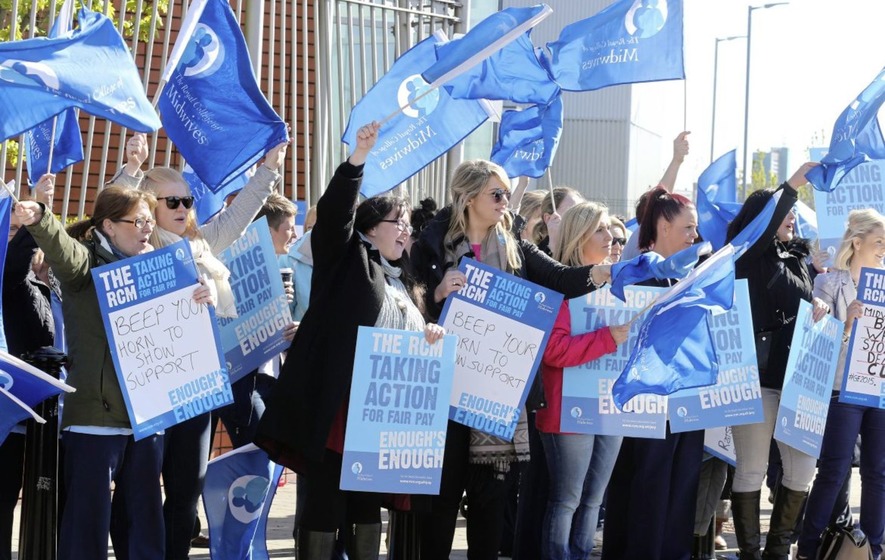
Midwife and maternity support worker (MSW) members of the Royal College of Midwives (RCM) across Scotland have overwhelmingly voted yes to taking industrial action, up to and including strike action, over the Scottish government's pay offer, which the RCM terms "insulting". The RCM ballot was launched on September 29. It closed on October 27. The offer was around a 5% pay increase for midwives and MSWs. A revised offer made late last week made no meaningful difference to the initial offer for most RCM members across Scotland; it was in fact a reduction for many. It came just as inflation rose above 10% with predictions indicating that it will rise even higher.
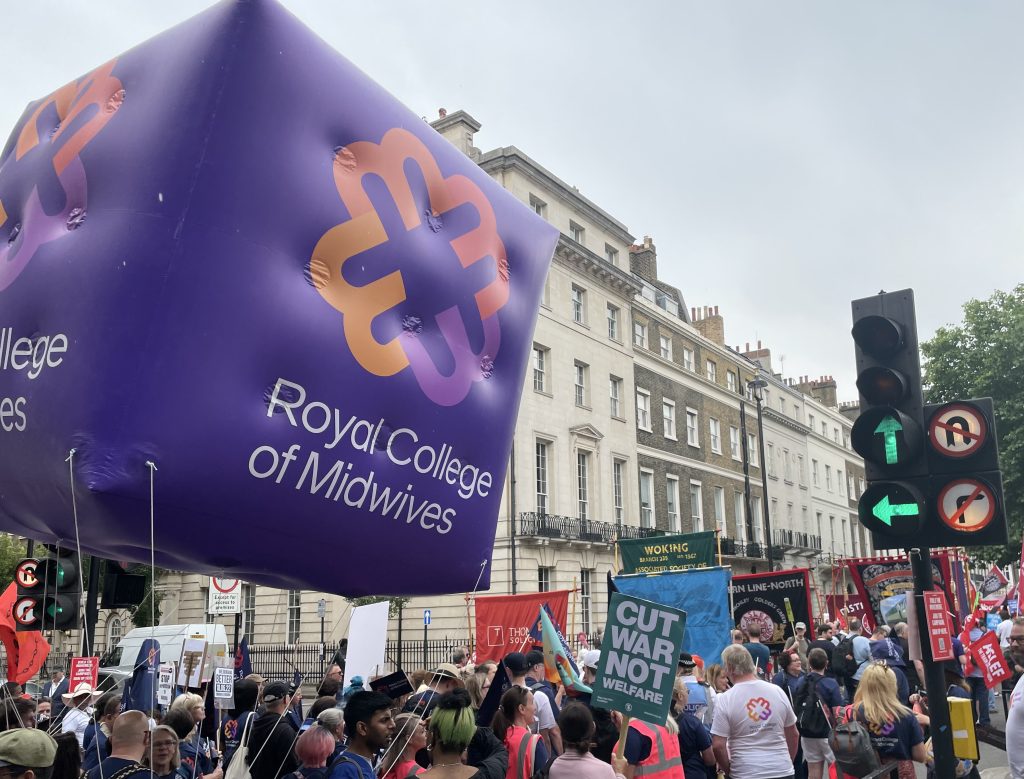
Photo: Nursing Times
For important public services, the government demands that at least 40% of those eligible to vote must be in favour of industrial action, on a turnout of at least 50% of those eligible to vote. Smashing through these thresholds, in a turnout of 61% of eligible voters, over 88% voted yes, which is 54% of all eligible voters, to taking industrial action consisting of a strike. On the question, "Are you prepared to take industrial action short of a strike," 94.6% voted yes.
The RCM therefore is very clear in declaring that its members across Scotland have sent a direct and unequivocal message that they firmly reject the initial offer from Scotland's government.
Jaki Lambert, Director for Scotland at the RCM, said: "Our members' feelings on their pay and the derisory offer from the Scottish government are patently clear. It reveals their disgust at a massively below inflation pay offer that goes nowhere near to catching up with inflation or makes up for years of pay freezes and pay stagnation. It shows that they feel just how little their dedication, commitment and skills are valued by this government. Our members have spoken, and they have said enough is enough!
"This is though not a decision they will have taken lightly. Indeed, they will have taken it with very heavy hearts, because they are committed to providing the best possible care for women, babies, and their families. They will continue to do that even if we do move to take industrial action. There is though still time to avert that. I repeat our call to the Scottish government to put a meaningful pay offer on the table that recognises that financial challenges our members face and gives them the pay award they deserve."
Enough is Enough! Photo: Irish News
The RCM says that if any type of industrial action takes place, NHS employers in Scotland will be given adequate notice. The RCM and its workplace representatives will work with maternity service managers to ensure there is cover during any work stoppages across Scotland so that safe care for mothers and babies is always prioritised.
Any decision to take industrial action must be approved by the RCM's elected Board. The RCM will now look at the result of the ballot and consider the next steps.
The RCM will begin balloting its members in England and Wales on pay on November 11. It is also currently consulting its members in the north of Ireland on pay.
The Royal College of Nursing (RCN) is also conducting a strike ballot. From October 6 to 12 noon on Wednesday, November 2, RCN members working in the NHS and Health and Social Care (HSC) on Agenda for Change contracts are being balloted on whether to take strike action. This follows the below-inflation pay award in England and Wales and pay offer in Scotland. There has been no award made in the north of Ireland at this time. The ballot is taking place by post.
RCN says: "Strike action is a last resort. But it can be a powerful tool for change. Unfairly low pay in our profession is driving chronic understaffing. It puts patients at risk and leaves nursing staff overworked, underpaid and undervalued."
(Royal College of Midwives)

Report to the national and foreign media by Cuban
Minister of Foreign Affairs Bruno Rodríguez Parrilla, October 19,
2022
Cuba has presented its report on the impact of the US blockade on the country in advance of the 30th United Nations General Assembly (UNGA) vote which takes place next week on November 2 and 3. The UNGA agenda item is: "Necessity of ending the economic, commercial and financial blockade imposed by the United States of America against Cuba".
As it has done every year since 1962, Cuba will present its "Update to the Report of Cuba on Resolution 75/289 of the United Nations General Assembly entitled 'Necessity of ending the economic, commercial and financial embargo imposed by the United States of America against Cuba' (August 2021 - February 2022)." The 29th vote, taken June 23, 2021, resulted in 184 countries voting in favour of the resolution, only two voting against it (United States and Israel), and three abstaining (Brazil, Colombia and Ukraine).
Outlining the update Cuba will present to the UNGA at a press conference on October 19, the Cuban Foreign Minister Bruno Rodríguez Parrilla described the blockade as a constant pandemic or hurricane, because of the damage it causes to Cuba.
He pointed out that this year's debate at the UN is taking place in a special context - one marked by the devastating effects of Hurricane Ian, by the effects of a multidimensional global crisis that includes an international economic crisis and an imminent threat of a global recession, food crisis, energy crisis, health crisis, and others. It also comes at a time of unprecedented intensification of the blockade, starting from the second half of 2019 based on the policy of the previous Republican government of the US of economic suffocation, of economic war, of deliberately seeking the collapse of the Cuban economy and the country, without measuring the serious humanitarian consequences or the impacts of that objective, which will never be fulfilled, he said, but which would undoubtedly lead to unpredictable consequences.
Rodríguez said that losses caused by the blockade between August 2021 and February 2022 were in the order of $3.8 billion, a record amount for such a short period of time. The Gross Domestic Product of Cuba, according to very conservative data, he said, could have grown, despite the adverse circumstances facing the economy, by 4.5 per cent in that period had those measures not been applied.
In 60 years, at current prices, he said, the accumulated damages add up to $154.2 billion. This is an exorbitant figure for a small economy like Cuba's, without great natural resources, insular, underdeveloped, he said. But, when quantifying the damage by taking into account the price of the US dollar against the value of gold on the international market, the amount comes to more than $1.391 trillion.
Some other facts he provided were:

Report to diplomatic corps, October 19,
2022
- Cuba cannot acquire, anywhere, in any way, technologies, equipment, parts, pieces, digital technologies or software, which have 10 per cent US components, which has an impact as serious as that of the lack of foreign currency to guarantee supplies.
- Dozens and dozens of banks deny services to Cuba for fear of incurring US fines. Between January 2021 and February 2022, foreign banks reported 642 refusals of service to Cuba in this regard. Dozens of diplomatic missions, of Cuban embassies today lack banking services.
- During the height of the pandemic the US allowed temporary exemptions from its unilateral coercive measures to dozens of sanctioned countries, which allowed them to purchase vaccines, oxygen and ventilators. No such exemption was allowed for Cuba.
The update explains that by keeping Cuba on its List of State Sponsors of Terrorism the US has reinforced the deterrent and intimidating impact of the blockade and Cuba's difficulties engaging in international trade and financial operations of all kinds. This represents "incalculable costs and consequences" for the Cuban people and economy.
Another aggravating factor this year's update refers to is that on top of its economic war, the US government has unleashed a pernicious media campaign in an attempt to destabilise the country. Lies, slander, manipulation of data, images and a host of other methods of unconventional warfare have been used in hopes it will lead to "regime change", which it calls a clear violation of the principle of non-interference in the internal affairs of countries:
"They placed our children, youth and artists at the centre of the media barrage. They promoted artificial leaders, fabricated pretexts for the rehearsal of a humanitarian intervention, encouraged irregular migration and displayed a misleading narrative in order to position the false image of a government in crisis, repressive and unstable, incapable of responding to the demands of its population," Cuba's Foreign Minister Rodriguez said.
The Foreign Minister said: "In the face of these adversities, in the face of the hostility of the US government, our country does not stop, or stop renewing itself. Cuba renews itself all the time. Cuba changes every day, and will continue to change. What does not change, what is not renewed, what remains anchored in the past, is the blockade policy."
As examples of the transformations taking place in Cuba, the Foreign Minister pointed to the expansion and registration of thousands of new micro, small and medium-sized companies, both state and private, as well as new opportunities for foreign investment. He referred also to the development of science, technology and innovation as a pillar of the revolutionary government's management. He mentioned the new Family Code, adopted by referendum on September 25, as another example of the principle Cuba adheres to of "changing everything that needs to be changed and moving towards a fairer, more humane, more democratic socialism for all our people".
Rodríguez made a point of saying that rejection of the blockade was one of the most discussed topics in the speeches of the Heads of State and Government at the High-Level Session of the UN General Assembly at the end of September, with 40 of them demanding the end of this policy. Some, he said, "called for Cuba to be removed from the United States government's arbitrary, unjust, capricious, immoral and illegal list of countries that sponsor terrorism. Others expressed appreciation for Cuba's cooperation, especially the international medical cooperation that Cuba offers in a modest and quiet way."
All of this shows, Rodríguez said, that the blockade only leads to isolation and discrediting of the United States government. The majority of those in the US oppose it, the majority of Cubans residing in the United States and in other countries oppose it, and it is rejected practically unanimously by the international community.
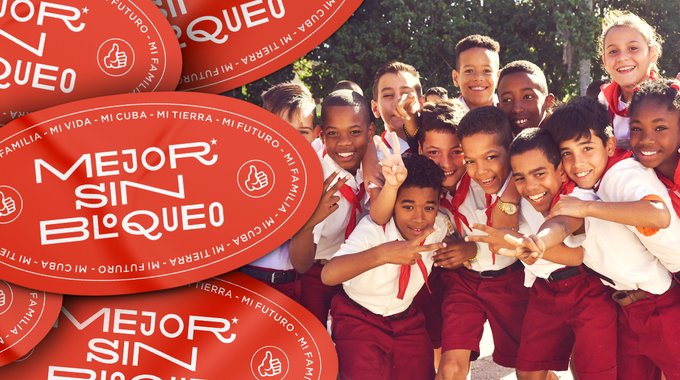
He concluded his remarks by saying, "Cuba has the right to live without a blockade; it has the right to live in peace. Cuba would be better off without lockdown. Everyone would be better off without the blockade. The United States would be a better country without a blockade against Cuba. The world would be better without the blockade against Cuba."
The full transcript of Minister Rodríguez's remarks can be found on
the website of the Cuban Solidarity Campaign:
https://cuba-solidarity.org.uk/news/article/4421/the-constant-pandemichurricane-of-the-blockade-on-cuba---report-in-advance-of-un-vote
Caribbean Network for Solidarity with Cuba (CNSC)

Flag No More Blockade
On the 2nd and 3rd of November 2022, the United Nations General Assembly (UNGA) will hold a plenary meeting to debate the item titled, "Necessity of ending the economic, commercial and financial embargo imposed by the United States of America against Cuba". It will also discuss the report submitted by the Secretary General on the implementation of Resolution 75/289 which was adopted by the General assembly on 23 June 2021. This resolution called on all member states to "refrain from promulgating and applying laws and measures" such as those that the US has adopted in its blockade of Cuba and further called on the US government "to take the steps necessary to repeal or invalidate them as soon as possible". This resolution was adopted with 184 votes in favour, 2 votes against, 3 abstentions and 4 non participants. Thus it reflects the near universal demand of the people of the world for the US to end its illegal and cruel economic blockade of Cuba which has no other purpose than to impose harsh suffering on the people of that country in order to bring about regime change there. The demand for the ending of the blockade is also reflected in the Secretary General's report which includes responses from 157 UN member states, 31 UN agencies and 3 UN observer organisations which outline their opposition to the US imposed embargo as well as identifying the ways in which this hampers Cuba's participation in international activities.
However, since the adoption of resolution 75/289 in June 2021, the US government has remained unmoved in disregarding world public opinion and maintaining its cruel blockade against Cuba and her people. The upcoming UNGA debate on the blockade will mark the 30th consecutive year that the world community has discussed this cruel economic warfare against Cuba and it is expected they will once again, as they have done on the previous 29 occasions, demand that the US lift its blockade.
It is hypocritical in the extreme that the US government demands that Russia pay attention to the views expressed by the UN General Assembly, while it ignores the views of this assembly when they demand that the US end its illegal blockade of Cuba. It is also worth noting, that while the current US Democratic administration claims to be opposed to Trump and his MAGA movement, it has faithfully implemented the additional sanctions introduced by Trump against Cuba.
Today, the world can no longer tolerate the US government's attempt to starve Cuba and her people into submission. This is particularly so when Cuba is attempting to recover from the destructive passage of Hurricane Ian and the recent accident at the Matanzas oil facility. Across the world, popular actions and mobilisations are taking place to demand that the US end its cruel blockade of Cuba. Even parliaments, such as Jamaica's, are adding their voice to this just call.
The Caribbean Network for Solidarity with Cuba (CNSC), along with people's organisations across the region, add our voice to this global call.
Lift the blockade and let Cuba live!
This statement is supported by the following organisations (in alphabetical order):
Association Martinique Cuba
Caribbean Network for Solidarity with Cuba
Cuban Barbadian Friendship Association
Grenada Cuba Friendship Association
Guyana Cuba Friendship Association
Jamaica Cuba Friendship Association
Latin American and Caribbean Continental Network of Solidarity with Cuba
Les Amis de Cuba (Guadeloupe)
Oilfield Workers Trade Union (Trinidad and Tobago)
Saint Lucia Cuba Humanistic Solidarity Association
Trinidad and Tobago Cuba Friendship Association
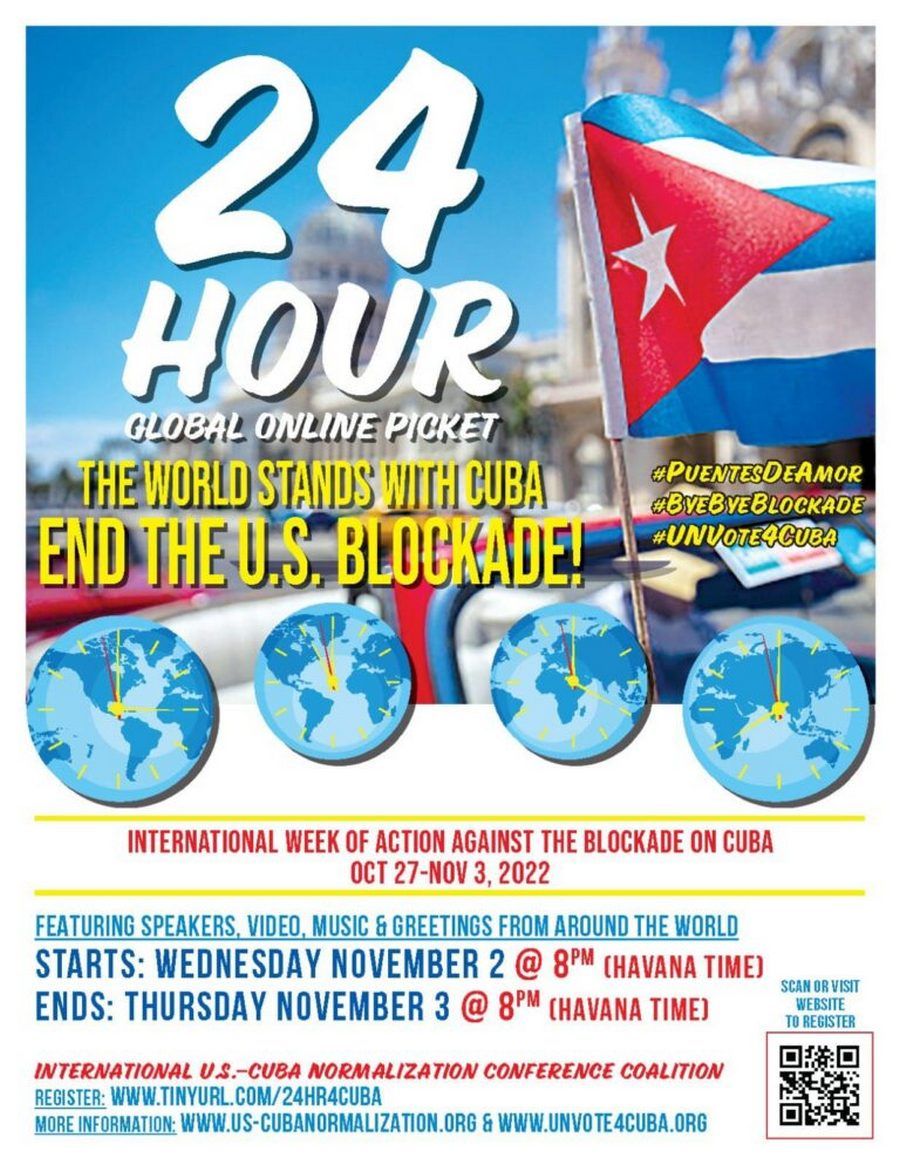
Starts: Wed., November 2 -- 8:00 pm (Havana Time/EDT)
Ends: Thurs., November 3 -- 8:00 pm (Havana Time/EDT)
Cuba Solidarity Campaign
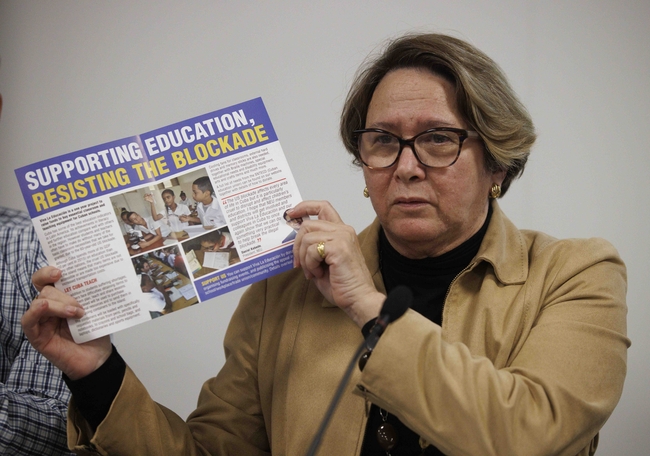
Her Excellency Bárbara Montalvo Álvarez -
Photo: Mark Thomas
CSC held successful fringe meetings at the TUC Congress and Labour Party Conference with MPs and trade union leaders from across the trade union movement this autumn.
On September 27, the Cuban ambassador to Britain, Her Excellency Bárbara Montalvo Álvarez, told Labour Party delegates in Liverpool of the "incalculable, massive and cruel" impact of the US blockade in its 60th year.
At the rescheduled TUC meeting in Brighton on October 18, a joint meeting together with the NEU (National Education Union) on "Supporting Education, Resisting the Blockade" focused on Cuba's achievements in education in the face of the blockade and building trade union support for the Viva La Educación appeal.
For the full CSC reports on these meetings, see:
Supporting Education, Resisting the Blockade:
https://cuba-solidarity.org.uk/news/article/4423/lsquosupporting-education-resisting-the-blockadersquo-tuc-congress-fringe-meeting
Sixty years too long - End the US blockade of Cuba:
https://cuba-solidarity.org.uk/news/article/4424/a-high-price-for-independence-labour-party-conference-report
Receive Workers'
Weekly E-mail Edition: It
is free to subscribe to the e-mail edition
We encourage all those who support the work of RCPB(ML) to also support it
financially:
Donate to
RCPB(ML)
Workers' Weekly is the weekly on
line newspaper of the
Revolutionary Communist Party of Britain (Marxist-Leninist)
Website:
http://www.rcpbml.org.uk
E-mail:
office@rcpbml.org.uk
170, Wandsworth Road, London, SW8 2LA.
Phone: 020 7627 0599:
