
|
|
||||
|---|---|---|---|---|
| Volume 52 Number 22, October 2, 2022 | ARCHIVE | HOME | JBCENTRE | SUBSCRIBE |
Mini-Budget:
Workers' Weekly Internet Edition: Article Index : ShareThis
Mini-Budget: Time for the Working Class to Set a New Direction for the Economy
Enough Is Enough!:
Broad Sections of Working People Participate in Actions on October 1Workers' Forum:
Dockers Vow to Continue Strike Action at Port of FelixstoweWorldwide day of action for Mother Earth:
September 23 Climate Strike Actions for Climate JusticeFor Your Reference:
The Monarchy, Human Trafficking and Slavery
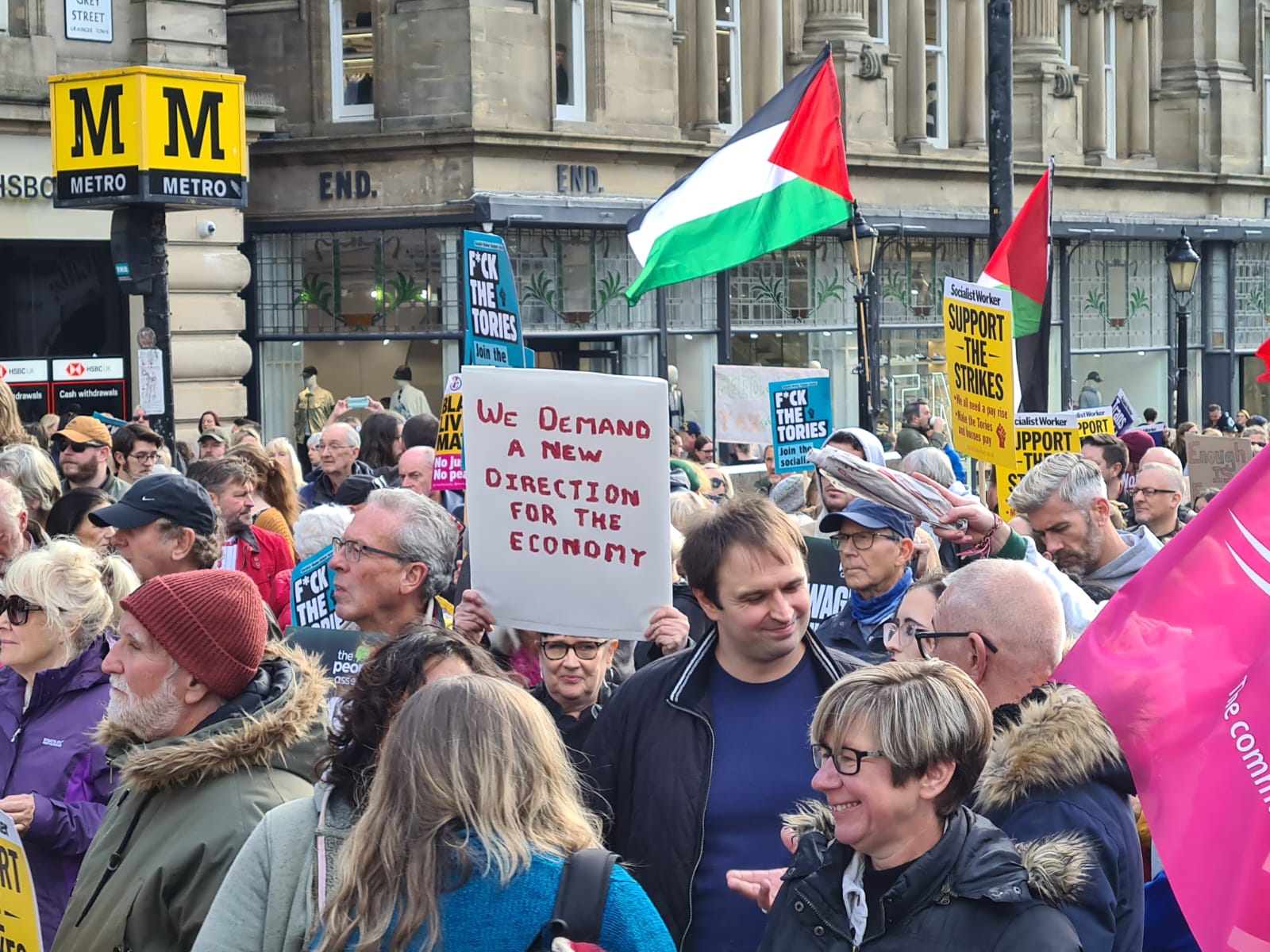
Enough is Enough Rally in Newcastle - October 1, 2022
Photo: Workers' Weekly
The so-called "Mini-Budget" elaborated in the House of Commons on Friday, September 23, was nothing but a financial package to make sure that the rich get paid in the conditions of an economic crisis that is the making of the ruling elites and oligarchs, not the working class and people.

Enough is Enough Rally in Nottingham - October 1, 2022 -
Photo: Westbridgford Wire
Chancellor of the Exchequer Kwasi Kwarteng's budget was an open declaration of war against working people, a declaration that the government is determined it will have no responsibility for the fate of society or care for social programmes. It was a declaration that working people and society as a whole can go to hell in a handcart as long as the financial oligarchy and the richest centile of the population can continue to make literally millions and billions in the context of the crisis. Gone is all vestige of the fraud of "levelling up", beloved of Boris Johnson. The rationale of the "mini-budget" does not even really justify the description of "trickle-down economics", itself a fraudulent concept as many even in the Conservative Party have declared, because "prosperity" and "growth" is made synonymous with safeguarding and expanding the interests of the rich by attacking the poor. As such, it is a programme to make sure that the rich can emerge from the crisis unscathed and further enriched. It is a prime example of government by police powers, of random, arbitrary dictate, that even the Conservative MPs, many of whom became marginalised under Boris Johnson and are being further marginalised under Liz Truss, are concerned about. [Stop press editorial note: It has been announced that the slashing of the tax band of 45% for earnings of above £150,000 p.a. is not to go ahead. It could simply be that the proposal was floated to ascertain reaction, which has been predictable to all but Liz Truss, Kwasi Kwarteng and their coterie. It also turns out that this measure was the Chancellor's decision alone, and had not been discussed in Cabinet.] One of the main features is to reverse the cap on bankers' bonuses, which had been introduced as one of the measures to salvage the neo-liberal economic system from its 2008 crisis. As commentator Craig Murray pointed out in his blog, "the cap on bankers' bonuses was to remove the perverse incentive whereby a banker got a bonus of ten years salary by creating 'assets' of bad loans, with no care whether those loans collapsed or not two years later, as he already had his ten years' bonus." It is further certain that there will be no cutbacks on military production and war preparations, themselves a further drain on the economy and a crucial factor in exacerbating the economic crisis.

Enough is Enough Rally in Nottingham - October 1, 2022 -
Photo: Westbridgford Wire
The mini-budget announcement, with its emphasis on every person for themselves and devil take the hindmost, has itself unleashed financial anarchy and chaos, with its unpredictable consequences. There is no coherence to the announced measures. It has become clear that clashing vested financial interests are at the heart of government. One such has been the "think-tank" Policy Exchange, for example. As an opinion piece by George Monbiot explained, "Truss's politics have been shaped by organisations that call themselves think-tanks, but would be better described as lobbyists who refuse to reveal who funds them. Now she has brought them into the heart of government." He continued: "Her senior special adviser, Ruth Porter, was communications director at the Institute of Economic Affairs (IEA), an extreme neo-liberal lobby group." George Monbiot elaborated: "When she worked at the IEA, Porter called for reducing housing benefit and child benefit, charging patients to use the NHS, cutting overseas aid and scrapping green funds. She then became head of economic and social policy at Policy Exchange, which was also listed by Transparify as 'highly opaque'. Policy Exchange is the group that (after Porter left) called for a new law against Extinction Rebellion, which became, in former home secretary Priti Patel's hands, the Police, Crime, Sentencing and Courts Act. We later discovered it had received $30,000 from the US oil company Exxon."
In opposition, there is a programme which is taking root within the working
class. One expression of this is the movement "Enough is Enough". It
is an expression that the workers will not be held captive to the self-serving
manoeuvres and ideology of narrow private interests, and neither will they be
subservient to governments that rule by police powers. Many strands are coming
together to show that this is a crucial historical juncture that the working
class must take advantage of. Along with the

Enough is Enough Rally in Nottingham - October 1, 2022 -
Photo: Westbridgford Wire"Enough is Enough"
movement has come a situation where the old forms of governance no longer
function, being brought to a head with the Truss government, and as well the
old constitutional order has been brought into question with the death of the
old monarch and the accession of a new one. The conclusion which the ruling
elites are trying to mystify is that new forms and a new constitutional order
must be brought into being, and the agency for this change must be the working
class and people themselves.
Once more, the situation crucially points to the working class organising on the basis of its own independent politics. It is based on the economic fact of life that it is working people who produce the social wealth of society. Who has priority claim on this wealth is the issue. Our call is that workers continue to make their claims on this wealth and do not halt the momentum of the movement to defend these claims. That is really the essence of the declaration that Enough is Enough! Within this, workers are declaring that they will defend what belongs to them by right, and by doing so will benefit the well-being not only of workers themselves but of society as a whole, directly counter to the programme and ideology of the present government. Furthermore, it can be recognised that this is a decisive historical juncture which calls for the workers to set out and move forward on a new course, a new direction for the economy and society as a whole. The workers' opposition must not be blocked. By keeping the initiative in their own hands, organising on the basis of their independent politics and programme, workers can and are determined to turn the situation around in their favour.
Now is the time for the working class to put on the agenda for solution the necessity to set a new direction for the economy and to achieve the political power which will be indispensable to achieve this transformation and bring the productive forces under their own control.
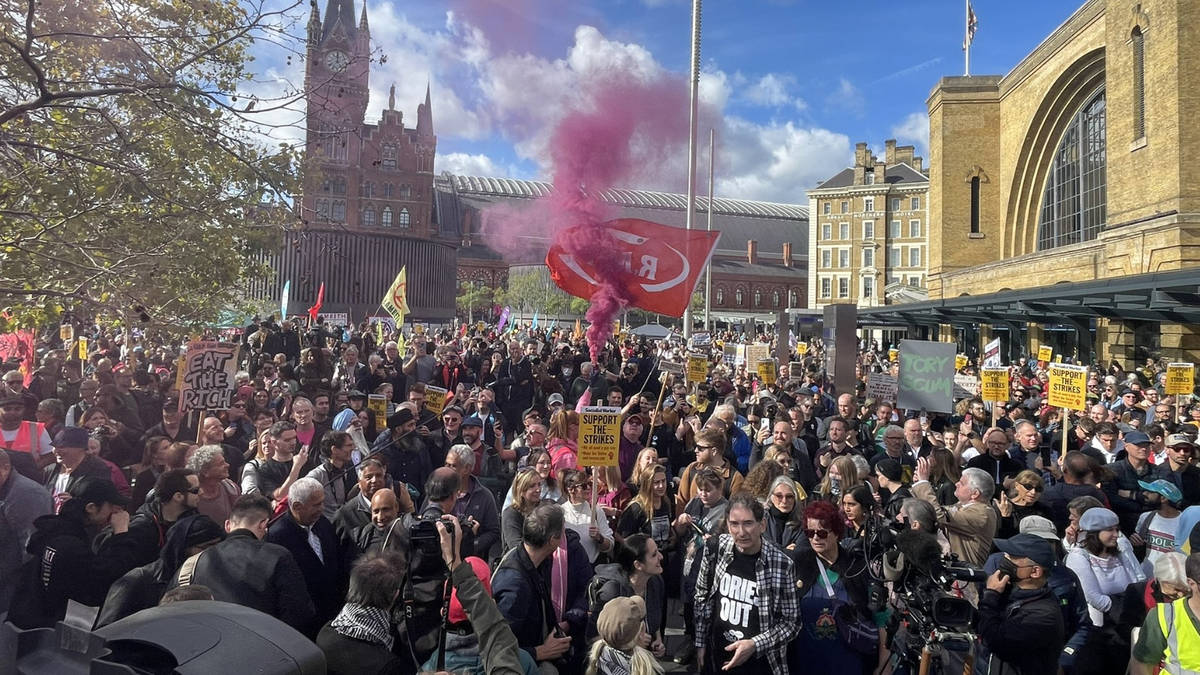
London Kings Cross - Photo: JNews
Many thousands of working people took to the streets in cities from Plymouth to Glasgow on October 1 in actions inspired by the movement Enough is Enough!
The context is the demand of workers that their rights, their wages and conditions, must not be sacrificed through the cost-of-living crisis. Actions at around 50 towns and cities were recorded. The participants in the demonstrations were swelled also by opposition to and anger against the government's "mini-Budget" and its hand-outs to the rich. Some 175,000 had signed up to march at the rallies.

Activists set fire to their energy bills in several cities including London, in a protest against rising energy bills. "Don't Pay UK" has launched a campaign that has received nearly 200,000 pledges from people who said they were prepared to stop paying their energy bills. The organisation has said that it will continue until the campaign reaches 1 million signatures.
In London, several thousand people gathered at the Enough is Enough protest outside King's Cross station speech to hear speeches from union leaders, MPs, strikers and celebrities. The atmosphere was one of collective rage and a determination to take a productive stand, mobilising the working class to fight for and defend its interests.
Speaker after speaker got massive cheers for denouncing the government and the chaos their system is delivering. Tower Hamlets MP Apsana Begum spoke of the dire consequences of the anti-social offensive. Jeremy Corbyn condemned a situation in which Britain leads Europe for inequality in the fifth biggest economy in the world. NEU joint general secretary Kevin Courtney called for unity and co-ordination between the strikers. This was also emphasised by RMT general secretary Mick Lynch, who said: "The working class is back and nothing should divide us. All the unions need to work together so they don't pick us off one by one and the People's Assembly and Enough is Enough and all the other campaigns need to be co-ordinating."

Manchester Rally - Photo: Karen Buckley
In a separate action, "Just Stop Oil" and climate campaigners blocked two bridges over the Thames, including Westminster Bridge, where activists sat in the road and played music, chanting slogans demanding that the climate crisis gets addressed. Crowds also gathered outside Euston station, carrying many Extinction Rebellion (XR) and Cuban flags and placards such as "Save My Future" and declaring that capitalism is "the enemy of Mother Earth".
Manchester had proportionately one of the biggest protests around the country. Around two thousand people assembled in Piccadilly Gardens. As well as Enough is Enough speakers, there were speakers from the rank and file of the unions, refugee campaigners, Acorn, Manchester TUC, the People's Assembly and others. Karen Buckley, People's Assembly Manchester convenor, stressed the need for maximum unity in the fight against the ruling elite.
Hundreds of people in Liverpool took to the streets. Protesters gathered at St George's Plateau in Liverpool city centre in an action backed by West Derby MP Ian Byrne and trade union groups including the Communication Workers' Union and the RMT, as well as community activist groups such as ACORN, Fans Supporting Foodbanks and Right to Food Campaign. Speakers at the rally, which attracted around 1,000 people, included trade unionists involved in the ongoing strikes at the Port of Liverpool, at National Rail and at Royal Mail delivery offices.

Also speaking were representatives of the Fire Brigade Union (FBU). Lee Hunter, a local firefighter and active member of Merseyside FBU said: "Firefighters work in the heart of our communities and see first-hand the consequences of inequality, brought about through austerity and continued attacks on the working class. Alongside other workers firefighters have effectively seen their pay cut as the cost of living has continued to rise, to the point where some are worrying about how they will cope financially. Our members will no longer suffer these ideological attacks and we will stand shoulder to shoulder with the most vulnerable in society to demand a better future for all. That is why the Fire Brigades Union on Merseyside and nationally support Enough is Enough."
In Glasgow, thousands of protesters gathered on the Buchanan Galleries steps, as two demonstrations converged. Activists from the Enough Is Enough campaign joined striking unions in the city, shouting slogans such as "Victory to the working class!". Chris Mitchell from the GMB union, who became well known in the city for his rousing speeches during the Glasgow bin workers strike during Cop26 in November 2021, told the protesters: "You should be proud of yourselves today. The working class are alive and kicking!"
In Birmingham, thousands joined the Enough Is Enough rally outside New Street station. The Conservative Party Conference began in Birmingham the next day, and a march was held from New Street to the ICC where the conference is being held.

March in Nottingham - Photo: Westbridgford
Wire
The Bristol Enough is Enough rally saw up to 1,500 people out on the streets. After speeches from Acorn and striking UCU FE workers, the march headed off to the headquarters of OVO energy which was temporarily besieged by the large crowd. Marchers then joined the picket line of striking rail workers at Temple Meads, where the main road was blocked for some time, clearing only to let an ambulance through. Hundreds of demonstrators then marched to a Royal Mail delivery office in South Bristol, joining the CWU pickets.
In Norwich there was a large turnout for a rally with people filling the streets, shouting slogans and holding signs with messages such as "Power to the people" and "Support the strikes".
In Nottingham, thousands marched from Nottingham Station to Old Market Square. Representatives from Unite the Union, RMT, CWU, West Bridgford Labour Party, University of Nottingham, Keep Our NHS Public were among many others joining the day of action.
Around 1,000 people filled the streets of Newcastle as they took part in the Enough is Enough rally against the cost of living crisis. It was one of the city's bigger rallies in recent years. Among the speakers at Grey's Monument in the city centre were Jo Shafto of CWU and Jessica Robinson of RMT, both currently in dispute, received great receptions as they condemned their profiteer employers for making a killing while forcing workers and service users to accept cuts. Representatives from UCU, PCS, TUC also spoke to huge cheers.
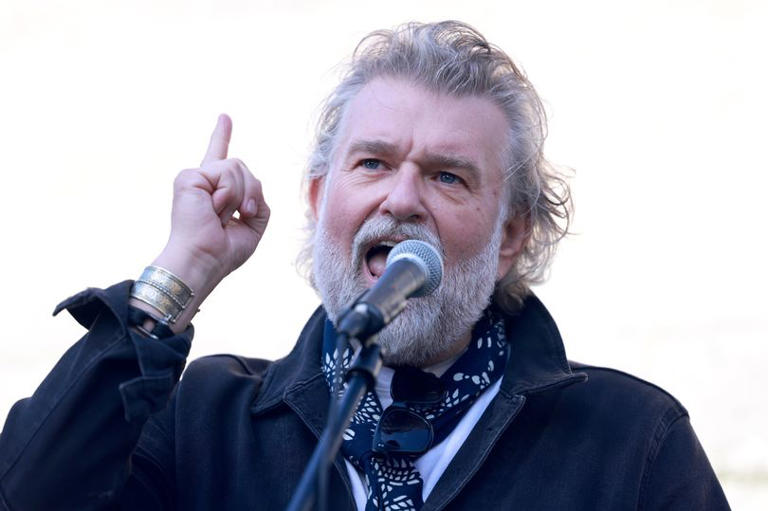
Hairy Bikers celebrity Si King - Photo: Newcastle
Chronicle
Speaking to crowds at the Newcastle rally, Hairy Bikers celebrity Si King said: "I am here to talk about hope. That we, the people, can change unfair systems that put profit and unending growth before our families and our communities. That we, the people, in calmness, can educate, inform, and debate. That, we the people, can make changes. Because as individuals and as families and communities, we the people, have the power to do so." Si King said: "People should rightly be concerned. It is not about party politics. I don't care whether you vote Tory, Liberal or Labour. What I do care about is the humanity of things. People are being pushed into poverty and desperation through absolutely no fault of their own but through systems in place that are fractures and broken and don't work. You can't continue to put profit and corporate wealth and power over people and their lives."

Newcastle Rally - Photo: Workers' Weekly
The North of Tyne Mayor Jamie Driscoll and local MP Ian Lavery both gave powerful speeches urging the need to fight on after today. People's Assembly's Tony Dowling's emphasised that the fight of striking workers "is everybody's fight!" chimed with the insurgent mood of the crowd. Lisa Doherty, a volunteer from NUFC Fans Food Bank, said, "We agree completely with the aims and demands of Enough is Enough. We go to St James' Park every match day and collect money and food which then gets given to the West End Food Bank - one of the biggest food banks in the country." Liz Blackshaw, TUC regional secretary for the northern region, said: "We are here to protest against the Government's continued lack of response to the cost of living crisis. We are not seeing enough wage increases and we're not seeing any response to demands for the windfall tax on big energy companies. We saw bankers lose their cap last week, so they have unlimited pay opportunities, whereas public service workers are still waiting for a cost of living reflection in their pay." Enough is Enough's Regional Coordinator for the North East Declan Mulholland, said: "Hard-working families in the North East are living in destitution and desperation whilst the rich get handouts. It's totally unacceptable, the working people of our region deserve better. We are gathering this Saturday to say Enough Is Enough." The rally was followed by a march to the RMT picket line at Central Station.

Rally at City Hall, Sheffield - Photo: James
Black
City Hall in Sheffield was the venue for a rally backed by the People's Assembly and the Trades Council. It ended in a march through the central shopping district. The secretary of the Sheffield Trades Council, Martin Mayer, called for people to fill all the remaining seats on the following day's coach to the demonstration at the Conservative Party conference in Birmingham.
In Crewe, East Cheshire People's Assembly and the Crewe and District Trades Council came together for the first time to organise a demonstration in support of striking rail and mail workers and to demand an end to the Tory Government. Taking part in the demonstration were pickets from RMT, TSSA, Aslef, Unite, and the CWU, alongside many others.
At the Hastings Demands Better large rally the mood was determined and defiant. Unions and local campaigns came together in unity against the cost of living crisis and against the system as a whole.

City Hall Belfast - Photo: Belfast News
Hundreds of people gathered outside City Hall in Belfast to demand more government action amid the cost of living crisis. The event, which was organised by campaign group the Cost of Living Coalition, was addressed by representatives from trade unions, community groups and political parties. One of those who spoke to the crowd was Northern Ireland's Children's commissioner Koulla Yiasouma. She said that prior to the pandemic there were 110,000 children in the north of Ireland living in poverty. The commissioner added there were concerns that some children could die from hypothermia over the winter months. "This is Northern Ireland in 2022 and we're worried about children dying of hypothermia," she said. "It's time for our governments, wherever they are, to make different choices."
On the Isle of Wight, people gathered in St James's Square, Newport. Darren Galpin, who has been organising the monthly protests under the banner of "The People's Assembly Against Austerity", spoke for the need for increasingly urgent action to help with the cost of living crisis. Cllr Richard Quigley and many members of the Island Labour Party were there, as was Vix Lowthion and her Green party supporters. Mark Chiverton of the trade union Unison, spoke on behalf of workers, and said that there will be another national rally on November 5 in Newport, as well as in London. People were keen to participate further in the local and national campaigns.
Among the other places where rallies and demonstrations were held on October 1 were Hull, Portsmouth, Plymouth, Southend, Ellesmere Port, Huddersfield, Lancaster and Bath.
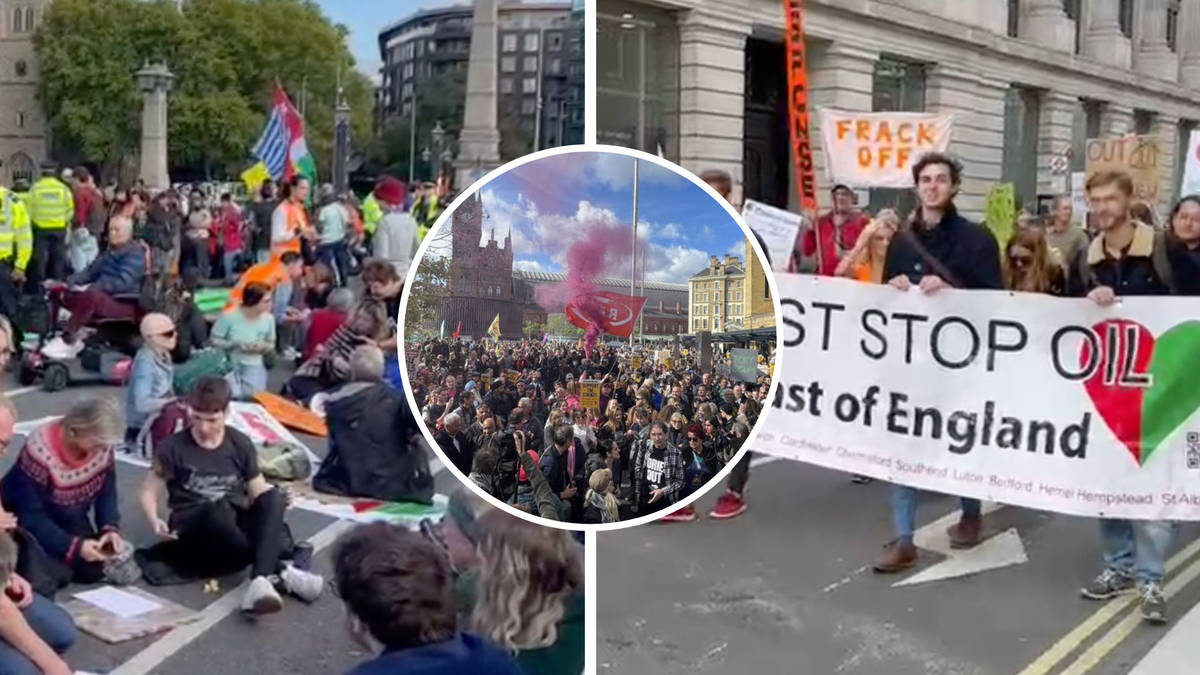
London
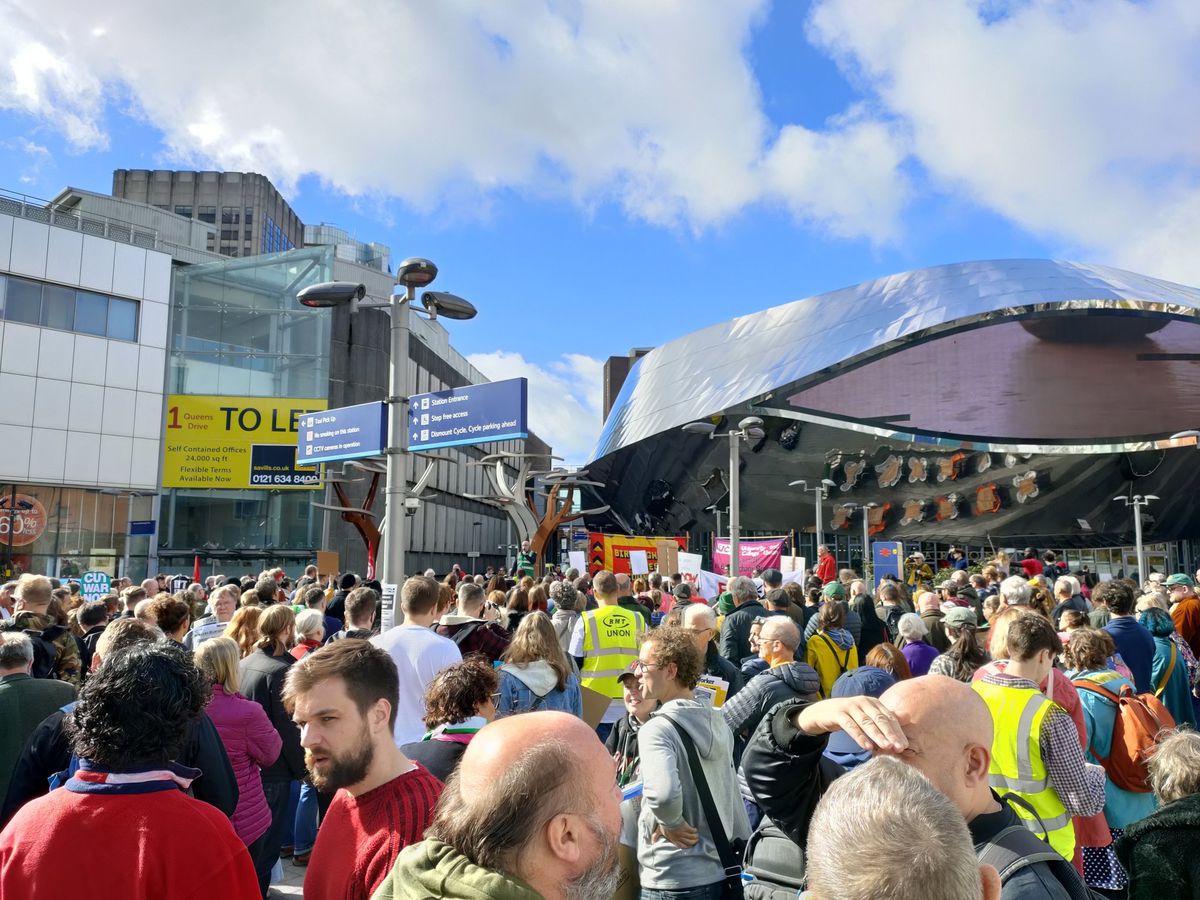

Birmingham - Newport Isle of Wight
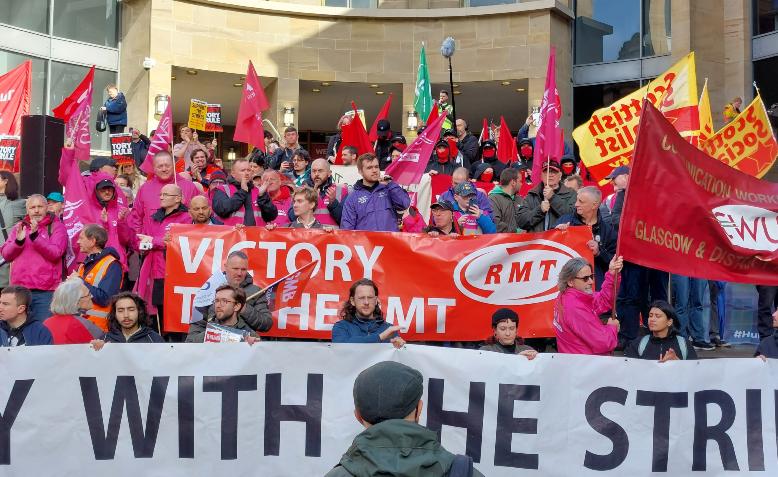
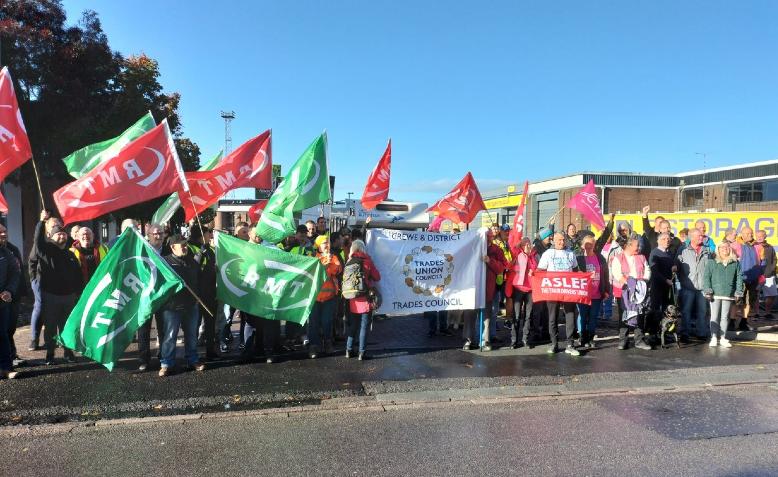
Glasgow - Crewe
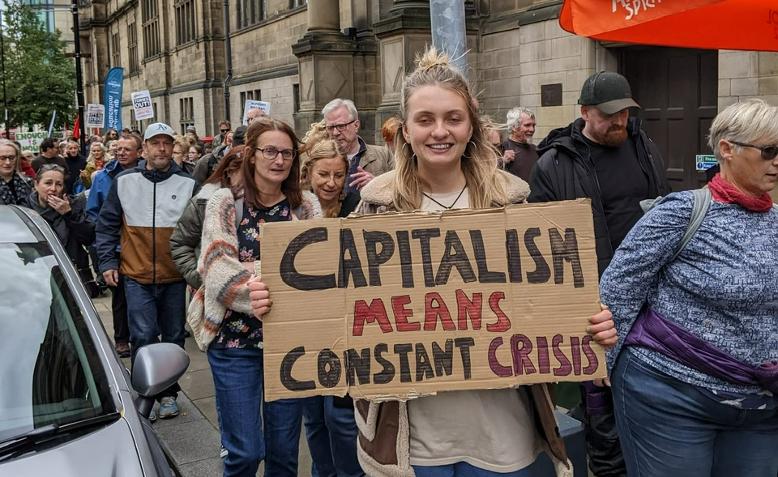

Sheffield - Nottingham
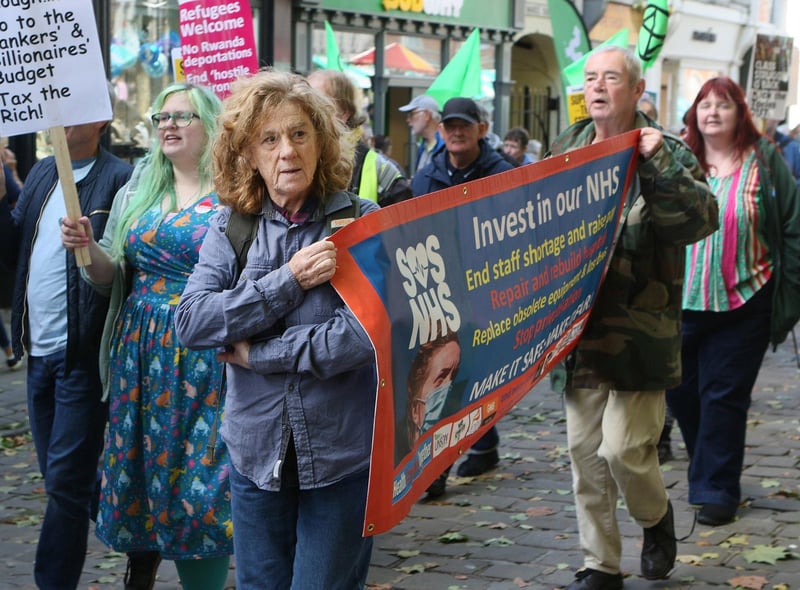
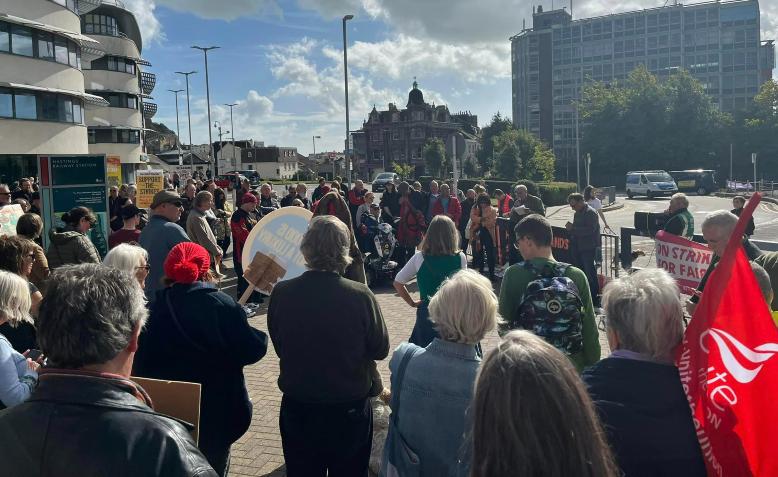
Chesterfield - Hastings
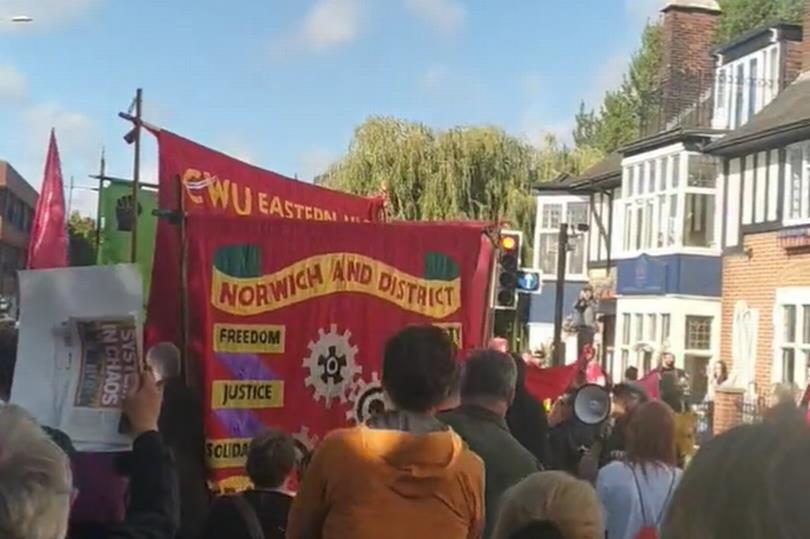

Norwich - Nottingham

Members of the Unite union on a picket line at the Port
of Felixstowe
After eight days of continuous strike action in August, 1,900 Felixstowe workers, members of Unite, began a new round of strikes at Britain's biggest container port on Tuesday, September 27. The disruption is having a huge effect on the supply chain as some 48% of the country's container trade normally passes through the Suffolk port.
The strike action is being held despite enormous pressure to block the dispute. Dockers refused to be intimidated from propaganda directed at them by media and employers. The pressure has been intense, both citing the state of the economy and calling on workers to cease action out of respect for the death of one monarch and ascension of another.
Despite this, workers held firm, with their union serving notice to the Port of Felixstowe that they would walk out from September 27 to October 5. Simultaneously, there is a two-week strike by workers at the port of Liverpool, from September 19 until October 3. In a statement, the Port of Felixstowe, which is owned by the multinational port operator CK Hutchison, registered in the Cayman Islands, said: "We are very disappointed that Unite has announced this further strike action at this time".
In complete disregard for the claim by workers, the company declared no prospect of reaching agreement. So much for "respect". The disrespect by the establishment and employers is unrelenting at present. Fire and rehire, the tearing of contracts and imposition of conditions, and the cost-of-living crisis reveal the kind of respect given to workers and their families across all sectors at this time. In this case, the Port company have imposed a pay package, which, in conditions of inflation surpassing 10%, provides mere 7% rise plus a "bonus" of £500. Workers have had no choice but to reject this imposition.

Felixstowe picket line at one of the entrances - Photo:
Richard Allday
All around we see workers fighting for their rights and the rights of all in the current crisis. The workers have declared that Enough is Enough! Unions and workers have even declared a national campaign using this call, which has underlined the momentum of the workers' movement to refuse to shoulder the burden of the cost-of-living crisis. The workers on the docks have declared their intention to keep up the momentum. Many workers wish to up the struggle to a new level.
"The latest strike action is entirely of Felixstowe's own making," said Unite national officer Bobby Morton. "Rather than seeking to negotiate a deal to resolve the dispute, the company instead tried to impose a pay deal."
Unite general secretary, Sharon Graham, said: "Felixstowe and CK Hutchison are both eye-wateringly wealthy but rather than offer a fair pay offer, they have instead attempted to impose a real-terms pay cut on their workers. Since the beginning of this dispute Unite has given its total support to its members at Felixstowe and that will continue until this dispute is resolved."
It is important to stay united and stand firm and not bow to the forces of the elite, including the monarchy, who are actively behind the intensifying anti-social offensive. The working class is striving to turn things around so that the arrangements in society favour them, constituting itself as the authority in the process. Workers demand a new direction for the economy, renewal of the political system and guaranteeing of the rights of all. This is why the workers have created their own initiative and call - Enough is Enough! - an independent stand and outlook that is not the property of anyone but themselves, as they prepare the conditions for control over their own lives, as the decision-makers in society.
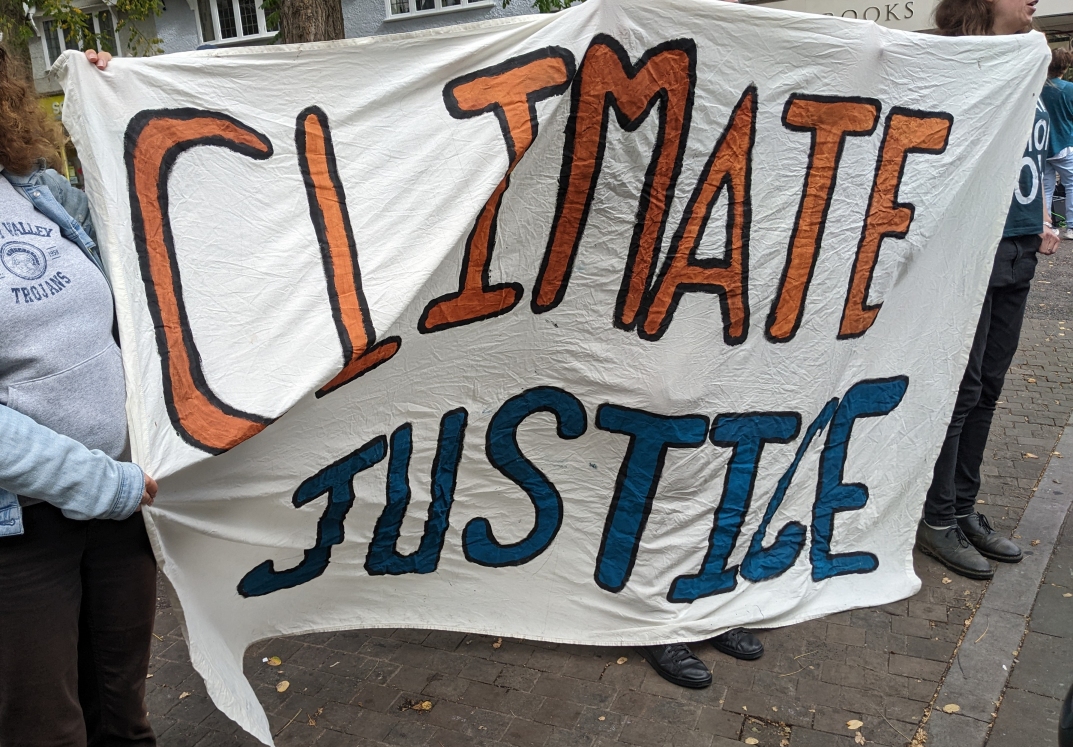
Friday, September 23, was a worldwide day of action to demand proper attention be paid to Mother Earth, in the face of the increasingly urgent situation resulting from the rule of the rich and the neglect by the ruling elites of their responsibilities towards the social and natural environment. The youth in particular, through their Climate Strike actions demanding "climate justice", are raising the claims on society.
The growing demand is for solutions and urgent action, so as to ensure that the natural and social environments are fit for modern human beings. In the modern world, the human productive forces have themselves grown into a force of nature, crying out to be brought under conscious control. People need a system of production that works in their favour, and fulfils their material and cultural needs. This requires a human-centred direction for the economy, in contrast to the present capital-centred direction. At present, the economy is directed to serving competing private interests, which includes plundering the environment to fulfil the aim of maximising profit, with complete disregard for sustainability and social responsibility.
Conforming to the outlook of the oligarchs who view public money as their entitlement, the role of government is simply to facilitate this profit-making, providing pay-the-rich schemes while giving the impression of taking measures to bring climate change under control. The actions of those in opposition are exposing their claims about "greening the economy" as a fraud. Under the solutions on offer of global competition, empowering big business to decide and paying the rich, the people themselves have no determining role. Furthermore, war and war production have an especially detrimental impact on the environment and economy. The arms producers and warmongers are the greatest polluters on the planet. It is an urgent matter to reverse the present pro-war direction and produce only for those aims which are in the interests of the natural and social environment.
The question of "who decides" is fundamental. The working class and people themselves need to be empowered to be the decision-makers, rather than being reduced to lobbying parties they do not control. There is a need for effective public authority directed by an empowered populace.
Oxford Youth Strike for Climate

As part of the September 23 Climate Strike actions, Oxford Youth Strike for Climate held a lively rally in Oxford's Bonn Square, followed by march through the city centre. Various other events took place in Oxford over the weekend and following week, including the Oxfordshire Great Big Green Week on September 24, and a Climate Day at St Frideswide Church on October 1.
Workers' Weekly interviewed Oxford Youth Strike to explain the significance of their action and demands in their own words.
Workers' Weekly: Could you explain how and why Oxford Youth Strike for Climate formed and what you consider its significance to be?
Oxford Youth Strike: Oxford Youth Strike for Climate Justice formed in 2019 at the start of the Fridays for Future movement, which was inspired by the actions of Greta Thunberg [1]. Since then, various different teenagers from across Oxfordshire have been part of the movement, striking from school about once a month to protest the lack of action on the climate crisis. The Youth Strike/Fridays for Future movement has given youth a local and international community in which to feel empowered to use the political power that we do have (as we cannot vote) to get the youth voice out there. It's also been one of the many movements that have got climate change into public and political discourse and that has kept it there.
WW: What were the issues being addressed by today's action? What are your demands? In particular, could you explain the demand for climate justice?
OYS: If we're serious about taking sufficient and effective steps to adapt to and mitigate the current environmental crisis, then we need not only to cut down on our carbon emissions, but to make sure that we adapt away from the systems of colonialism, capitalism, and extractivism that have caused them. Climate justice entails the consideration of how to fairly and equitably divide the benefits and burdens of climate change and the responsibilities to deal with it, in a way that achieves maximum justice for those already being affected by the climate crisis and those who the systems that have caused the climate crisis have.
The main demands [2] of yesterday's global youth climate strike were that "policymakers and world leaders prioritise #PeopleNotProfit [3], starting by listening to MAPA [Most Affected People and Areas] voices and immediately work to Loss & Damage Finance the communities most affected by the climate crisis - rather than, in the case of the UK government, approve yet more oil fields and appoint climate deniers to the cabinet. In Oxford [2], we were also protesting the government's current attempts to restrict people's right to protest with acts like the Police, Crime, Sentencing and Courts Act and trying to raise people's awareness that they do have a political voice and the power to help create a sustainable world.

WW: A placard at the rally asked the question: "Are we the last generation?" Youth and students are evidently striving for change at present, and in recent years especially have been taking matters into their own hands. Could you give your answer to the placard's question?
OYS: My generation will be the last generation one way or another, and hopefully we will be the last generation to live in a world where the government doesn't listen to the words of striking workers and youth have to skip school to have a voice. As my generation has grown up, we've managed to gain more power and sustainable social norms have gained ground, but we're not in the clear yet. We are still very likely to be the last generation to live in a healthy world. The world we grow up into and pass onto our children could be one where we reminisce about how cool it was last summer. In truth it's unlikely that Gen Z will be the last generation to live in the UK. However, the current generations living in the most affected areas, like Pakistan, which was a third underwater very recently, may very well be the last to live there if we do not start adapting to and taking more ambitious steps towards mitigation than a 2050 target for net zero based on technology we do not yet have.
Are we the last generation? Yes, we'll hopefully be the last generation to live in an unsustainable world full of ecological and social injustice. Yes, we'll be the last generation to live in a healthy world if we do not act now. We could decide to go either way. MAPA are not so lucky.

WW: Relating to this, another placard gave the call to Act Now. In a situation where people are relegated to a pressure group, while political parties try to convince us that they are guardians of the environment, this would seem to mean taking up the issue of who decides, particularly given that a lot of young people are disillusioned with the big party system. What are your views on this?
OYS: "Act now" is not a call for any one group to decide but rather a call for more democracy because that is what climate justice is. People's assemblies, localised circular sustainable economies, the most marginalised having a voice are all key parts of climate justice. Oxford youth strikers are a mixed bunch of political views as is the wider environmental movement but I think we all agree that there are some fundamental issues with our political systems. Corporations can spread doubt and denial, creating a post-truth world where our politicians can build off the same doubt and denial to keep their investors and voters happy far too easily. We are part of the youth disillusioned with the big party system. Climate Justice=More democracy.
WW: How are the youth themselves summing up their experiences, and how do you see things developing in the immediate future?
OYS: I cannot speak for the youth in general although from conversations at school there is a real mix of hope and despair. With the coming cost of living crisis, the Police and Sentencing Act, and the climate attitudes of the new cabinet, it seems like it's going to get worse before it gets better. However, there have been shifts: during the time I've been at my secondary school massive changes have occurred. Within my school community we've introduced a vegan option in the canteen, installed solar panels, planted plants whenever there has been space, and joined a network of school eco groups across the country. Government and public policy may not be anywhere near enough socially just or sustainable yet, but slowly communities are changing shape and social norms are shifting. I've seen an amazing amount of change, so despite the UK government's plan to set off the next carbon bomb, the Rose Wade oil fields, I'm hopeful that sooner rather than later society will reach a state where social and environmental justice are more than dreams and more than slogans.
WW: Would you like to say anything in conclusion?
OYS:There is hope for a world where people not profit are prioritised, and it's not easy to get to the point where you feel able to act to make it happen, if you're even in a situation that allows you to, but we are just one example of where you can find hope.
Notes
1. The Fridays for Future movement
https://fridaysforfuture.org/
2. oxfordyouthstrike Instagram profile
https://www.instagram.com/p/ChZ1_0EsRAd
3. September 23 #PeopleNotProfit, Fridays for Future
https://www.instagram.com/p/ChZ1_0EsRAd

As early as 1558, the first year of Elizabeth Tudor's reign, the Guinea Company was granted a royal monopoly of trade with West Africa for ten years. John Hawkins began his human trafficking activities four years later in 1562. Although it has been reported that in conversation with him Elizabeth Tudor is supposed to have warned, "if any Africans should be carried away without their free consent, it would be detestable, and call down the vengeance of Heaven upon the undertakers," she clearly knew the nature of his maritime activities and invested in them herself [1]. Elizabeth Tudor, like many monarchs who succeeded her, was fully engaged in the enslavement and human trafficking of Africans.

The Emancipation Statue standing in Bridgetown,
Barbados.
The monarchy's appetite for the human trafficking of Africans was greatly increased the following century after the introduction of sugar production in the newly acquired colonies in the Caribbean. The demand for enslaved African labour soared and soon became the major preoccupation of the English state abroad. After 1655, when England seized Jamaica from Spain, several state monopolies were established to conduct the trafficking of Africans to the new colonies, the most well-known being the Company of Royal Adventurers Trading in Africa, established after the restoration of the monarchy in 1663 and the Royal Africa Company established in 1672. In the ten years following 1663 at least 10,000 Africans each year were trafficked across the Atlantic. The wealth that flowed from this great crime and the "Africa trade" led to the creation of a new coin, the golden "guinea", first minted in 1663 and afterwards stamped with the elephant and castle, the crest of the Royal Africa Company. The Stuarts retained the same interest in human trafficking as their predecessors. The Duke of York, the brother of the monarch, became the first president of the Royal Adventurers, while Charles Stuart and many of those close to the royal family were its main investors.
When the Royal Africa Company was formed, the Duke of York became its first governor and had his initials branded on African men, women and children. In 1677 "several members" of the Royal Africa Company asked for a legal opinion as to whether human trafficking was in keeping with the Navigation Acts, mercantilist laws which required all trade to be carried out in British ships. The Solicitor-General reassured them that "negroes ought to be esteemed goods and commodities within the Acts of Trade and Navigation," thus dehumanising Africans in the process [2].

British Slave ship Brookes, 1788, showing how the slaves
were stowed in the ship.
The creation of the Bank of England and the National Debt, in 1694, were the necessary means for raising the finance for carrying out the major trade and colonial wars of the late seventeenth and early eighteenth centuries, waged mainly against France. These wars led in 1713 to the famous Treaty of Utrecht, by which Britain secured Gibraltar from Spain but even more importantly secured the asiento to supply Spain's American colonies with enslaved Africans. Queen Ann even boasted of the fact that "I have insisted and obtained that the asiento or contract to supply the Spanish West Indies with negroes shall be made with us for thirty years" [3]. The government promptly sold the rights for £7.5m to the South Sea Company, an early and ultimately unsuccessful rival to the Bank of England, whose first governor was also employed as the Chancellor of the Exchequer [4]. In 1720 over five hundred members of both Houses of Parliament were shareholders in the South Sea Company, so too were the Royal Family.
Just as the monarchy was one of the most zealous defenders and beneficiaries of slavery so too was it one of the most determined opponents of the abolition of that great crime. The future William IV made one of his most notable speeches on the subject in the House of Lords in 1799. Therein he presented an entire history of human trafficking not hesitating to point out the involvement of every British monarchy in this great crime, in order to show that the monarchy had since the time of Elizabeth Tudor always supported the enslavement and trafficking of Africans. Amongst other things His Royal Highness made the following remarks:

This map shows what was transported between Africa,
Britain, the Caribbean and North America at the height of the slave trade. As
well as enslaved people, British traders took products such as gold, ivory and
spices, from Africa.
"I have declared, and I always shall declare, that I have been, that I am, and that I always shall be, a sincere friend to wise and humane regulations in transporting the Negroes from Africa to the West Indies... it is humane, it is wise and praiseworthy of this Great Commercial Nation, to prevent diseased and infected Negroes from being imported into the British West India Plantations."
"...In the year 1788 the British property in the West Indies amounted to £70,000,000 sterling. Admitting that the price of Negroes, since the commencement of the war, has risen from £50 to between £80 and £90 sterling per head, the improvement of property in the same period much more than counter-balances the advance; and hence I am perfectly well warranted in saying, that the whole capital of the Old British West India property amounts to at least £80,000,000 sterling. If allowed to add the value of the New West India property, namely, the conquests from the French, Spaniards, and Dutch, amounting to at least £20,000,000, I may safely assert, that the present British Capital in the West Indies, is equal, upon a fair calculation, to ONE HUNDRED MILLIONS STERLING! A sum, my Lords, which demands your most serious consideration, before you consent to the Abolition of that Trade without which it could not exist." [5]
Such was the nature of the monarchy and no doubt the source of some of its great wealth.
Notes
1. Quoted in H. Thomas, The Slave Trade: The History of the Atlantic Slave
Trade 1440-1870 (London: Papermac, 1997), p.156.
2. "America and West Indies: July 1677, 16-31", in Calendar of
State Papers Colonial, America and West Indies: Volume 10, 1677-1680, ed. W
Noel Sainsbury and J W Fortescue (London, 1896), pp. 116-138. British
History Online
http://www.british-history.ac.uk/cal-state-papers/colonial/america-west-indies/vol10/pp116-138
3. Thomas, The Slave Trade, 236.
4. Thomas, The Slave Trade, 235.
5.
https://en.wikisource.org/wiki/Substance_of_the_speech_of_His_Royal_Highness_the_Duke_of_Clarence,_in_the_House_of_Lords
Receive Workers'
Weekly E-mail Edition: It
is free to subscribe to the e-mail edition
We encourage all those who support the work of RCPB(ML) to also support it
financially:
Donate to
RCPB(ML)
Workers' Weekly is the weekly on
line newspaper of the
Revolutionary Communist Party of Britain (Marxist-Leninist)
Website:
http://www.rcpbml.org.uk
E-mail:
office@rcpbml.org.uk
170, Wandsworth Road, London, SW8 2LA.
Phone: 020 7627 0599:
