
|
|
||||
|---|---|---|---|---|
| Volume 49 Number 23, December 7, 2019 | ARCHIVE | HOME | JBCENTRE | SUBSCRIBE |
Tata Steel to make one in eight of its British workforce redundant

Hundreds of steel workers from Redcar, Tata and Caparo
steel plants marched on Parliament to confront the government over the steel
industry closures on October 28 2015
Workers in the steel industry are facing yet another dose of wrecking of steel production. Tata Steel has announced it expects to cut over 1,000 jobs across Britain. Two thirds of the job losses will be management and office-based roles, Tata said. In the Netherlands 1,600 positions are also set to go, with 350 others cut elsewhere in the world. Port Talbot employs 4,000 workers - nearly half of Tata's British workforce. Tata has one steel-making site and five other facilities in Wales.
Community, the union which represents Steelworkers, said it was "seriously concerned about the direction that Tata Steel Europe is taking". It said it wanted to see "a vision for the future, which includes plans for investment".
"We have been presented with short-term plans, which only create worry and uncertainty.
"It feels like the company is just managing decline and we need a significant change of direction that can inspire the workforce that they have a future."
Recently, the collapse of a planned merger with Germany's Thyssenkrupp, which would have created Europe's second biggest steelmaker was stonewalled, showing that the monopoly,Tata and the steel oligopolies, including various Global Capitalist States like Britain, were not able to solve the world steel crisis. The European Commission blocked the deal citing pricing and competition rules.
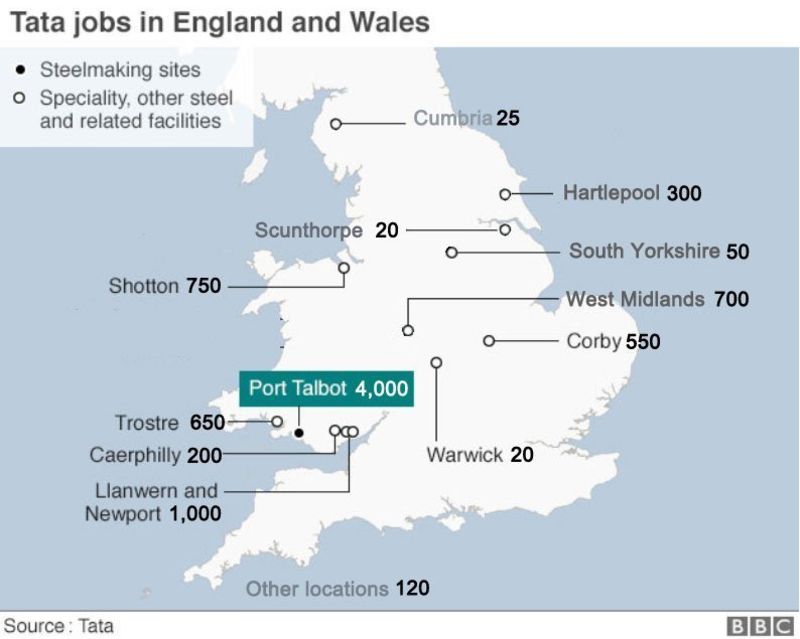
Tata blamed a drop in demand for steel across the EU for the job cuts, which it said was made worse by global trade tensions. The capitalist global market and ruthless competition represents in built systemic failure and is riddled with crisis. Tata also cited an increase in the cost of emissions allowances for the heavily polluting industry, showing clear that carbon capture technology needs to be investment and also research.
Much of the British steel production has become dependent on recycling rather than fresh iron ore. It led to closure of various bessamers. Heating and forging has been faced with fossil fuel use rather than modern electric smelting. Tata has said that it is necessary to improve production processes.
Other producers have faced similar problems. 4,000 jobs were recently saved at British Steel after the Chinese firm Jingye bought the company's Scunthorpe site.
Roy Rickhuss, general secretary of the Community union which represents workers in the steel industry, said,
"I think the way the company have handled this has been atrocious, it's never a good time but having this announcement hit us a few weeks before Christmas is absolutely scandalous.

Militant demonstration of Teesside steelworkers,
2015
He told BBC Radio Wales the plans had "no credibility" for the unions and Tata had been told to "go away, think again, and come back with a clear strategy, come back with a strategy for the future".
"We want to know about investment, what the future holds and all they've done is come up with this awful proposal just to cut jobs.
"Tata Steel has previously confirmed that they intend to seek to avoid compulsory redundancies and I will be impressing on the company the importance of standing by this commitment."
David Rees, Labour AM for Aberavon, said the "uncertainty" of not knowing where the UK roles would be cut "does not help steelworkers, their families and the wider community".
Of concern also to the steel-workers is the talk about the "pension liabilities", which means that the government puts the rightful claims of the workers to their pensions to the bottom of its concerns. Sajid Javid, Conservative government business secretary under Teresa May, ruled out taking responsibility for the workers' pensions.
The British steel industry is going through a crisis that threatens its very existence. Rather than take either practical emergency measures or make longer term plans to safeguard the present and future of this essential part of the national economy, the government has continually claimed that nothing could be done. Non-establishment candidates in the General Election argue the contrary that things can be and must be done.
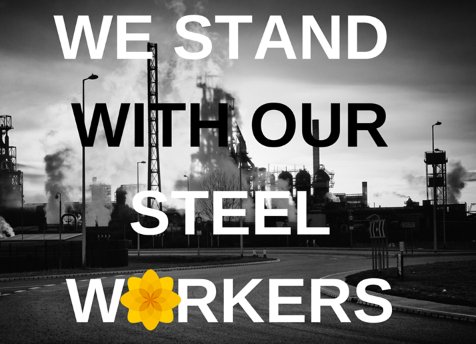
Britain, exporting more steel than it imports, has the potential to produce all the steel required by the national economy. Any surplus or deficit in production could be traded with other countries in a planned and controlled manner to the benefit of both Britain and its trading partners. In conditions of unrestricted monopoly-controlled trade, with local production competing with global production, crisis is inevitable. An alternative direction is required, social production needs a pro-social economy. Closure of plants, making workers redundant and the loss of skills seriously erodes the self-reliant potential of the economy.
An economy cannot be built to ensure the claims of society on it without a manufacturing base, which requires basic materials such as steel. Steel is still ubiquitous, not least in machinery and infrastructure. Steel remains a necessity for the functioning of the economy.
The present crisis of Britain's steel industry today is the culmination of years of closing of plants and selling off the remaining assets to private interests of what was previously the state-owned British Steel Corporation.
The Labour Party Election manifesto refers to the steel industry. Workers have demanded that the issues that have faced British steel production in the last three years in particular, should be addressed. The Labour Manifesto under a Corbyn government says, "A thriving steel industry will be vital to the Green Industrial Revolution. Labour will support our steel through public procurement, taking action on industrial energy prices, exempting new capital from business rates, investing in R&D, building three new steel recycling plants and upgrading existing production sites". [Labour Manifesto, 2019]
The steel industry is a vital part of the economy. It must not be destroyed!