
|
|
||||
|---|---|---|---|---|
| Volume 45 Number 10, April 25, 2015 | ARCHIVE | HOME | JBCENTRE | SUBSCRIBE |
Workers' Weekly Internet Edition: Article Index :
The Funding of the NHS Is a Central Election Issue
The Campaign against Euro-Federalism:
CAEF AGM and Public Meeting
CAEF AGM Resolution: No! to the EU of the Monopolies - There is An Alternative
CAEF AGM Resolution: Oppose TTIP and ISDSNon-Intervention and Respect for Sovereignty Are Election Issues
Weekly On Line Newspaper of the
Revolutionary Communist Party of Britain (Marxist-Leninist)
Website:
http://www.rcpbml.org.uk
E-mail:
office@rcpbml.org.uk
170, Wandsworth Road, London, SW8 2LA.
Phone: 020 7627 0599:
Workers' Weekly Internet Edition
Freely available online
Workers' Weekly E-mail Edition
Subscribe
by e-mail daily: Free / Donate
WW
Internet RSS Feed

The Line of March Monthly
Publication of RCPB(ML) Subscribe

One of the
most important questions raised in the General Election campaign, and one over
which the maximum confusion is spread, is over the necessity to fund the NHS.
One would think, to hear the complaints coming from the ruling elite, that to
assert that health care is a right is to avoid the question of the funding of
election promises, that people do not live in a socialised economy, that the
onus is on everyone to fend for themselves. So great is this pressure that
parties who are demanding an alternative to austerity are either ridiculed that
their agenda is uncosted, or it is assumed that heavy progressive taxation is
the answer to the funding of social programmes.
The mantra of the Coalition government has been that “you can only deliver a strong NHS with a strong economy”. In this scenario, public services including the NHS are a “cost and a burden” to that “strong economy”. It is never discussed that all those who live and work in the socialised economy are producers of the social product and have a claim over the goods and services of society. Therefore a strong economy is one in which all have a right to a strong NHS and other public services as of right. In other words, a strong economy is an economy that serves the interests of all and is an economy that can only be strong if it guarantees the right of all the people in society to free public health care and other public services.
But this is only
the beginning of what a strong NHS means to a strong economy. For one thing, a
definition of a strong economy in a modern civilised society must mean that it
serves the interests of the society. The issue is not “rationing”
the NHS, but reversing the direction whereby the monopolies have a stranglehold
and demand privatisation at all costs. But another issue is that a healthy
population is best placed to contribute to the health of the national economy.
That the monopolies and their representatives cannot even see this far, but
denigrate the population as “consumers” of health care and are
prepared to decimate the NHS and starve it of funding for their private
interests shows how low they have sunk. Furthermore, a poverty-stricken,
unemployed and vulnerable population is almost by definition unhealthy, as the
statistical connection between poverty and ill health underlines. This is where
the austerity agenda is increasingly leading. The ruling elite has abandoned
the aim of promoting the public good, and is making the victims of the
recurring economic crises the scapegoat for its ills, including the problems
exhibited by the health service.
However, the
issue of “funding” must also be addressed head on. The propaganda
of the ruling elite wants people to think that the NHS is a “cost and
burden” to the economy that must serve the interests and the monopolies
first. Then to fund and “ring fence” the NHS there must be cuts to
public services elsewhere so as not to affect the interests of the rich to
“create wealth”, but rather “balance the budget” and
“eliminate the deficit”. The reality is that the NHS and its health
workers like all the working class and people are not a cost to society but
quite the opposite. They create added value. Health workers provide society
with a healthy workforce as do other public service workers and social
programmes which look after the welfare of society and all its members. That
means the NHS and other public services add the value of a healthy workforce to
the private monopolies for which these 
big corporations
do not pay. They reap vast wealth from the society. Some of these monopolies
outstrip the economy of whole nation-states in terms of the scale of their
private expropriation of the wealth the working class produces. Then working
people are left to pay for their public services and the profits of the
privateers of their public services out of the taxation of their wages. Also,
government borrow funds and pay the “deficit” interest from the
very privatised social wealth that working people have created in the first
place by social production. The conclusion is that the monopolies must pay a
proper exchange value for what could be called the product of the NHS, as well
as for all public services utilised by them in a similar fashion. General
taxation, particularly of individuals, cannot be the answer to increasing the
necessary investment and funding of the NHS. Not to mention the existence of
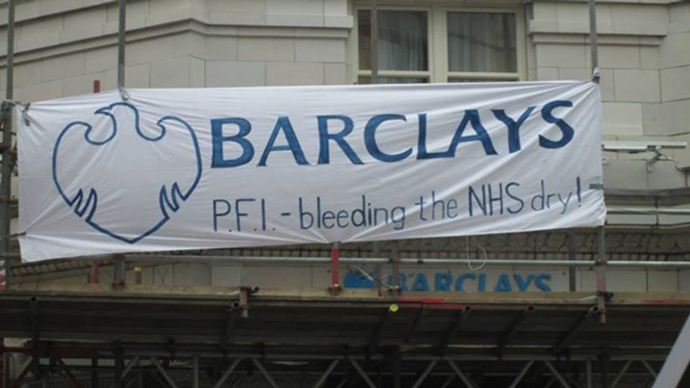
outrageous pay-the-rich schemes such as PFI which cripple and distort the
health service.
The crucial issue of funding the NHS and public services in a modern society requires that this whole question of the direction of the economy that pays the rich out of the social wealth that is produced needs to be addressed. Health care is a right, as are the public services that satisfy the well being of all people resident in Britain. The rights of all in society have to be met by an economy fit for a modern world that has to meet those needs. Increasing taxation simply lets the financial oligarchy off the hook and makes the working people pay again. The funding of the NHS must be done not by increasing taxation on the people, or increasing the deficit to the financial oligarchy.
A pro-social direction for the economy and society is absolutely necessary, and the demand must be that the monopolies disgorge their accumulated social wealth in paying for a healthy workforce when they realise the value worked up in that workforce. The electorate must be in a position to enforce this payment. That is why funding for the NHS is such a crucial and central election issue. All candidates which oppose the austerity agenda as applied to the NHS must be supported.
ShareThis

The Campaign
against Euro-Federalism (CAEF) held its AGM followed by a public meeting on
April 11 in Birmingham.
AGM
Reports on CAEF’s activity, financial situation and influence were all positive. Despite a small membership it is estimated and agreed that CAEF punches way over its weight with good results and positive influence.
Two resolutions were adopted at the AGM and are printed below. The first deals with fighting for the alternative in relation to the EU. The second resolution deals with TTIP and similar so-called trade agreements and CAEF’s total opposition to them.
Public Meeting
The public meeting after the AGM was addressed by Mick Brooks, an active trade unionist, who spoke on the current capitalist crisis and addressed the difference between deficit and debt. He made quite clear that the austerity policies are making matters worse for everyone except the rich. The latter, he said, spend their accumulated wealth on luxuries rather than invest in production for the benefit of the national economy.
The second speaker, Michael Chant, addressed the question of the General Election and the stand on the possibility of a Referendum on EU membership. It was generally agreed that it can’t be a foregone conclusion that the question written for the Referendum would be a straight in/out vote. Serious work has to be carried out to build the movement against the neo-liberal EU, so the workers' movement responds from a position of strength.
He emphasised that underlying the prevailing logic of the debate of the Westminster parties is not what favours the people, but rather what favours competing sections of those who control the economy in Britain. The ability of the people to set the agenda is not being debated, and therefore it is necessary to unpick from the debate what serves the opposition of the people to the dictate of all sections of finance capital, so that the day when the people have decision-making power is brought closer.
Michael Chant argued that clarity and unity is forged in the fight, and unity in action is called for. CAEF is able to join the fight against neo-liberal globalisation with the firm stand that the European Union serves the interests of the rich, and that there is an alternative. TTIP is being exposed in the course of the election campaign and of the fight to safeguard the future of the health service, for example. It is being exposed as entrenching the power of the monopolies to enforce their interests against sovereign governments. The opposition to this has given rise to such slogans as: No to Monopoly Right! Yes to Public Right!
To have a “proper debate”, he continued, on Britain's place in Europe, as some have suggested following Blair's intervention that putting “exit on the agenda” would threaten Britain's position as a “great global nation”, is itself a fraud unless the context of the reactionary programme to “make Britain great again” is put in place.
The speaker underlined that under the guise of the “British nation” and “British values”, global crimes, aggression, warmongering, intervention, racism and subjugation of peoples and minorities have been carried out. Today's clamour for “British values” and the interests of the “British nation” is a continuation of this sordid history.
In conclusion, Michael Chant reiterated that the fight against Britain's membership of the EU must be carried out in the course of fighting for the alternative, of developing the Workers' Opposition to austerity, and in conjunction with the fight to deprive those presently in power of their power to deprive us, the working people, of decision-making-power.
John Boyd as CAEF Secretary and joint author of the First World War pamphlet drew attention to the parallels between the run up to the war and the EU today. Imperialism has been resuscitated and is again on the march around the world. This is especially so in Africa and the Middle East where some problems emanate directly from the imperialist carve-up over a century ago. In fact the desperate situation where people risk their lives to cross the Mediterranean to reach a country in the EU is a symptom of the implications of imperialism.
Questions and discussion followed each speaker giving all who attended to put in their point of view. This was a successful and enjoyable AGM and Public Meeting which followed hard on the equally successful CAEF conference earlier in the year. The hallmark of CAEF events is unity around CAEF's aims. Members from different political parties and groups and those of none can sit down together and discuss matters without any display or hint of sectarianism.
(The Democrat, March-April 2015)
ShareThis
The Campaign against Euro-federalism recognises that:
1. The European Union represents the interests of the neo-liberal agenda of the dominance of the global monopolies, the transnational corporations and the financial oligarchy of the EU. This includes the so-called "free trade", a "free trade" which in fact constitutes control of markets, resources and labour.
2. The alleged aim of so-called "free trade" and "free movement of capital, goods, services and labour" to create jobs, spur investment and promote economic growth is a complete fraud.
3. The EU project is one of neo-liberal globalisation which is imposing a fraudulent austerity agenda on the peoples of Europe.
4. The EU violates the sovereignty of the nations, national governments and states that are its members.
5. The "old imperialist powers" of Europe are colluding and contending to dominate the other states, including the former Eastern European countries, as well as Greece and others.
And notes that:
1. Those whose interests are served by the EU attempt to sway public opinion by imbuing workers with false hopes that future employment will be brought about by implementing EU directives and reactionary government policies.
2. The dangerous developments within the EU, such as the secret TTIP negotiations with the United States, are designed to impose private monopoly interests and wreck public services. This is under the fraud of harmonising regulation, and the proposals for a European armed force which would lead to the escalation and broadening of armed conflict.
3. The austerity programme pursued by the Westminster Government has been consistent with the neo-liberal programme of the EU, which concentrates political, economic and military power in fewer and fewer hands.
4. That there is a powerful movement of the people in this country and throughout Europe against the imposition of "austerity", a movement which fights against the neo-liberalism which enriches the elite who expropriate the people's social wealth. This devastates living standards and destroys public services, public authority and social programmes, as well as devastating the environment.
In these circumstances, the Campaign against Euro-federalism (CAEF) affirms that there an alternative which puts the people's well-being at the centre of considerations and defends the rights of all. This alternative is where people have control of their own lives and future, in which the economy is our economy, resources are our resources, and the co-operation of the peoples of Europe is strengthened for their mutual benefit, not for the rich and powerful. The interests of the monopolies are made subservient to the public good in each and every country and throughout Europe.
Some features of this alternative, to which the people aspire and are fighting to realise are:
1. The power for sovereign states to decide on their own development strategies and policies.
2. The power of economic sovereignty for people to decide on the direction of their own economies.
3. The power to restrict the operation of foreign capital and monopolies and instead to develop co-operation within the working class movement for the public interest.
4. The power to unite with workers from whatever origin so that the rights of all workers are upheld and remuneration and conditions are raised, not lowered.
5. The power to develop public services for the public good away from the control of private interests.
6. The power to conduct investment, as well as inter-European and international trade, away from the control of the bodies of the European Union - pending and future trade agreements should be concluded not on the basis of neo-liberal "free trade", which means domination of the monopolies, but on the basis of mutual benefit of working people of sovereign countries.
7. Current "free trade agreements" which represent the right of the monopolies to dictate the economic agenda to the detriment of working people should be abrogated. International trade should be conducted on the basis of the principles of self-reliance, equal trade for mutual benefit with all nations regardless of their political regime, and the inalienable right of working people to control all decision-making that affects the socialised economy and the social and natural environment.
In short, the alternative lies in upholding the public good, opposing the dictate of European and global monopolies, including the international financiers, and affirming the sovereignty of each state's public authority over the direction of its economy and society as a whole. On that basis, the people of each country can develop their co-operation and unity which expresses their interests and not that of the transnational corporations; on that basis sovereign peoples can develop their own institutions of international mutual benefit.
Passed unanimously
ShareThis
CAEF should carry out every possible action and alert all affiliated organisations and members on the full implications of the US/EU Transatlantic Trade and Investment Partnership (TTIP) and the Investor State Dispute Settlement (ISDS). This also applies to the imminent Canada/EU Comprehensive Trade Agreement (CETA) and the Trade in Services Agreement (TiSA), the Trans Pacific Partnership (TPP) and India/EU trade agreement. The contents and text of these treaties has been deliberately kept secret from governments, national parliaments and electorates.
CAEF recognises that TTIP combined with ISDS, which is already in operation, CETA and TiSA is the largest frontal attack in history on all forms of democracy. If not stopped they would:
* Give rights to transnational corporations and banks to override national governments and parliaments and write the rules for this hidden process
* Erode the sovereignty of nation states and their rights to self determination, national independence and democracy
* Lower social standards
* Attack and undermine workers and trade union rights
* Strangle the development of economies
* Dilute food safety rules
* Undermine regulations on the use of toxic chemicals
This AGM of CAEF resolves to assist affiliated organisations and member to expose and oppose TTIP, ISDS, CETA and TiSA in this attempt to bolt together the EU, Canadian and US markets. This to be done by:
* Regular updates on the CAEF website
* Providing as much information in electronic formats as practical
* Reports on the CAEF website of actions and protests taking place across Europe, the US and Canada
* Presenting arguments against those forces and vested interests which support these treaties
* Making clear that even if ISDS was stopped there are many other severe implications which would emanate from the other treaties
CAEF recognises this as an opportunity to soundly defeat those interests which support these treaties who influence and operate the EU, eg the unelected Commission, European Round Table of Industrialists and tens of thousands of lobbyists in Brussels.
CAEF’s primary aims remain the defence of democracy, the right to self determination of nation-states and mutually beneficial trade agreements.
Passed unanimously
ShareThis
Michael Chant, The Democrat, March-April 2015

One of the most important subjects
that candidates should take a stand on in the General Election is the
Transatlantic Trade and Investment Partnership (TTIP). We think that it is
important that electors in their constituencies should examine the stand of the
various candidates in order to decide how to cast their vote. This is an
important pointer in deciding whether the candidates genuinely take a stand
against the fraudulent austerity agenda which seeks to offload all the ill
effects of economic and other crises onto working people.
There are several political parties standing candidates in the General Election opposed to TTIP. They include the following:
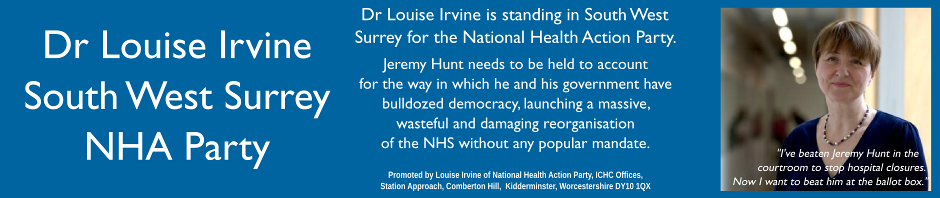
National Health Action (NHA) Party
The NHA Party opposes TTIP from the point of view of restoring the NHS as a safe, comprehensive, publicly funded, publicly delivered, and publicly accountable integrated healthcare system. It points out that TTIP threatens not only the NHS but the health and well-being of the public. Its manifesto states: “TTIP will leave the UK prey to being sued in secret courts under the Investor-State Dispute Settlement (ISDS) clause and the supposed economic benefits of the treaty benefits are now being seriously questioned. If the EU does sign this treaty with the United States, we believe the British Government must exercise its right to a full opt out.”
The Party also is opposed in principle to monetary union, pointing out that the Eurozone has been transformed into a two-tier system in which richer nations have the power to impose “austerity” policies on poorer ones.
Socialist Labour Party
The SLP points out that international monopolies put human well-being at risk. Its manifesto states: “We vigorously oppose any moves through secretive trading alliance such as the Transatlantic Trade and Investment Partnership (TTIP) to give added power to Corporations to challenge governments and other democratic agencies to secretive courts from preventing them profiteering from their harmful products and activities.”
Green Party
The Greens are opposing TTIP from the point of view of decisions being made by private corporations and not by democratically elected governments. Its manifesto states: “TTIP is globalisation in its worst form, designed to submit democratically elected governments to the will of private corporations. Companies will be able to take legal action against governments that they think threaten their profits. National policies in EU countries for health, environmental, consumer and social protection could be challenged by companies from anywhere in the world in private international tribunals, run by corporate lawyers.”
The manifesto points out that under TTIP, attempts to bring the NHS and the railways back into public ownership could be financially penalised or blocked; authorisations for GMOs could be accelerated; and the regulations of banks and the financial industry would be harder, if not impossible.
Plaid Cymru
Plaid Cymru oppose TTIP in the context of supporting locally produced food and ensuring food quality standards are not breached. Their manifesto opposes “the lowering of quality thresholds as part of the EU-US TTIP trade negotiations.”
Trade Unionist and Socialist Coalition (TUSC)
TUSC takes a stand for “public ownership, not private profit”. Its manifesto states: “No to ... TTIP and all secret austerity treaties.”
Communist Party of Britain
The CPB point out the extreme danger posed by TTIP, including the danger to healthcare, education and workplace rights.
Left Unity
Left Unity oppose TTIP, both in terms of opening up the NHS to the market, and in terms of opposing neo-liberal economic policies. Its manifesto states that it supports “governments that stand up for ordinary people against the corporations, speculators and investment bankers”.
Scottish National Party
The SNP states: “We will also seek an explicit exemption for the NHS and Scottish Water, as part of a general public sector exemption, from the terms of the proposed TransAtlantic Trade and Investment Partnership.”
Of the other parties, the Conservative Party has taken every opportunity to try to justify TTIP. The Lib Dems have taken an enthusiastic position in TTIP’s support.
And although there are Labour politicians who oppose TTIP, the Labour Party manifesto states: “We support the principles behind the negotiations on the Transatlantic Trade and Investment Partnership Treaty (TTIP). We will hold the European Commission to account on issues of concern, including the impact on public services and the Investor to State Dispute Settlement Mechanism. And we will ensure the NHS is protected from the TTIP treaty.” It should also be pointed out that there are several trade unions who oppose TTIP, and the TUC itself adopted a comprehensive resolution at the 2014 Congress opposing TTIP. In addition, local TUCs at their own conferences opposed TTIP.
Electors, therefore, must make up their own minds about whether the Labour candidates oppose austerity or not.
What is certain is that the campaign against TTIP will continue irrespective of whichever party or parties eventually form the government.
Perhaps as never before, the election campaign is showing that people are in struggle and participating in the campaign on that basis, rather than sitting back and merely putting a cross or abstaining as the sum total of their political involvement.
Nevertheless, the electorate must be wary of the establishment, which is in favour of TTIP, staging an electoral coup against the will of the electorate. The struggle against TTIP and the whole austerity agenda must be seen through to the end.
(The Democrat is the paper of the Campaign against Euro-federalism.)
ShareThis

The recently
televised debate, which featured the leaders of five of the major political
parties contesting the forthcoming general election, revealed a significant
difference of approach on several vital questions.
One of the most important of these is what stand should a modern political party take towards military, political, economic and other forms of intervention and respect for the sovereignty of other countries? This is perhaps particularly important at the present time when the media is full of harrowing accounts of the continual loss of life that is the consequence of previous interventionist actions taken by governments and political parties in Britain. However, not surprisingly it is an issue that has barely featured in the stage-managed events organised by the three major parties, nor in the coverage of the mass media.
In the televised debate the
approach that has become characteristic of the Westminster consensus was most
evident in the comments of Ed Miliband, the leader of the Labour Party. He was
eager to demonstrate that his party remains committed to an interventionist and
warmongering stance, particularly in North Africa and western Asia, allegedly
in response to the threat of what is referred to as ISIS. At the same time, he
was the most fervent supporter of maintaining and modernising the
country’s nuclear arsenal. The SNP, Plaid Cymru and the Green Party,
however, stood in clear opposition to the Westminster consensus and all argued
for the scrapping of Trident. In their manifestos these parties not only demand
an alternative to austerity but also, in varying degrees, oppose the
warmongering and interventionist positions of the big parties. The Green Party
for example expresses its opposition to previous military intervention in
Afghanistan, 
Blockade of Faslane Trident base, April
14thIraq and Libya, while Plaid Cymru makes clear its
stand in support of the rights of all peoples to determine and make decisions
about their own futures. Many of the other smaller parties are taking similar
stands. One of the features of the election is therefore the emerging division
between those that stand for the austerity and the interests of the rich and
those that stand for the alternative and the rights of all.
The global interventionist and warmongering policies pursued by the current Coalition government and by the previous Labour governments have created all the conditions for the instability that currently grips the world. It is the fostering of civil strife, the NATO bombing and enforced regime change in Libya carried out by the government of Britain an its allies, with the support of all the major political parties, that has led to the almost complete collapse of what was once one of the most developed countries in Africa. Anarchy in Libya created the conditions for the savagery of ISIS, which the Westminster consensus claims it is opposed to. It also created the conditions for the rise in people trafficking across the Mediterranean, which has led to the deaths of so many. Even the mainstream press is now blaming the policies of Britain’s governments for these deaths. It is of note that as well as many Africans, those making the hazardous Mediterranean crossing also include many Syrians fleeing from another conflict fuelled and encouraged by interventionist and warmongering policies, which have also facilitated the emergence of the sinister ISIS.
In these circumstances there is surely a need to for all candidates in the forthcoming election to take a stand against intervention and warmongering and in support of the sovereign rights of all countries. At the same time there is a need for the electorate to support only those candidates who take such a stand and make non-intervention and respect for sovereignty election issues. Furthermore there is a need for all those concerned about the continual loss of innocent lives and instability in the world to condemn intervention and warmongering and make sure that the election is used as a springboard to organise for an anti-war government which stands for the rights of all at home and abroad.
ShareThis