
|
|
||||
|---|---|---|---|---|
| Volume 44 Number 17, June 28, 2014 | ARCHIVE | HOME | JBCENTRE | SUBSCRIBE |
Workers' Weekly Internet Edition: Article Index :
On the Proposals of NHS England Chief Executive Simon Stevens:
No Solutions Given to the Anti-Social Direction of the NHS
Weekly On Line Newspaper of the
Revolutionary Communist Party of Britain (Marxist-Leninist)
Website:
http://www.rcpbml.org.uk
E-mail:
office@rcpbml.org.uk
170, Wandsworth Road, London, SW8 2LA.
Phone: 020 7627 0599:
Workers' Weekly Internet Edition
Freely available online
Workers' Weekly E-mail Edition
Subscribe
by e-mail daily: Free / Donate
WW
Internet RSS Feed

The Line of March Monthly
Publication of RCPB(ML) Subscribe
On the Proposals of NHS England Chief Executive Simon Stevens:
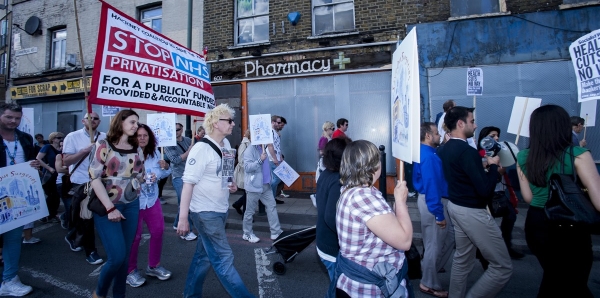
Protest in Tower Hamlets, East London, against cuts
in funding of GP surgeries and in the
NHS locally, June 5 The statements of newly-appointed
NHS England CEO Simon Stevens on his plans and vision for the NHS reveal that
the root cause of the anti-social direction of the NHS is not being addressed.
The anti-social direction is one of the privatisation of health care delivery
under whatever pretext it is presented. Its reversal to a pro-social direction
would involve the recognition by government and the Chief Executive that health
care is a right, and that the funding of health care is the responsibility of a
modern society. Such funding cannot be considered as a cost to the economy or
to the Treasury. Nor can the demand that the NHS be properly funded be turned
into a programme to enrich the private health monopolies. On the contrary, it
is a necessary demand that the monopolies that make use of and benefit from a
healthy work force in order to realise their profits should be the ones who
fund this health care. The escalating control and delivery of health care
privately or by the monopolies through the NHS is what must be challenged and
reversed.
This is not how Simon Stevens sees the challenges. For example, on May 29 he said in an interview that “parts of the NHS must be completely reinvented”. While the spin that was put on this was that he wanted a return to “cottage hospitals” and that closing “smaller community hospitals was wrong”, it is necessary to be vigilant about his proposal. It has been pointed out that Stevens’ proposals are a close fit with a new business model promoted by global management consultancy companies like Ernst and Young and the Coalition government’s new Office for Life Sciences. Another source made the point that “while the sites might remain, Mr Stevens clearly envisages quite dramatic change in the way they are working or, in his words, complete reinvention. That’s not the same as preservation.”
The fact is that community hospitals are continuing to be closed, or stripped of their services, and even bigger hospitals are being threatened and subject to “special measures” and taken over by the private sector management, or the biggest NHS Trusts. Clinical commissioners and management are imposing cuts in the name of health care and imposing diktats on health workers with the continued refusal of government to increase investments to meet the needs of a modern health service in Britain.

As another
commentator wrote, in his speeches, such as the one delivered to the NHS
Confederation Annual Conference in Liverpool on June 4, Simon Stevens
“praises managers lavishly ... urging them to promote community,
diversity and a listening culture. He favours ‘local solutions’ in
which commissioners involve health and wellbeing boards ... in stress testing
better care fund plans. But local plans ‘must be grounded in the context
of strategic five-year reviews’, he also told his audiences. So local,
but not too local.”
Whatever the platitudes, the reality is that the NHS is entering an unprecedented government-created crisis in investment which is seeing vital acute and community services budgets being wrecked at an alarming rate. The fight for survival is taking precedence over the claim that this is all being run for the needs of patients according to some well worked out plan for the NHS. Simon Stevens has no intention of actually addressing the real issues facing the NHS in order to safeguard its future. For example, in South West London it was reported that the health service regulators are complaining that they cannot cut half a billion pounds from the south London health services budget and that it is “unachievable”. Across the whole of England, NHS Trusts and Clinical Commissioning Groups are “reconfiguring” and “transforming” NHS by drastically cutting the number of beds and closing acute hospitals and cutting back on mental and health beds and social services in very similar ways to achieve the massive budget cuts demanded by the government.
Andy Burnham, speaking to the same NHS Confederation conference the following day, criticised the way the government was “integrating” health and social care with the “better care fund”. However, on the issue of funding he went on to say, “I can understand why a growing number of people are calling for [more money for the NHS] but I don’t see that can be the first response that we make in the public arsenal.” He said that before more money could be put into the NHS, a Labour government would “have to be able to assure patients that the health service was making the best use of its existing allocation” and then claimed that this was “something he said the NHS was not doing”.
The speeches of both Simon Stevens and Andy Burnham are based on the logic, in Stevens’ words, that there is a “backdrop of multiple fundamental, long-range, health challenges”. These “challenges” are those of a “growing population”, an “aging population”, such issues as “obesity, dementia, multimorbidity”, and “more expansive and more expensive treatments”.

This is
fundamentally an anti-human way of posing the issues, that people are not an
asset, that their well-being is an unwelcome problem for society, that working
people themselves have no part in producing value, and that investments in
social programmes are a drain on the economy. Simon Stevens’ answers, in
short, require the application of so-called business models, and
capital-centred programmes.
Only by increasing investments in the NHS, and ending the market in the NHS and its privatisation can the wrecking of the health service be reversed. A human-centred solution requires that health care be recognised as a right and guaranteed.
ShareThis

On June 18, up
to 1,000 protesters gathered outside the Senedd, Cardiff, to oppose planned
Welsh Government changes to services at Withybush Hospital in Pembrokeshire.
The Save Withybush Action Team (SWAT) and other protesters travelled to Cardiff in an attempt to get Health Minister Mark Drakeford to listen to growing fears that lives will be lost if health service changes go ahead.
Plans to move consultant obstetrics, full paediatric cover and the special care baby unit from Withybush and replacing them with a three bed midwife led unit have met with opposition from clinicians, residents and opposition politicians. A Judicial Review is currently underway.
Politicians and speakers were united in their opposition to these plans. One speaker pointed out that the changes being imposed on Withybush is part of a wider agenda which aims at decimation and privatisation of the NHS as a whole. While it is excellent that the political parties are united in their opposition, it is only the growing strength of the people themselves that can guarantee victory. Bringing a message of solidarity from the Lewisham campaign, the same speaker led the rousing cheer: “The NHS is Our NHS! Save the NHS!”
ShareThis
by Michael Chant, reprinted from The Democrat, Paper of the Campaign Against Euro-Federalism (CAEF), May-June 2014
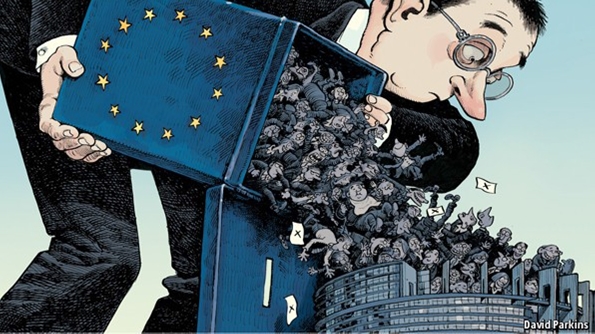
Elections to the
European Parliament were held across the 28 states of the European Union
between May 22 and 25, 2014, the first such elections following the coming into
force of the Lisbon Treaty on December 1, 2009. The European Parliament
consists of 751 members. The UK now has 73 MEPs, up from 72 at the last
election, distributed between 12 regions.
UKIP won 24 seats, Labour 20, the Conservatives 19, and the Green Party three. The Liberal Democrats won only one seat, down from 11 at the 2009 European election. The BNP lost both of the two seats they had won for the first time at the previous election.
Turnout across the EU was 43%, but was lower in some newer member states. UK turnout was 35.4%, slightly higher than 34.5% in 2009, but lower than 38.4% in 2004, when four regions held all-postal ballots.
The largest of the groupings is likely to be European People’s Party. The second largest group is the Progressive Alliance of Socialists and Democrats. New groups and allegiances are likely to be formed during the new Parliament. This eighth Parliament will be constituted on July 1.
What are the implications for the labour and trade movement?
The results show an intensification of the dog-fights amongst the EU powers, including the British government, which wants its own share of power, particularly to maintain Britain’s role as a centre of international finance capital, as well as to negate the rights of workers from the “new Europe”, thereby attacking the rights and conditions of all workers, and to promote the weapons of the political elite of racism and chauvinism. But the results also demonstrate the electorate’s opposition to the negation of the sovereignty of the European peoples, and opposition to the austerity agenda promoted by the big powers of the EU.
The people want empowerment so as to have control over their life, they want the rights of the people and the rights of trade unions, the youth and other collectives to be recognised and their exercise guaranteed.
In any case, the elections sort out nothing. Here in this country as well as elsewhere many smaller parties participated either to take a stand against the EU or to take a stand for a pro-social agenda.
The European parliament lacks any legitimacy whatsoever. It is not based on the sovereignty of the people - in fact, the opposite - it is based on the attempted legitimisation of the power of the EU monopolies.
The “pro-social Europe” has become completely exposed, which is why parties were standing in the context of the national situation rather than claiming that to come to power in the European Parliament brings any degree of empowerment to the people. In class terms, the institutions of the EU represent a concentration of power in the hands of European finance capital, which is driving austerity programmes against the people of sovereign states. There is no accountability of these centralised EU institutions.
CAEF calls on the labour and trade union movement and all progressive forces to unite in action against the EU and monopolies in the wake of the elections. They should cast aside any illusions that the European Union represents an opportunity for working people to collaborate for their own interests. Reality shows that the more the European project has been centralised, the more has the programme of austerity been dictated against the interests of working people, the poor and the youth. The labour and trade union movement naturally tends to proletarian internationalism, but new arrangements, built in opposition to the ones which entrench the interests of the monopolies, are required to embody this internationalism.
The election results have shown that working people have no faith in the EU. The labour and trade union movement must now intensify the struggle against the Europe of the monopolies!
ShareThis