| Year 2002 No. 19, January 29, 2002 | ARCHIVE | HOME | SEARCH | SUBSCRIBE |
|---|
Tony Blair's Speech on Public Services:
Workers' Daily Internet Edition : Article Index :
Tony Blair's Speech on Public Services:
Cut Back on Investment or Investment with Reform – A
"Third Way" Choice
Thousand-Strong Demonstration against US-Backed Israeli Aggression
Daily On Line Newspaper of the
Revolutionary Communist Party of Britain (Marxist-Leninist)
170, Wandsworth Road, London, SW8 2LA. Phone 020 7627 0599
Web Site:
http://www.rcpbml.org.uk
e-mail:
office@rcpbml.org.uk
Subscription Rates (Cheques made payable to Workers' Publication
Centre):
Workers' Weekly Printed Edition:
70p per issue, £2.70 for 4 issues, £17 for 26 issues, £32 for 52
issues (including postage)
Workers' Daily Internet Edition sent by e-mail daily (Text
e-mail):
1 issue free, 6 months £5, Yearly £10
Tony Blair's Speech on Public Services:
Tony Blair delivered a speech at the Centre of Life in Newcastle on January 25 on backing staff to deliver better public services.
He referred to a very serious debate taking shape. The choice, he said, is this: "Do we believe as a nation that the problem in our public services is years of underinvestment and that the solution is sustained investment matched with reform? Or do we believe the problem is that the Thatcherite revolution was never completed and that the solution is to cut back on investment, cut taxes and then get people to purchase their own services?"
Once the choice is formulated in this way, and you are invited to choose, then progressive sentiment is likely to go with alternative number one, as indeed Tony Blair calculates. "Obviously, I favour the first analysis," he says. But what is the qualification of sustained investment by matching it with "reform"? And, if we are to reject choice number two, does that mean we opt for increasing taxes?
Further on in Tony Blair’s speech, he begins to elaborate on the qualification. "The opportunity now is to use the prospect of investment to lever in reform," he says. "Because as we all know, it is not just about money. The services urgently need change, redesigning them around the needs of the consumer, making them fit for the new age of high expectations in which we live." Pursuing this line of argument, he elaborates "four key principles", concluding that they add up to a "fundamental shift away from the old public sector ethos to a new public sector ethos." So, of course, the devil is in the detail. "High national standards and full accountability"; "Empowering front-line staff to encourage diversity and local creativity"; "Flexibility of employment so that staff are better able to deliver modern public services"; "The promotion of alternative providers and greater choice for consumers". These are the "four key principles". Somehow reform has taken over and sustained investment slipped from view.
If a modern definition of public sector ethos is needed, this is not it. A modern definition would start with the principle that health care is a right, and that society should be renewed so that it gives a guarantee that the people’s claims to health care are met. Tony Blair does not start with this key principle, and ends up treating the people as consumers. Consumers presuppose a market, and a market is premised upon producers providing commodities for profit, and this is the bottom line of what Tony Blair is proposing. Similar arguments are being used in all public sector services, or social programmes. On the rail, a number of "not-for-profit" companies are being mooted. But adopting this tag does not change the reality that the government is not shouldering responsibility on behalf of society to meet the social needs of the people, nor that private finance is making a killing in a thousand-and-one ways through the delivery of public services into its hands.
When people demand that investment in social programmes be increased, they also demand that the government should stop paying the rich. If the "investment" provided by the government, possibly through increased taxes, goes straight into the pockets of the rich, should the people agree to this kind of "sustained investment matched reform"?
The Thatcherite revolution of privatisation had, it is true, gone into crisis. In steps Tony Blair to ensure that instead of replacing Thatcherism with a new society in which the rights of the people are paramount, a "Third Way" "solution" is presented to take forward the neo-liberal agenda in these conditions, of globalisation and profound crisis and reaction. This is the significance of the choice Tony Blair is presenting on public services.
A packed public meeting attended by several hundred people to commemorate the 30th anniversary of the Bloody Sunday massacre was held at the Irish Centre, Hammersmith, London, on January 27. The meeting was chaired by Jeremy Corbyn MP.
The final session was addressed by Michael McKinney, brother of one of those killed. He spoke of the long and bitter campaign waged by relatives, against British state intransigence, to reveal the truth of what happened and to prove the innocence of the victims. He expressed the determination of the relatives to continue to seek the truth, whether the current Saville Enquiry did this or not. He was followed by Gerry O’Hara, Sinn Fein leader on the Derry City Council. He recounted how, as a 17-year-old at the time, he had experienced Bloody Sunday as a seminal event, encapsulating for him the entire Irish struggle for freedom, all that was wrong with British rule in Ireland. He explained that the demand for an enquiry into Bloody Sunday had been an important demand of Sinn Fein in the Peace Process. It was not about revenge but about building a nation. It was certainly to exonerate those killed. But most of all it was to expose the cover up, to reveal the planning behind the atrocity. He then spoke of how the policies of Sinn Fein had developed, of what he described as the streamlining of their radical republican revolutionary positions, of building the political struggle to get Britain out of Ireland. In reply to questions he spoke in detail about some current problems in the north of Ireland and of his belief in the growing strength of the movement and of the inevitability of a United Ireland. The session was concluded by John McDonnell MP, who paid tribute to those who had campaigned over 30 years, who described Bloody Sunday as a turning point in the anti-colonial struggle comparable to Amritsar or Sharpeville, and who called for renewed pressure on the British government for withdrawal from Ireland.
At an earlier session Siobhan McGuire described the campaigns in Britain concerning Bloody Sunday and other injustices back to the 19th century. Eamonn McCann, journalist and long-time Derry activist, said that the issue with Bloody Sunday was not what happened, which was well known, but why? He spoke in detail of the Saville Enquiry, which he was attending daily. He said that he considered it important that the mass of the British public knew that the murder of 14 innocents had been sanctioned at the highest level of British government and had been deliberately covered up by the consequent Widgery Tribunal. He said that Bloody Sunday went to the heart of so-called British democracy and justice. It shed light on British state atrocities at home and abroad right up to the present. Former MP Tony Benn said that he fully backed this indictment of British policy in Ireland. He said that revealing the truth about Bloody Sunday would transform the relations between the British and Irish people. He said that the decisions at the time must have been taken at the very highest level.
On Saturday, January 26, a protest took place outside the Israeli embassy from about 1:00 pm onwards. This was not just a protest but a demonstration of a thousand supporters and sympathisers of the Palestinian cause against Israeli occupation and subjugation with the full backing of US imperialism. This protest and demonstration was organised by Stop the War Coalition set up in response to Anglo-US aggression against Afghanistan. The weather was atrocious with continued rain all through the rally opposite Queen's Gate in Kensington Gore and the march a short distance to the Israeli embassy in High Street Kensington where a brief rally was again held.
Opposite Queen's Gate, six speakers addressed the rally including the outspoken Labour MP Jeremy Corbyn, who denounced the US aggression in Afghanistan and the barbaric treatment of prisoners and made an especial reference to them as prisoners of war. Other speakers denounced the cynicism of US imperialism towards Israeli occupation and its policy of targeted assassination of Palestinian political figures. An account of the method used by Israeli military was given and their use of US supplied armaments. Referral was also made to the assassination of a key witness who was about to testify against Prime Minister Ariel Sharon for the massacre at Sabra and Chatila refugee camps in April 1982. There was constant mention of Afghanistan.
Outside the Israeli embassy organisers thanked all those who had taken part in the demonstration for showing solidarity with the Palestinian struggle. The protests continued beyond 3:00 pm.
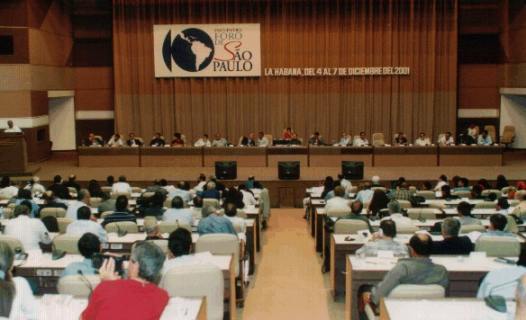
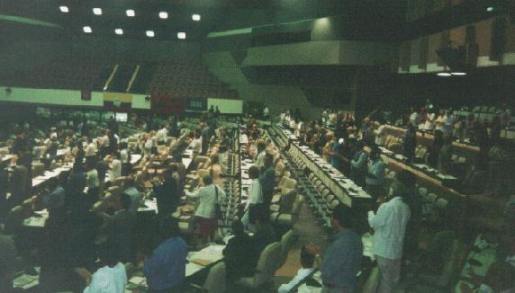
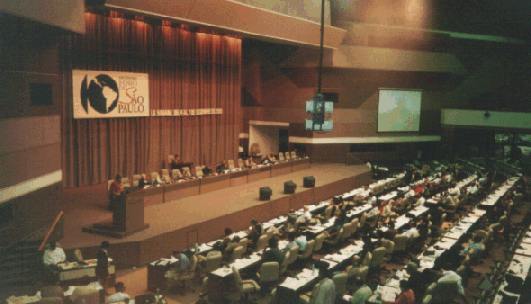
The 10th Sao Paulo Forum attracted 513 delegates from 82 countries; 138 political parties were invited, 73 of them registered members of the Sao Paulo Forum. Many others from within the Latin America and Caribbean region came. Others still from other parts of the four corners of the globe gathered in the beautiful city of Havana at the fabulous venue of the Palace of Congresses between December 4-7, 2001, to deliberate on the key issues facing the people of the world and the left forces in the current international situation. A delegation from RCPB(ML) participated with the status of observer at the invitation of the Communist Party of Cuba. Delegations from CPB(ML) and "Fight Racism! Fight Imperialism!" also participated from Britain.
We are posting in this issue of WDIE some photos of the gathering. For a full report, see Workers' Weekly, January 26, 2002, Vol.32, No.4.
The 11th Forum of Sao Paulo will take place in November 2002 in Guatemala.